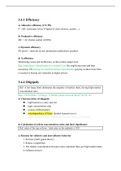
3.4.1 Efficiency
a) Allocative efficiency (CS+PS)
P = MC (consumer lower P higher Q, more choices, quality…)
b) Productive efficiency
MC = AC (better exploit of EOS)
c) Dynamic efficiency
SN profit + innovate in new production method/new products
d) X-efficiency
Minimizing waste and inefficiency at that certain output level
E.g. using factor of prdocution in a wasteful way (by employing more ppl than
necessary) OR paying too much for factors of production (paying workers more than
is needed or buying raw materials at higher prices)
3.4.4 Oligopoly
Def: A few large firms dominates the majority of market share, having high market
concentration ratio
E.g. 1) Soft drinks, 2) Energy, 3) Mobile phone network like BT & EE, O2
a) Characteristics of oligopoly
high barriers to entry and exit
high concentration ratio
product differentiation
interdependence of firms (kinked demand curve)
(where one firms decision is influenced by the likely behavior of rival firms)
b) Calculation of n-firm concentration ratios and their significance
Def: sales of the top n-firms / total sales in the industry x 100
c) Reasons for collusive and non-collusive behavior
1. Increase profit (game theory)
2. Reduce competition
3. The market concentration becomes more saturated (they got high market share
to influence prices)
, 4. They think CMA won’t catch them (maybe they are having tacit collusion)
However,
Even with collusion, prices may not be increased so high becoz it has a
strong incentive for new entrants to join the market
Potential to cheat (payoff matrix)
Although have both collusive and non-collusive oligopoly (meaning they
will compete with each other including price = price war)
=Competitive oligopoly VS non-competitive oligopoly
d) Overt and tacit collusion; cartels and price leadership
Collusion: To agree and put up prices with other firms and reduce competition
Overt/Cartel: A spoken or written form of collusive agreement that reduce
competition
Tacit collusion: An unspoken or unwritten form of collusive agreement that reduce
competition
e) Kinked demand curve (explaining interdependence) = price rigidity/stickiness
Each firm in oligopoly market are interdependent.
This model assumes: When price increase, other firms will not increase their
prices. When price falls, other firms tend to follow by lowering their price.
This means that when price is increased, demand becomes elastic. Whereas
prices falls, demand becomes inelastic. Therefore either raise or lower in price,
firms will lose out.
a) Allocative efficiency (CS+PS)
P = MC (consumer lower P higher Q, more choices, quality…)
b) Productive efficiency
MC = AC (better exploit of EOS)
c) Dynamic efficiency
SN profit + innovate in new production method/new products
d) X-efficiency
Minimizing waste and inefficiency at that certain output level
E.g. using factor of prdocution in a wasteful way (by employing more ppl than
necessary) OR paying too much for factors of production (paying workers more than
is needed or buying raw materials at higher prices)
3.4.4 Oligopoly
Def: A few large firms dominates the majority of market share, having high market
concentration ratio
E.g. 1) Soft drinks, 2) Energy, 3) Mobile phone network like BT & EE, O2
a) Characteristics of oligopoly
high barriers to entry and exit
high concentration ratio
product differentiation
interdependence of firms (kinked demand curve)
(where one firms decision is influenced by the likely behavior of rival firms)
b) Calculation of n-firm concentration ratios and their significance
Def: sales of the top n-firms / total sales in the industry x 100
c) Reasons for collusive and non-collusive behavior
1. Increase profit (game theory)
2. Reduce competition
3. The market concentration becomes more saturated (they got high market share
to influence prices)
, 4. They think CMA won’t catch them (maybe they are having tacit collusion)
However,
Even with collusion, prices may not be increased so high becoz it has a
strong incentive for new entrants to join the market
Potential to cheat (payoff matrix)
Although have both collusive and non-collusive oligopoly (meaning they
will compete with each other including price = price war)
=Competitive oligopoly VS non-competitive oligopoly
d) Overt and tacit collusion; cartels and price leadership
Collusion: To agree and put up prices with other firms and reduce competition
Overt/Cartel: A spoken or written form of collusive agreement that reduce
competition
Tacit collusion: An unspoken or unwritten form of collusive agreement that reduce
competition
e) Kinked demand curve (explaining interdependence) = price rigidity/stickiness
Each firm in oligopoly market are interdependent.
This model assumes: When price increase, other firms will not increase their
prices. When price falls, other firms tend to follow by lowering their price.
This means that when price is increased, demand becomes elastic. Whereas
prices falls, demand becomes inelastic. Therefore either raise or lower in price,
firms will lose out.