

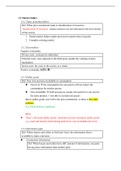
1.3 Market failure
1.3.1 Types of market failure
Def: When price mechanism leads to misallocation of resources
‘misallocation of resources’ means resources are not allocated to the best interest
of the society
1. Partial market failure (under provision/overprovision of goods)
2. Complete missing market
1.3.2 Externalities
Negative externality:
Private costs: costs pay by individual
External costs: costs imposed to the third party outside the working of price
mechanism
Social costs: the costs to the society as a whole
Positive externality 大同小異 “
1.3.3 Public goods
Def: Non rival and non-excludable in consumption
Non rival the consumption for one person will not reduce the
consumption for another person
Non excludable both non payers/ people who paid for it can receive
the same product /// not able to exclude non payers
Becoz public goods were left to the price mechanism, so there is free rider
problem
E.g. Flood defense, lighthouse
EVA
There’s still quasi-public goods, sometimes private sometimes public goods
e.g. roads and beaches (both during peak hrs hv non excludable but rival)
1.3.4 Information gaps
Def: Where buyers and sellers or both don’t have the information that is
available to make a decision
Asymmetric information
Def: When buyers and sellers have diff. amount of information, one party
having more information than another party
1.3.1 Types of market failure
Def: When price mechanism leads to misallocation of resources
‘misallocation of resources’ means resources are not allocated to the best interest
of the society
1. Partial market failure (under provision/overprovision of goods)
2. Complete missing market
1.3.2 Externalities
Negative externality:
Private costs: costs pay by individual
External costs: costs imposed to the third party outside the working of price
mechanism
Social costs: the costs to the society as a whole
Positive externality 大同小異 “
1.3.3 Public goods
Def: Non rival and non-excludable in consumption
Non rival the consumption for one person will not reduce the
consumption for another person
Non excludable both non payers/ people who paid for it can receive
the same product /// not able to exclude non payers
Becoz public goods were left to the price mechanism, so there is free rider
problem
E.g. Flood defense, lighthouse
EVA
There’s still quasi-public goods, sometimes private sometimes public goods
e.g. roads and beaches (both during peak hrs hv non excludable but rival)
1.3.4 Information gaps
Def: Where buyers and sellers or both don’t have the information that is
available to make a decision
Asymmetric information
Def: When buyers and sellers have diff. amount of information, one party
having more information than another party


