Electric quantities
Electric charge
- unlike charges attract and like charges repel
- Charging a body involves the addition or removal of electrons
Conductors - allow electrons to flow through them
Insulators - impede the flow of electrons
When two insulators are rubbed together
- electrons move from one to the other and they become charged
Ex: when a rod is rubbed with cloth, Electrons are transferred from the rod onto the cloth and the rod
becomes positively charged.
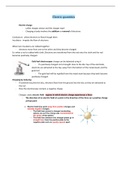
Gold leaf electroscope: charge can be detected using it
- If a positively charged rod is brought close to the disc top of the electrode,
electrons are attracted to the top, away from the bottom of the metal steam and the
gold leaf.
- The gold leaf will be repelled from the metal stem because they both become
positively charged.
Charging by inducing
- If someone touches the disc, electrons flow from the ground into the disc as they are attracted to
the rod
- Now the electroscope contains a negative charge
Charges create electric field - regions in which electric charge experiences a force
- The direction of an electric field at a point is the direction of the force on a positive charge
at that point
, Current
- rate of flow of charge at a point in the circuit
I = Q/t
- current is measured in Amps (A)
- 1A = 1C/s
- It is measured with an ammeter placed in series.
- In metals, current is due to a flow of electrons.
- Because electrons are negatively charged, conventional current (which is the rate of flow of positive
charge) is in the opposite direction to the flow of electrons.
Voltage
V = E/Q or Work done/Q
- energy transferred per unit charge
Electromotive force
- Electromotive force (e.m.f.) of an electrical source of energy is measured in volts
- Energy supplied by a source in driving charge round a complete circuit
Potential difference
- p.d. measured in volts
- 1V = 1J/C
- work done per unit charge in moving between two points in a circuit.
- It is measured with a voltmeter placed in parallel across the component.
- The higher the potential difference, the greater the current.
Resistance
Voltage/current = constant value (resistance)
R = V/I
- current is directly proportional to the voltage (Graph is a straight line through the origin)
- Measured In ohms
- As the length of a resistor increases, the resistance increases.
- The resistance is directly proportional to the length.
- As the diameter of a resistor increases, the resistance decreases.
- The resistance is inversely proportional to the cross-sectional area.
- In an ohmic conductor, the current is
directly proportional to the voltage
(has constant resistance).
- In a non-ohmic conductor (such as a
filament lamp), the resistance changes
as the voltage and current change.
Electric charge
- unlike charges attract and like charges repel
- Charging a body involves the addition or removal of electrons
Conductors - allow electrons to flow through them
Insulators - impede the flow of electrons
When two insulators are rubbed together
- electrons move from one to the other and they become charged
Ex: when a rod is rubbed with cloth, Electrons are transferred from the rod onto the cloth and the rod
becomes positively charged.
Gold leaf electroscope: charge can be detected using it
- If a positively charged rod is brought close to the disc top of the electrode,
electrons are attracted to the top, away from the bottom of the metal steam and the
gold leaf.
- The gold leaf will be repelled from the metal stem because they both become
positively charged.
Charging by inducing
- If someone touches the disc, electrons flow from the ground into the disc as they are attracted to
the rod
- Now the electroscope contains a negative charge
Charges create electric field - regions in which electric charge experiences a force
- The direction of an electric field at a point is the direction of the force on a positive charge
at that point
, Current
- rate of flow of charge at a point in the circuit
I = Q/t
- current is measured in Amps (A)
- 1A = 1C/s
- It is measured with an ammeter placed in series.
- In metals, current is due to a flow of electrons.
- Because electrons are negatively charged, conventional current (which is the rate of flow of positive
charge) is in the opposite direction to the flow of electrons.
Voltage
V = E/Q or Work done/Q
- energy transferred per unit charge
Electromotive force
- Electromotive force (e.m.f.) of an electrical source of energy is measured in volts
- Energy supplied by a source in driving charge round a complete circuit
Potential difference
- p.d. measured in volts
- 1V = 1J/C
- work done per unit charge in moving between two points in a circuit.
- It is measured with a voltmeter placed in parallel across the component.
- The higher the potential difference, the greater the current.
Resistance
Voltage/current = constant value (resistance)
R = V/I
- current is directly proportional to the voltage (Graph is a straight line through the origin)
- Measured In ohms
- As the length of a resistor increases, the resistance increases.
- The resistance is directly proportional to the length.
- As the diameter of a resistor increases, the resistance decreases.
- The resistance is inversely proportional to the cross-sectional area.
- In an ohmic conductor, the current is
directly proportional to the voltage
(has constant resistance).
- In a non-ohmic conductor (such as a
filament lamp), the resistance changes
as the voltage and current change.