GAS EXCHANGE
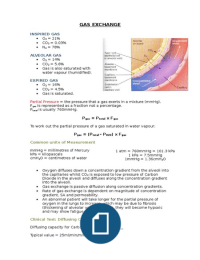
INSPIRED GAS
O2 = 21%
CO2 = 0.03%
N2 = 78%
ALVEOLAR GAS
O2 = 14%
CO2 = 5.6%
Gas is also saturated with
water vapour (humidified).
EXPIRED GAS
O2 = 16%
CO2 = 4.5%
Gas is saturated.
Partial Pressure = the pressure that a gas exerts in a mixture (mmHg).
Fgas is represented as a fraction not a percentage.
Ptotal is usually 760mmHg.
Pgas = Ptotal x Fgas
To work out the partial pressure of a gas saturated in water vapour:
Pgas = (Ptotal – PH2O) x Fgas
Common units of Measurement
mmHg = millimetres of Mercury 1 atm = 760mmHg = 101.3 kPa
kPa = kilopascals 1 kPa = 7.5mmHg
cmH2O = centimetres of water 1mmHg = 1.36cmH2O
Oxygen diffuses down a concentration gradient from the alveoli into
the capillaries whilst CO2 is exposed to low pressure of Carbon
Dioxide in the alveoli and diffuses along the concentration gradient
into the alveoli.
Gas exchange is passive diffusion along concentration gradients.
Rate of gas exchange is dependent on magnitude of concentration
gradient, SA and permeability.
An abnormal patient will take longer for the partial pressure of
oxygen in the lungs to increase; which may be due to fibrosis
(thickening of alveolar wall); therefore, they will become hypoxic
and may show fatigue.
Clinical Test: Diffusing Capacity
Diffusing capacity for Carbon Monoxide: VCO
PACO
Typical value = 25ml/min/mmHg
, Ventilation-Perfusion Ratio
Ventilation is higher at bottom
because of the compliance of
different parts of the lung.
Blood flow is greater at the
bottom of the lung.
Ventilation-Perfusion ratio is
different at different parts of the
lung.
Ventilation is higher than blood
flow at top of lung therefore has
higher ventilation-perfusion
ratio compared to the bottom of
the lung where blood flow is greater than ventilation.
Area of lung with a high ventilation-perfusion ratio will have a
slightly higher PO2 and slightly lower PCO2 (visa versa for low
ventilation-perfusion ratio).
Alveolar-Arterial Oxygen Difference
Alveolar-arterial (PAO2-PaO2) difference is frequently used to measure how
well the lungs are working and to work out if there are any ventilation
inequalities.
Normally, PAO2is greater than PaO2 due to physiological shunts.
PaO2 is measured using a sample of arterial blood.
PAO2 is calculated using alveolar gas equation: PAO2 = PIO2 – PACO2
RQ
INSPIRED GAS
O2 = 21%
CO2 = 0.03%
N2 = 78%
ALVEOLAR GAS
O2 = 14%
CO2 = 5.6%
Gas is also saturated with
water vapour (humidified).
EXPIRED GAS
O2 = 16%
CO2 = 4.5%
Gas is saturated.
Partial Pressure = the pressure that a gas exerts in a mixture (mmHg).
Fgas is represented as a fraction not a percentage.
Ptotal is usually 760mmHg.
Pgas = Ptotal x Fgas
To work out the partial pressure of a gas saturated in water vapour:
Pgas = (Ptotal – PH2O) x Fgas
Common units of Measurement
mmHg = millimetres of Mercury 1 atm = 760mmHg = 101.3 kPa
kPa = kilopascals 1 kPa = 7.5mmHg
cmH2O = centimetres of water 1mmHg = 1.36cmH2O
Oxygen diffuses down a concentration gradient from the alveoli into
the capillaries whilst CO2 is exposed to low pressure of Carbon
Dioxide in the alveoli and diffuses along the concentration gradient
into the alveoli.
Gas exchange is passive diffusion along concentration gradients.
Rate of gas exchange is dependent on magnitude of concentration
gradient, SA and permeability.
An abnormal patient will take longer for the partial pressure of
oxygen in the lungs to increase; which may be due to fibrosis
(thickening of alveolar wall); therefore, they will become hypoxic
and may show fatigue.
Clinical Test: Diffusing Capacity
Diffusing capacity for Carbon Monoxide: VCO
PACO
Typical value = 25ml/min/mmHg
, Ventilation-Perfusion Ratio
Ventilation is higher at bottom
because of the compliance of
different parts of the lung.
Blood flow is greater at the
bottom of the lung.
Ventilation-Perfusion ratio is
different at different parts of the
lung.
Ventilation is higher than blood
flow at top of lung therefore has
higher ventilation-perfusion
ratio compared to the bottom of
the lung where blood flow is greater than ventilation.
Area of lung with a high ventilation-perfusion ratio will have a
slightly higher PO2 and slightly lower PCO2 (visa versa for low
ventilation-perfusion ratio).
Alveolar-Arterial Oxygen Difference
Alveolar-arterial (PAO2-PaO2) difference is frequently used to measure how
well the lungs are working and to work out if there are any ventilation
inequalities.
Normally, PAO2is greater than PaO2 due to physiological shunts.
PaO2 is measured using a sample of arterial blood.
PAO2 is calculated using alveolar gas equation: PAO2 = PIO2 – PACO2
RQ