VENTILATION AND AIRWAY RESISTANCE
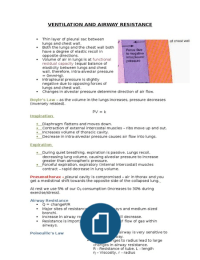
Thin layer of pleural sac between
lungs and chest wall.
Both the lungs and the chest wall both
have a degree of elastic recoil in
opposite directions.
Volume of air in lungs is at functional
residual capacity (equal balance of
elasticity between lungs and chest
wall, therefore, intra-alveolar pressure
= 0mmHg).
Intrapleural pressure is slightly
negative due to opposing forces of
lungs and chest wall.
Changes in alveolar pressure determine direction of air flow.
Boyle’s Law – as the volume in the lungs increases, pressure decreases
(Inversely related).
PV = k
Inspiration
Diaphragm flattens and moves down.
Contraction of external intercostal muscles – ribs move up and out.
Increases volume of thoracic cavity.
Decrease in intra-alveolar pressure causes air flow into lungs.
Expiration
During quiet breathing, expiration is passive. Lungs recoil,
decreasing lung volume, causing alveolar pressure to increase
greater than atmospheric pressure.
Forceful expiration, expiratory (internal intercostal) muscles
contract – rapid decrease in lung volume.
Pneumothorax – pleural cavity is compromised – air in thorax and you
get a medistinal shift towards the opposite side of the collapsed lung.
At rest we use 5% of our O2 consumption (increases to 30% during
exercise/stress).
Airway Resistance
Q = changeP/R
Major sites of resistance are upper airways and medium-sized
bronchi.
Increase in airway resistance – gas flow will decrease.
Resistance is important as a determinant of flow of gas within
airways.
Poiseuille’s Law Resistance of airway is very sensitive to
radius of airway.
Small changes to radius lead to large
changes in airway resistance.
R - Resistance of tube, L - length
η – Viscosity, r - radius
Thin layer of pleural sac between
lungs and chest wall.
Both the lungs and the chest wall both
have a degree of elastic recoil in
opposite directions.
Volume of air in lungs is at functional
residual capacity (equal balance of
elasticity between lungs and chest
wall, therefore, intra-alveolar pressure
= 0mmHg).
Intrapleural pressure is slightly
negative due to opposing forces of
lungs and chest wall.
Changes in alveolar pressure determine direction of air flow.
Boyle’s Law – as the volume in the lungs increases, pressure decreases
(Inversely related).
PV = k
Inspiration
Diaphragm flattens and moves down.
Contraction of external intercostal muscles – ribs move up and out.
Increases volume of thoracic cavity.
Decrease in intra-alveolar pressure causes air flow into lungs.
Expiration
During quiet breathing, expiration is passive. Lungs recoil,
decreasing lung volume, causing alveolar pressure to increase
greater than atmospheric pressure.
Forceful expiration, expiratory (internal intercostal) muscles
contract – rapid decrease in lung volume.
Pneumothorax – pleural cavity is compromised – air in thorax and you
get a medistinal shift towards the opposite side of the collapsed lung.
At rest we use 5% of our O2 consumption (increases to 30% during
exercise/stress).
Airway Resistance
Q = changeP/R
Major sites of resistance are upper airways and medium-sized
bronchi.
Increase in airway resistance – gas flow will decrease.
Resistance is important as a determinant of flow of gas within
airways.
Poiseuille’s Law Resistance of airway is very sensitive to
radius of airway.
Small changes to radius lead to large
changes in airway resistance.
R - Resistance of tube, L - length
η – Viscosity, r - radius