Darrow: Myth of Immortality (pg. 59-62)
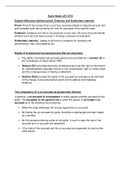
-Written when 71 years old; Defense Lawyer (everyone eventually becomes philosophers) -Darrow rejects the idea of the soul and, with that, Socrates belief in immortality -Considers and rejects resurrection which is sometimes presented as an alternative to the Socratic concept —(1): immortality of the “soul"- consciousness persists after death -man is "dual being"- body and soul are separate entities -cells alone don't have souls, but together create a soul (that is developed through gestation and growth) -"your consciousness, your memory, may exist even after you are dead. This is what we mean by the soul.” -consciousness develops through growth and experiences -can be conscious during early experience at the time, and not aware of it now (how he remembered death of soldier, but not of Abe Lincoln) -raises question: May your consciousness persist after death, even though you're not aware of the fact? -(older people) body will function even though ego is practically dead -(2): "the resurrection of the body” -body of every man now is part made from the dead -modern scientific doctrine of the indestructibility of matter and force -Coal Metaphor: some goes up chimney, some heat to the house, and residue in the hearth… as is us. -When we realize that we all are approaching an inevitable doom will we be more kind and considerate of each other -We must live a common life and die a common death Kubler Ross: Stages of Death and Dying (pg. 63-71) Kubler-Ross: —Philosopher, psychologist by training —Researcher in the field of thanatology (the study of death and dying) -Best known for theory that people come to terms with death over a protracted period of time and that process usually involves passing through five distinct stages: 1st Stage: Denial and Isolation —“No, not me, it cannot be true” —Anxious denial is typical of patient who informed by someone who does not know patient well or does it quickly to “get it over with” —Denial isn’t gone, it comes back time to time 2nd Stage: Anger —“Why me?” —Looks at others: “Why not him? He was 82 years old, and he is of no earthly use…” —Anger is displaced in all directions and projected onto the environment at times almost at random —Nurses get it bad —Patient who is respected and understood will soon lower his voice and reduce his angry demands. He will know that he is a valuable human being, cared for, allowed to function at the highest possible level as long as he can 3rd Stage: Bargaining —“If God as decided to take us away from this earth and he did not respond to my angry pleas, he may be more favorable if I ask nicely” —Singer asks to be able to sing one more time —Asks for extension of life, followed by the wish for a few days without pain or physical discomfort — 4th Stage: Depression —Reactive Depression -Woman loses breasts, gets breast prosthesis. -Husband learns how to help her self esteem after she feels less of woman -Mom learns that her children play in yard with neighbors while husband is at work —Preparatory Depression -When the depression is a tool to prepare for the impending loss of all the love objects, in order to facilitate the state of acceptance, then encouragements and reassurances are not as meaningful —Don’t tell not to be sad —No to little need for words. Much more a feeling that can be mutually expressed better by stroke of hand 5th Stage: Acceptance —Should not be mistaken for happy stage. It is almost a void of feelings —Also time where family needs more help, understanding, and comfort than the patient himself Sarte’s Nausea Malhotra’s Sartre and Yoga (Chapters 1-3) Characters: Anny— -main character that at one point loved Roquentin. -She believed in ‘big moments’ in the beginning but in the end she didn’t -Only time anything made sense is when on stage. -Everything is pre-determined, steps to take on stage already planned -This is when she tasted meaningful life -In the End: Comes to tell that she doesn’t believe in perfect/big moments anymore She is Roquentin's old lover and lives in Paris. Even though she begs Roquentin to come see her, she is more interested in the man he used to be. She admittedly lives in the past, rereading the same history books and recalling the "perfect moments" of her life. She refuses to resume her relationship with Roquentin since she is already the mistress of a number of men who pay for her apartment. Roquentin— -suffers from nausea -he is a existentialist -A non-fiction historian writer who came to Bouville, France -Bouville: because all the papers he needs is in the library in village -Decides to become fiction writer The Self-Taught Man— as Roquentin goes to the library to write chapter and research… he finds someone else in the library Function he serves: -he follows the ruck -Even though he’s always in there reading he isn’t getting any wisdom -Many think if we are reading many book we are getting wisdom -But it only works if you put it together as knowledge to wisdom. -Roquentin mocks him for thinking he can learn all there is to know by reading everything in the Library in alphabetical order. -He is a defender of humanism, believing that all men and women are united by the common bond of love. Francoise— The barmaid of a local cafe, she is Roquentin's sometime lover. As his nausea progresses he is more and more disgusted at the prospect of having sex with her.
Written for
- Institution
- Northwest Vista College
- Module
- BIO1342
Document information
- Uploaded on
- January 13, 2023
- Number of pages
- 12
- Written in
- 2022/2023
- Type
- Other
- Person
- Unknown
Subjects
-
darrow myth of immortality pg 59 62
-
myth of immortality pg 59 62
-
darrow myth of immortality