TRUTH AND RECONCILIATION COMMISSION
Answering questions of the victims, the survivors and their families
Only by dealing with the past could SA achieve reconciliation among its
people and move forward as a united nation
Restorative justice > retributive justice
Example of retributive justice (focus on revenge): Nuremberg Trials
Argentina and Chile
also used o Tried Nazi leaders for war crimes and crimes against
Commissions humanity
o Large number found guilty and hanged or imprisoned
‘Not so much to punish as to redress or restore a balance that has been
knocked askew’
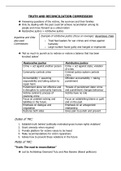
Restorative justice Retributive justice
Crime = act against another person Crime = act against state; violation
of a law
Community controls crime Criminal justice system controls
crime
Accountability = assuming Offender accountability = taking
responsibility and taking action to punishment
repair harm
Punishment alone not effective and Threats of punishment deter crime
is disruptive to community harmony and punishment changes behaviour
Victims central to process of Victims have no role
resolving crime
Focus on problem-solving and Focus on establishing blame or guilt
liabilities in the future and on the past
Emphasis on dialogue and Emphasis on an antagonistic
negotiation relationship
Restores both sides Gives pain to punish and prevent
Duties of TRC:
1. Establish truth behind ‘politically motivated gross human rights violations’
2. Grant amnesty when required
3. Provide platform for victims voices to be heard
4. Make recommendations for victim reparations
5. Advise how to prevent these violations in the future
Motto of TRC:
“Truth: The road to reconciliation”
Led by Archbishop Desmond Tutu and Alex Boraine (liberal politician)
, Key commissioners: Mary Burton, Advocate Chris de Jager, Bongani Finca, Sisi
Khampepe, Richard Lyster, Wynand Malan, Reverend Khoza Mgojo, Hlengiwe
Mkhize, Dumisa Ntsebeza, Wendy Orr, Advocate Denzil Potgieter, Mapule
Ramashala, Dr Faizel Randera, Yasmin Sooka, Glenda Wildschut
Began work in 1996 (19 Commissioners)
22 000+ victims applied
Given 2 years to complete its work
October 1998: Tutu gave Mandela 5 volume report
Amnesty work continued for another 2 years (7000 applications; 1000 successful)
and was completed in 2003 when 2 more volumes published
Cost R70 million
3 branches of the TRC:
1. Human Rights Violation Committee
Aim: gain most complete picture possible of the nature, causes and extent of gross
human rights violations committed
Actions: held hundreds of hearings for 2,5 years
2. Amnesty Committee
Aim: Grant amnesty to those who make full disclosure of all relevant facts relating to
acts associated with political objective
Actions: those who committed atrocities and came forward to tell the truth and
prove that their motives were purely political were granted amnesty
3. Reparation and Rehabilitation Committee
Aim: determine what people lost as a result of apartheid policies and laws and
compensate these people
The TRC investigated:
o Actions of those who worked for Apartheid gov
o Actions of liberation movements
o Actions of politicians
o Actions of supporters in pre-election violence
o [Murder of Cradock Four, Bisho Massacre, Phila Ndwandwe etc…]
Powers of TRC: (same as any court of law)
Could subpoena (summon) any person before it if deemed necessary in order
to find out truth
Could obtain search warrants from judges to gather info
Had the right to enter a private house if believed to be hiding evidence
Answering questions of the victims, the survivors and their families
Only by dealing with the past could SA achieve reconciliation among its
people and move forward as a united nation
Restorative justice > retributive justice
Example of retributive justice (focus on revenge): Nuremberg Trials
Argentina and Chile
also used o Tried Nazi leaders for war crimes and crimes against
Commissions humanity
o Large number found guilty and hanged or imprisoned
‘Not so much to punish as to redress or restore a balance that has been
knocked askew’
Restorative justice Retributive justice
Crime = act against another person Crime = act against state; violation
of a law
Community controls crime Criminal justice system controls
crime
Accountability = assuming Offender accountability = taking
responsibility and taking action to punishment
repair harm
Punishment alone not effective and Threats of punishment deter crime
is disruptive to community harmony and punishment changes behaviour
Victims central to process of Victims have no role
resolving crime
Focus on problem-solving and Focus on establishing blame or guilt
liabilities in the future and on the past
Emphasis on dialogue and Emphasis on an antagonistic
negotiation relationship
Restores both sides Gives pain to punish and prevent
Duties of TRC:
1. Establish truth behind ‘politically motivated gross human rights violations’
2. Grant amnesty when required
3. Provide platform for victims voices to be heard
4. Make recommendations for victim reparations
5. Advise how to prevent these violations in the future
Motto of TRC:
“Truth: The road to reconciliation”
Led by Archbishop Desmond Tutu and Alex Boraine (liberal politician)
, Key commissioners: Mary Burton, Advocate Chris de Jager, Bongani Finca, Sisi
Khampepe, Richard Lyster, Wynand Malan, Reverend Khoza Mgojo, Hlengiwe
Mkhize, Dumisa Ntsebeza, Wendy Orr, Advocate Denzil Potgieter, Mapule
Ramashala, Dr Faizel Randera, Yasmin Sooka, Glenda Wildschut
Began work in 1996 (19 Commissioners)
22 000+ victims applied
Given 2 years to complete its work
October 1998: Tutu gave Mandela 5 volume report
Amnesty work continued for another 2 years (7000 applications; 1000 successful)
and was completed in 2003 when 2 more volumes published
Cost R70 million
3 branches of the TRC:
1. Human Rights Violation Committee
Aim: gain most complete picture possible of the nature, causes and extent of gross
human rights violations committed
Actions: held hundreds of hearings for 2,5 years
2. Amnesty Committee
Aim: Grant amnesty to those who make full disclosure of all relevant facts relating to
acts associated with political objective
Actions: those who committed atrocities and came forward to tell the truth and
prove that their motives were purely political were granted amnesty
3. Reparation and Rehabilitation Committee
Aim: determine what people lost as a result of apartheid policies and laws and
compensate these people
The TRC investigated:
o Actions of those who worked for Apartheid gov
o Actions of liberation movements
o Actions of politicians
o Actions of supporters in pre-election violence
o [Murder of Cradock Four, Bisho Massacre, Phila Ndwandwe etc…]
Powers of TRC: (same as any court of law)
Could subpoena (summon) any person before it if deemed necessary in order
to find out truth
Could obtain search warrants from judges to gather info
Had the right to enter a private house if believed to be hiding evidence