Economics summary Y1Q2
Economics summary chapter 3
The market forces of Supply & Demand
Markets and competition
The terms supply and demand refer to the behaviour of people as they interact with one
another in markets.
Competitive markets
A markets a group of buyers and sellers of a particular good or service.
Buyers determine demand
Sellers determine supply
In a competitive market, buyers and sellers have a negligible impact on the market price.
Each seller has limited control over the price because other sellers are offering similar
products and each seller only supplies a very small amount in relation to the total supply
of the market.
In a perfectly competitive market the products are identical (homogenous) so a seller has
little reason to charge less than the going price.
Competition: perfect and otherwise
- Perfect competition; the products are identical (homogenous) so a seller
has little reason to change price because there are many buyers and
sellers (price takers). (fruits and veggies)
- Monopoly; one seller and sets the price. (local water company)
- Oligopoly; fall between extremes. Few sellers that do not always compete
aggressively. Many markets are an oligopoly. (supermarkets, phones)
- Monopolistically competitive; contains many sellers but each offers
something slightly different. Because of this, sellers can set their own
prices. (magazines)
Demand
The demand curve: the relationship between price and quantity demanded
Quantity demand the amount of goods that buyers are willing and able to purchase
Law of Demand other things equal, the quantity demanded of a good fall when the
price of the good rises. It is represented by the demand curve.
Demand schedule a table that shows the relationship between the price of a good
and the quantity demanded.
Demand curve a graph of the relationship between the price of a good and the
quantity demanded.
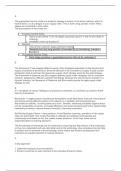
A decrease in price increases quantity of a product demanded.
, Economics summary Y1Q2
Changes in quantity demanded
Changes in the price of the product lead to a movement along the demand curve.
(Exhibit above)
Shifts versus movement along the demand
Assume the price of milks falls.
More will be demanded because of the income and substitution effects.
Income effect: consumers can now afford to buy more with their income.
Substitution effect: consumers will choose to
substitute the more expensive drinks with the now
cheaper milk.
Shift in the demand curve
Shifts caused by factors other than price
Consumer income
- As income increases the demand for a
normal good will increase
- As income increases the demand for an
inferior good will decrease
Prices of related goods (substitutes and
complements)
- When a fall in the price of one good
reduces the demand for another good, the two goods are called substitutes
Economics summary chapter 3
The market forces of Supply & Demand
Markets and competition
The terms supply and demand refer to the behaviour of people as they interact with one
another in markets.
Competitive markets
A markets a group of buyers and sellers of a particular good or service.
Buyers determine demand
Sellers determine supply
In a competitive market, buyers and sellers have a negligible impact on the market price.
Each seller has limited control over the price because other sellers are offering similar
products and each seller only supplies a very small amount in relation to the total supply
of the market.
In a perfectly competitive market the products are identical (homogenous) so a seller has
little reason to charge less than the going price.
Competition: perfect and otherwise
- Perfect competition; the products are identical (homogenous) so a seller
has little reason to change price because there are many buyers and
sellers (price takers). (fruits and veggies)
- Monopoly; one seller and sets the price. (local water company)
- Oligopoly; fall between extremes. Few sellers that do not always compete
aggressively. Many markets are an oligopoly. (supermarkets, phones)
- Monopolistically competitive; contains many sellers but each offers
something slightly different. Because of this, sellers can set their own
prices. (magazines)
Demand
The demand curve: the relationship between price and quantity demanded
Quantity demand the amount of goods that buyers are willing and able to purchase
Law of Demand other things equal, the quantity demanded of a good fall when the
price of the good rises. It is represented by the demand curve.
Demand schedule a table that shows the relationship between the price of a good
and the quantity demanded.
Demand curve a graph of the relationship between the price of a good and the
quantity demanded.
A decrease in price increases quantity of a product demanded.
, Economics summary Y1Q2
Changes in quantity demanded
Changes in the price of the product lead to a movement along the demand curve.
(Exhibit above)
Shifts versus movement along the demand
Assume the price of milks falls.
More will be demanded because of the income and substitution effects.
Income effect: consumers can now afford to buy more with their income.
Substitution effect: consumers will choose to
substitute the more expensive drinks with the now
cheaper milk.
Shift in the demand curve
Shifts caused by factors other than price
Consumer income
- As income increases the demand for a
normal good will increase
- As income increases the demand for an
inferior good will decrease
Prices of related goods (substitutes and
complements)
- When a fall in the price of one good
reduces the demand for another good, the two goods are called substitutes