Development and Ageing – Theories of Ageing
Some aspects of ageing….
“a continuation of development?” or a “pathological process”
Should we treat ageing as a disease?
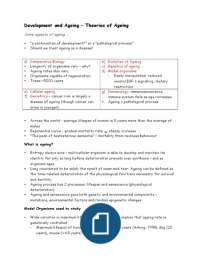
a) Comparative Biology b) Evolution of Ageing
Longevity of organisms vary – why? c) Genetics of ageing
Ageing rates also vary d) Model organisms
Organisms capable of regeneration - Easily manipulated: reduced
Trees ~5000 years insulin/IGF-1 signalling, dietary
restriction
e) Cellular ageing g) Immunology: immunosenescence,
f) Geriatrics – cancer risk is largely a immune system fails as age increases
disease of ageing (though cancer can Ageing = pathological process
arise in younger)
Across the world – average lifespan of women is 5 years more than the average of
males
Exponential curve – gradual mortality rate steady increase
“The peak of testosterone dementia” – mortality from reckless behaviour
What is ageing?
Entropy always wins – multicellular organism is able to develop and maintain its
identity for only so long before deterioration prevails over synthesis – and so
organism ages
Long considered to be solely the result of wear-and-tear: Ageing can be defined as
the time-related deterioration of the physiological functions necessary for survival
and fertility
Ageing process has 2 processes: lifespan and senescence (physiological
deterioration)
Ageing and senescence gave both genetic and environmental components –
mutations, environmental factors and random epigenetic changes
Model Organisms used to study
Wide variation in maximum lifespan between species implies that ageing rate is
genetically controlled
- Maximum lifespan of humans estimated to be 121 years (Arking, 1998), dog (20
years), mouse (~4.5 years)
, - Species-specific lifespan appears to be determined by genes that effect a
trade-off between early growth and reproduction and somatic maintenance
- Ageing appears to result from natural selection operating on more early survival
and reproduction than on having a vigourous post-reproductive life
Molecular evidence indicates that certain genetic componenets of longevity
conserved between species: flies, worms, mammals, even yeast have homologus
genes
S. cerevisiae Cheap, easy to manipulate but is not an animal (Do they age in the
sense animals do)
C. elegans Animal, cheap to work with, no interbreeding effects, not a mammal
D. melanogaster Same as C.elegans, longer lived, show interbreeding effects
M. musculus Mammal, good genetics, shows interbreeding effects (expensive to
do lifespan tests)
The Insulin Signalling Cascade
Classical genetic approach to identify candidate ageing genes
1. Isolate mutants with altered rates of ageing
2. Map, clone, sequence genes concerned
3. Identify life-span determining proteins, biochemistry, Understand ageing?
Insulin signalling regulates ageing in a conserved manner, insulin receptor mediates its
effects via the PI3K-AKT/SGK pathway, which culminates in negative regulation of the
Forkhead transcription factor (Greer and Brunet, 2008)
C. elegans shows symptoms of ageing: reduced movement, feeding, fertility, gonadal
atrophy, wrinkling of collagenous outer cuticle, increased protein oxidation (protein
carbonyls)
Michael Klass (1983) isolated first mutants after mutagenesis long lived mutants
more informative than short-lived ones
Tom Johnson (1988) identified age-1(hx546): Mutation leads to >65% increase in
mean life span (Strain normal development and movement, extended youthspan)
Cynthia Kenyon (1993): daf-2 mutants show doubled lifespan, also affects dauer
larva formation
Normal C. elegans development involves 4 larval stages – after which if becomes an
adult
- If nematodes are overcrowded or under stress (high temp or low food), larva
can enter a metabolically dormant state dauer larva stage, nonfeeding state of
diapause
, - Development and ageing are suspended – nematode can remain the dauer larva
stage for up to 6 months (post dauer adults have normal lifespans)
- In the diapausal state – nematode has increased resistance to oxygen radicals
that can crosslink proteins and destroy DNA
Over 30 genes have been found to control dauer larva formation
- daf (dauer larva formation) mutants: Dauer-
constitutive (Daf-c), form dauers in non-dauer
inducing conditions; dauer-defective (Daf-d)
mutants cannot form dauers at all
- daf genes have been ordered into a complex,
branched pathway. One branch also affects
ageing: includes daf-c genes daf-2 and age-1,
and daf-d gene daf-16.
- Most daf-2 mutations temperature-sensitive:
Daf-c at non-permissive temperature. At
permissive temperature develop into long-lived
ad ults.
- All age-1 mutants are long-lived, but only severe
age-1 alleles are Daf-c.
- daf-16 and daf-2; daf-16 mutants not long lived either.
daf-16(-)suppresses daf-2 life extension. Thus, wild-
type daf-16 promotes longevit y.
- Increased longevity of daf-2 and age-1 adults
due to misexpression of dauer longevity in the adult.
Thus, longevity of dauers not just due to developmental
arrest or dormancy, but rather dauer-specific longevity assurance processes.
- C. elegans genome has two distinct longevity programmes: for adult and dauer larva.
Gary Ruvkun (1987, 1988)
- daf-2 encodes cell surface receptor like vertebrate insulin and insulin-like growth
factor (IGF-I) receptors. age-1 encodes catalytic subunit of a lipid kinase,
phosphatidylinositol 3-OH kinase.
- daf-16 encodes a FoxO class forkhead transcription factor.
- Homologues of 3 genes act together in mammalian cells.
Pathway that regulates both dauer larva formation and longevity has been identified
as insulin signalling pathway
- Favourable environments signal activation of the insulin receptor homologue
DAF-2 and this receptor stimulates onset of adulthood
- Poor environments fail to activate the DAF-2 receptor, dauer formation ensues
- Severe loss-of-function alleles in this pathway cause formation of dauer larvae
in any environment, weak mutations in the insulin-signalling pathway enable the
animals to reach adulthood and live 4 times longer than wt animals
Down-regulation of the insulin signalling pathway also has several other functions
- Influences metabolism, decreasing mitochondrial electron transport
Some aspects of ageing….
“a continuation of development?” or a “pathological process”
Should we treat ageing as a disease?
a) Comparative Biology b) Evolution of Ageing
Longevity of organisms vary – why? c) Genetics of ageing
Ageing rates also vary d) Model organisms
Organisms capable of regeneration - Easily manipulated: reduced
Trees ~5000 years insulin/IGF-1 signalling, dietary
restriction
e) Cellular ageing g) Immunology: immunosenescence,
f) Geriatrics – cancer risk is largely a immune system fails as age increases
disease of ageing (though cancer can Ageing = pathological process
arise in younger)
Across the world – average lifespan of women is 5 years more than the average of
males
Exponential curve – gradual mortality rate steady increase
“The peak of testosterone dementia” – mortality from reckless behaviour
What is ageing?
Entropy always wins – multicellular organism is able to develop and maintain its
identity for only so long before deterioration prevails over synthesis – and so
organism ages
Long considered to be solely the result of wear-and-tear: Ageing can be defined as
the time-related deterioration of the physiological functions necessary for survival
and fertility
Ageing process has 2 processes: lifespan and senescence (physiological
deterioration)
Ageing and senescence gave both genetic and environmental components –
mutations, environmental factors and random epigenetic changes
Model Organisms used to study
Wide variation in maximum lifespan between species implies that ageing rate is
genetically controlled
- Maximum lifespan of humans estimated to be 121 years (Arking, 1998), dog (20
years), mouse (~4.5 years)
, - Species-specific lifespan appears to be determined by genes that effect a
trade-off between early growth and reproduction and somatic maintenance
- Ageing appears to result from natural selection operating on more early survival
and reproduction than on having a vigourous post-reproductive life
Molecular evidence indicates that certain genetic componenets of longevity
conserved between species: flies, worms, mammals, even yeast have homologus
genes
S. cerevisiae Cheap, easy to manipulate but is not an animal (Do they age in the
sense animals do)
C. elegans Animal, cheap to work with, no interbreeding effects, not a mammal
D. melanogaster Same as C.elegans, longer lived, show interbreeding effects
M. musculus Mammal, good genetics, shows interbreeding effects (expensive to
do lifespan tests)
The Insulin Signalling Cascade
Classical genetic approach to identify candidate ageing genes
1. Isolate mutants with altered rates of ageing
2. Map, clone, sequence genes concerned
3. Identify life-span determining proteins, biochemistry, Understand ageing?
Insulin signalling regulates ageing in a conserved manner, insulin receptor mediates its
effects via the PI3K-AKT/SGK pathway, which culminates in negative regulation of the
Forkhead transcription factor (Greer and Brunet, 2008)
C. elegans shows symptoms of ageing: reduced movement, feeding, fertility, gonadal
atrophy, wrinkling of collagenous outer cuticle, increased protein oxidation (protein
carbonyls)
Michael Klass (1983) isolated first mutants after mutagenesis long lived mutants
more informative than short-lived ones
Tom Johnson (1988) identified age-1(hx546): Mutation leads to >65% increase in
mean life span (Strain normal development and movement, extended youthspan)
Cynthia Kenyon (1993): daf-2 mutants show doubled lifespan, also affects dauer
larva formation
Normal C. elegans development involves 4 larval stages – after which if becomes an
adult
- If nematodes are overcrowded or under stress (high temp or low food), larva
can enter a metabolically dormant state dauer larva stage, nonfeeding state of
diapause
, - Development and ageing are suspended – nematode can remain the dauer larva
stage for up to 6 months (post dauer adults have normal lifespans)
- In the diapausal state – nematode has increased resistance to oxygen radicals
that can crosslink proteins and destroy DNA
Over 30 genes have been found to control dauer larva formation
- daf (dauer larva formation) mutants: Dauer-
constitutive (Daf-c), form dauers in non-dauer
inducing conditions; dauer-defective (Daf-d)
mutants cannot form dauers at all
- daf genes have been ordered into a complex,
branched pathway. One branch also affects
ageing: includes daf-c genes daf-2 and age-1,
and daf-d gene daf-16.
- Most daf-2 mutations temperature-sensitive:
Daf-c at non-permissive temperature. At
permissive temperature develop into long-lived
ad ults.
- All age-1 mutants are long-lived, but only severe
age-1 alleles are Daf-c.
- daf-16 and daf-2; daf-16 mutants not long lived either.
daf-16(-)suppresses daf-2 life extension. Thus, wild-
type daf-16 promotes longevit y.
- Increased longevity of daf-2 and age-1 adults
due to misexpression of dauer longevity in the adult.
Thus, longevity of dauers not just due to developmental
arrest or dormancy, but rather dauer-specific longevity assurance processes.
- C. elegans genome has two distinct longevity programmes: for adult and dauer larva.
Gary Ruvkun (1987, 1988)
- daf-2 encodes cell surface receptor like vertebrate insulin and insulin-like growth
factor (IGF-I) receptors. age-1 encodes catalytic subunit of a lipid kinase,
phosphatidylinositol 3-OH kinase.
- daf-16 encodes a FoxO class forkhead transcription factor.
- Homologues of 3 genes act together in mammalian cells.
Pathway that regulates both dauer larva formation and longevity has been identified
as insulin signalling pathway
- Favourable environments signal activation of the insulin receptor homologue
DAF-2 and this receptor stimulates onset of adulthood
- Poor environments fail to activate the DAF-2 receptor, dauer formation ensues
- Severe loss-of-function alleles in this pathway cause formation of dauer larvae
in any environment, weak mutations in the insulin-signalling pathway enable the
animals to reach adulthood and live 4 times longer than wt animals
Down-regulation of the insulin signalling pathway also has several other functions
- Influences metabolism, decreasing mitochondrial electron transport