Xenopus Specification of Cell Fates
Early Gastrulae are ventralised
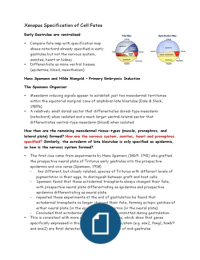
Compare fate map with specification map
shows notochord already specified in early
gastrulae but not the nervous system,
somites, heart or kidney
Differentiate as more ventral tissues
(epidermis, blood, mesothelium)
Hans Spemann and Hilde Mangold – Primary Embryonic Induction
The Spemann Organiser
Mesoderm inducing signals appear to establish just two mesodermal territories
within the equatorial marginal zone of amphibian late blastulae (Dale & Slack,
1987b)
A relatively small dorsal sector that differentiates dorsal-type mesoderm
(notochord) when isolated and a much larger ventral-lateral sector that
differentiates ventral-type mesoderm (blood) when isolated
How then are the remaining mesodermal tissue-types (muscle, pronephros, and
lateral plate) formed? How are the nervous system, somites, heart and pronephros
specified? Similarly, the ectoderm of late blastulae is only specified as epidermis,
so how is the nervous system formed?
The first clue came from experiments by Hans Spemann (1869- 1941) who grafted
the prospective neural plate of Triturus early gastrulae into the prospective
epidermis and vice versa (Spemann, 1918)
- two different, but closely related, species of Triturus with different levels of
pigmentation in their eggs, to distinguish between graft and host cells
- Spemann found that these ectodermal transplants always changed their fate,
with prospective neural plate differentiating as epidermis and prospective
epidermis differentiating as neural plate.
- repeated these experiments at the end of gastrulation he found that
ectodermal transplants no longer changed their fate, forming ectopic patches of
either neural plate (in the epidermis) or epidermis (in the neural plate)
- Concluded that ectodermal fates become fully committed during gastrulation.
This is consistent with more recent molecular studies, which show that genes
specifically expressed in the early Xenopus nervous system (e.g. sox2, foxg1, hoxb9
and snai2) are first detected in the dorsal ectoderm of mid-gastrulae
, - Neural specific genes such as sox2 (pan neural), foxg1 (forebrain), hoxb9 (spinal
cord) and snail (neural cret) increases during gastrulation whole mount in situ
hybridisation and microarray analysis
- Studies suggest that the nervous is specified during gastrulation
Spemann’s student Hilde Mangold performed similar expt.(Spemann & Mangold,
1924)
- Of all the tissues in the early gastrula, only one had its fate autonomously
determined = dorsal lip of the blastopore – tissue derived from grey crescent
cytoplasm
- Used pigmented embryos of Triturus taeniatus and T. cristatus so donor and
host tissues could be identified
- Dorsal lip of early T. taeniatus was removed and implanted into ventral epidermis
of T. cristatus gastrula – dorsal lip invaginated as it normally does (showing self-
determination) and disappeared beneath the vegetal cells
- Pigmented donor tissue then continued to self-differentiate into the notochord
and other mesodermal structures
- She found that a partial conjoined twin was formed on the ventral side of
neurulae, which included notochord, somites, pronephroi, and neural plate
- notochord was always formed by grafted cells (their normal fate), while host
cells predominantly formed the other tissues
- Somites and pronephroi were formed by cells that would otherwise have formed
lateral plate mesoderm and ventral mesoderm, while the neural plate was formed
by cells that would otherwise have formed epidermis.
- As donor cells participate of production in new embryo, host cells participate in
producing new embryo
- Secondary embryo: somite seen containing both donor and host tissue, dorsal lip
cells could also interact with host tissues to form a complete neural plate from
host ectoderm embryo is conjoined face to face with host
- Repeated in many amphibian species, including Xenopus
Proposed an organiser – cells which organise the dorsal ectoderm into a neural tube
and transform flanking mesoderm into AP-axis
- Interaction of the chordamesoderm and ectoderm initiates a series of
sequential inductive events this is the key/primary induction (where progeny
of dorsal lip cells induce the dorsal axis and neural tube)
, The organiser (Spemann, 1938)
1. Spemann concluded that the dorsal
blastopor e lip was an organising
centre that induced neural plate in
dorsal ectoderm (neural induction)
and somites and pronephroi in the
mesoderm (dorsalisation)
These inductions occur during
gastrulation, when dorsal mesoderm
is moving beneath the dorsal ectoderm.
2. He subsequently observed that complete secondary axes, including heads, were only
induced if the organiser was grafted at the beginning of gastrulation; at later
stages secondary axes lacked a head
Lead to the suggestion that there are two organisers; a head organiser and a trunk
organiser – organisers are conserved across taxa
- As the mesoderm involutes, the head organiser moves away from the dorsal
blastopore lip to be replaced by the trunk organiser, thus only the trunk is
formed when late dorsal blastopore lip is grafted
- Identical results were subsequently obtained with Xenopus gastrulae (Smith &
Slack, 1983) and similar axis inducing organisers have been identified in
gastrulae from zebrafish (the shield), chicks (Henson’s node), and mice (the
node)
- All of these regions are specified as notochord
- Grafting a chick or mouse node to Xenopus gastrula stage animal caps causes
the latter to form (Xenopus) neural tissue, suggesting that the chick and mouse
node release the same neural inducing signals as the Xenopus dorsal blastopore
lip
Organiser Signals
Following the discovery of the Spemann organiser, embryologists and biochemists
spent 4 decades years trying to identify the molecules involved
Chiefly by adding various reagents to Triturus gastrula stage animal caps and
looking for induced neural tissue
- Unfortunately, Triturus (and Ambystoma) animal caps readily form neural tissue
in response to stress and many of the reagents used caused considerable stress.
- The problem was therefore not the difficulty of finding reagents that induced
neural tissue but their abundance and varied chemical nature.
- It is now clear that the technologies available at the time (1930-1970) were
inadequate for the task. Only with the development of molecular techniques that
Early Gastrulae are ventralised
Compare fate map with specification map
shows notochord already specified in early
gastrulae but not the nervous system,
somites, heart or kidney
Differentiate as more ventral tissues
(epidermis, blood, mesothelium)
Hans Spemann and Hilde Mangold – Primary Embryonic Induction
The Spemann Organiser
Mesoderm inducing signals appear to establish just two mesodermal territories
within the equatorial marginal zone of amphibian late blastulae (Dale & Slack,
1987b)
A relatively small dorsal sector that differentiates dorsal-type mesoderm
(notochord) when isolated and a much larger ventral-lateral sector that
differentiates ventral-type mesoderm (blood) when isolated
How then are the remaining mesodermal tissue-types (muscle, pronephros, and
lateral plate) formed? How are the nervous system, somites, heart and pronephros
specified? Similarly, the ectoderm of late blastulae is only specified as epidermis,
so how is the nervous system formed?
The first clue came from experiments by Hans Spemann (1869- 1941) who grafted
the prospective neural plate of Triturus early gastrulae into the prospective
epidermis and vice versa (Spemann, 1918)
- two different, but closely related, species of Triturus with different levels of
pigmentation in their eggs, to distinguish between graft and host cells
- Spemann found that these ectodermal transplants always changed their fate,
with prospective neural plate differentiating as epidermis and prospective
epidermis differentiating as neural plate.
- repeated these experiments at the end of gastrulation he found that
ectodermal transplants no longer changed their fate, forming ectopic patches of
either neural plate (in the epidermis) or epidermis (in the neural plate)
- Concluded that ectodermal fates become fully committed during gastrulation.
This is consistent with more recent molecular studies, which show that genes
specifically expressed in the early Xenopus nervous system (e.g. sox2, foxg1, hoxb9
and snai2) are first detected in the dorsal ectoderm of mid-gastrulae
, - Neural specific genes such as sox2 (pan neural), foxg1 (forebrain), hoxb9 (spinal
cord) and snail (neural cret) increases during gastrulation whole mount in situ
hybridisation and microarray analysis
- Studies suggest that the nervous is specified during gastrulation
Spemann’s student Hilde Mangold performed similar expt.(Spemann & Mangold,
1924)
- Of all the tissues in the early gastrula, only one had its fate autonomously
determined = dorsal lip of the blastopore – tissue derived from grey crescent
cytoplasm
- Used pigmented embryos of Triturus taeniatus and T. cristatus so donor and
host tissues could be identified
- Dorsal lip of early T. taeniatus was removed and implanted into ventral epidermis
of T. cristatus gastrula – dorsal lip invaginated as it normally does (showing self-
determination) and disappeared beneath the vegetal cells
- Pigmented donor tissue then continued to self-differentiate into the notochord
and other mesodermal structures
- She found that a partial conjoined twin was formed on the ventral side of
neurulae, which included notochord, somites, pronephroi, and neural plate
- notochord was always formed by grafted cells (their normal fate), while host
cells predominantly formed the other tissues
- Somites and pronephroi were formed by cells that would otherwise have formed
lateral plate mesoderm and ventral mesoderm, while the neural plate was formed
by cells that would otherwise have formed epidermis.
- As donor cells participate of production in new embryo, host cells participate in
producing new embryo
- Secondary embryo: somite seen containing both donor and host tissue, dorsal lip
cells could also interact with host tissues to form a complete neural plate from
host ectoderm embryo is conjoined face to face with host
- Repeated in many amphibian species, including Xenopus
Proposed an organiser – cells which organise the dorsal ectoderm into a neural tube
and transform flanking mesoderm into AP-axis
- Interaction of the chordamesoderm and ectoderm initiates a series of
sequential inductive events this is the key/primary induction (where progeny
of dorsal lip cells induce the dorsal axis and neural tube)
, The organiser (Spemann, 1938)
1. Spemann concluded that the dorsal
blastopor e lip was an organising
centre that induced neural plate in
dorsal ectoderm (neural induction)
and somites and pronephroi in the
mesoderm (dorsalisation)
These inductions occur during
gastrulation, when dorsal mesoderm
is moving beneath the dorsal ectoderm.
2. He subsequently observed that complete secondary axes, including heads, were only
induced if the organiser was grafted at the beginning of gastrulation; at later
stages secondary axes lacked a head
Lead to the suggestion that there are two organisers; a head organiser and a trunk
organiser – organisers are conserved across taxa
- As the mesoderm involutes, the head organiser moves away from the dorsal
blastopore lip to be replaced by the trunk organiser, thus only the trunk is
formed when late dorsal blastopore lip is grafted
- Identical results were subsequently obtained with Xenopus gastrulae (Smith &
Slack, 1983) and similar axis inducing organisers have been identified in
gastrulae from zebrafish (the shield), chicks (Henson’s node), and mice (the
node)
- All of these regions are specified as notochord
- Grafting a chick or mouse node to Xenopus gastrula stage animal caps causes
the latter to form (Xenopus) neural tissue, suggesting that the chick and mouse
node release the same neural inducing signals as the Xenopus dorsal blastopore
lip
Organiser Signals
Following the discovery of the Spemann organiser, embryologists and biochemists
spent 4 decades years trying to identify the molecules involved
Chiefly by adding various reagents to Triturus gastrula stage animal caps and
looking for induced neural tissue
- Unfortunately, Triturus (and Ambystoma) animal caps readily form neural tissue
in response to stress and many of the reagents used caused considerable stress.
- The problem was therefore not the difficulty of finding reagents that induced
neural tissue but their abundance and varied chemical nature.
- It is now clear that the technologies available at the time (1930-1970) were
inadequate for the task. Only with the development of molecular techniques that