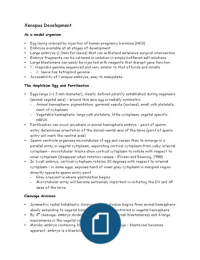
Xenopus Development
As a model organism
Egg laying induced by injection of human pregnancy hormone (HCG)
Embryos available at all stages of development
Large embryos (1.3mm for laevis) that can withstand extensive surgical intervention
Embryo fragments can be cultured in isolation in simple buffered salt solutions
Large blastomere can easily be injected with reagents that disrupt gene function
X. tropicalis genome sequenced and very similar to that of birds and mmalls
- X. laevis has tetraploid genome
Accessibility of Xenopus embryos, easy to manipulate
The Amphibian Egg and Fertilisation
Eggs large (~1.3 mm diameter), clearly defined polarity established during oogenesis
(animal-vegetal axis) – around this axis egg is radially symmetric
- Animal hemisphere: pigmentation, germinal vesicle (nucleus), small yolk platelets,
most of cytoplasm
- Vegetable hemisphere: large yolk platelets, little cytoplasm, vegetal specific
mRNA
Fertilisation can occur anywhere in animal hemisphere embryo – point of sperm
entry determines orientation of the dorsal-vental axis of the larva (point of sperm
entry will mark the ventral side)
Sperm centriole organises microtubules of egg and causes then to arrange in a
parallel array in vegetal cytoplasm, separating cortical cytoplasm from yolky internal
cytoplasm – microtubular tracks allow cortical cytoplasm to rotate with respect to
inner cytoplasm (disappear when rotation ceases – Elinson and Rowning, 1988)
In 1-cell embryo, cortical cytoplasm rotates 30 degrees with respect to internal
cytoplasm – in some eggs, exposes band of inner grey cytoplasm in marginal region
directly opposite sperm entry point
- Grey crescent is where gastrulation begins
- Microtubular array will become extremely important in initiating the DV and AP
axes of the larva
Cleavage divisions
Symmetric radial holoblastic divisions – first division begins from animal hemisphere
slowly extending to vegetal hemisphere: yolk concentrated in vegetal hemisphere
By 4th cleavage: embryo dvided into 4 micromeres (small blastomeres) and 4 large
macromeres in the vegetal region
Morula: embryo containing 16-64 cells, at 128 cell stage – blastocoel becomes
apparent, embryo is a blastula
, Amphibian blastocoel: permits cell
migration during gastrulation,
prevents cells beneath from
interacting prematurely with cells
above it
- Nieuwkoop (1973) – embryonic
newt cells from roof of the
blastocoel in the animal
hemisphere (animal cap) and
placed them next to yolky vegetal cells from base of blastocoel, animal cap cells
differentiated into mesodermal tissue instead of ectoderm
- Blastocoel prevents contact of the vegetal cells destined to become endoderm
with those cells in the ectoderm fated to give rise to skin and nerves
Numerous cell adhesion molecules keep cleaving blastomeres together
- EP-cadherin – mRNA for this protein supplied in oocyte cytoplasm
- If message destroyed by anti-sense oligonucleotides, so no EP-cadherin is made,
adhesion between blastomeres is dramatically reduced, obliteration of
blastocoel (Heasman et al., 1994)
Mid-blastula transition
Important precondition for gastrulation is activation of the genome
Xenopus laevis: few genes appear to be transcribed during early cleavage, nuclear
genes not activated until late in 12th cell cycle (Yang et al., 2002)
Embryo experiences MBT, different genes begin to be transcribed in different
cells, cell cycle acquires gap phases, blastomeres acquire motility
Thought that some factor in egg is being absorbed by newly made chromatin,
transition can be changed by experimentally altered ratio of chromatin to cytoplasm
in the cell (Newport and Kirschner, 1982)
Xenopus – late blastula, there are a loss of methylation on the promoters of genes
activated at MBT – methylation of lysine-4 on histone H3 (forming trimethylated
lysine that is associated with active transcription) – also seen on 5’ ends of many
genes during MBT
- Once the chromatin at the promoters remodelled – various transcription factors
eg, vegT protein (formed in vegetal cytoplasm from localised maternal mRNA)
bind to promoters and initiate new transcription
- Vegetal cells become endoderm and begin secreting factors that inducing cells
above them to become mesoderm
Gastrulation
, First sign of gastrulation is
appearance of darkly pigmented
dorsal blastopore in vegetal
hemisphere, which is created by
bottle cells
Gastrulation movements in frog
embryos act to position the mesoderm between outer ectoderm and inner
endoderm: these movements initiated on future dorsal side of the embryo, below
equator, in region of grey crescent
Bottle cells line the archenteron (primitive gut) as it forms, and similar to
gastrulating sea urchin, invagination of cells initiates formation of the archenteron
- However, unlike sea urchins, gastrulation in the frog begins not in the most
vegetal region but in the marginal zone (region surrounding the equator of
blastula, where animal and vegetal hemispheres meet)
The blastopore extends around the entire circumference of the embryo before
closer over the vegetal hemisphere (epiboly)
Mesoderm and endoderm involute at the blastopore and migrate along the inner
surface of the dorsal ectoderm
Involution is more extensive at the dorsal blastopore
Blastocoel is obliterated as the archenteron, the lumen of the gut is formed
Fate mapping in Amphibian Gastrulae
Animal cells form ectoderm, vegetal cells endoderm and
equatorial cells (marginal zone) mesoderm
Neural Tube Closure
At the end of gastrulation, nervous system is simple, flat,
epithelial sheet on dorsal side of the embryo – neural plate
Lateral edges elevate toward the dorsal midline, where they meet and fuse to form
the neural tube
Tube now lies beneath dorsal epidermis
Vertebrate Body Plan
Following the completion of neurulation the embryo has acquired a body plan that it
shares with all vertebrate embryos.
The nervous system is already divided into forebrain (prosencephalon), midbrain
(mesencephalon), hindbrain (rhombencephalon) and spinal cord, the eyes are forming
and an adhesive organ, the cement gland, forms in the ectoderm of the “chin”
As a model organism
Egg laying induced by injection of human pregnancy hormone (HCG)
Embryos available at all stages of development
Large embryos (1.3mm for laevis) that can withstand extensive surgical intervention
Embryo fragments can be cultured in isolation in simple buffered salt solutions
Large blastomere can easily be injected with reagents that disrupt gene function
X. tropicalis genome sequenced and very similar to that of birds and mmalls
- X. laevis has tetraploid genome
Accessibility of Xenopus embryos, easy to manipulate
The Amphibian Egg and Fertilisation
Eggs large (~1.3 mm diameter), clearly defined polarity established during oogenesis
(animal-vegetal axis) – around this axis egg is radially symmetric
- Animal hemisphere: pigmentation, germinal vesicle (nucleus), small yolk platelets,
most of cytoplasm
- Vegetable hemisphere: large yolk platelets, little cytoplasm, vegetal specific
mRNA
Fertilisation can occur anywhere in animal hemisphere embryo – point of sperm
entry determines orientation of the dorsal-vental axis of the larva (point of sperm
entry will mark the ventral side)
Sperm centriole organises microtubules of egg and causes then to arrange in a
parallel array in vegetal cytoplasm, separating cortical cytoplasm from yolky internal
cytoplasm – microtubular tracks allow cortical cytoplasm to rotate with respect to
inner cytoplasm (disappear when rotation ceases – Elinson and Rowning, 1988)
In 1-cell embryo, cortical cytoplasm rotates 30 degrees with respect to internal
cytoplasm – in some eggs, exposes band of inner grey cytoplasm in marginal region
directly opposite sperm entry point
- Grey crescent is where gastrulation begins
- Microtubular array will become extremely important in initiating the DV and AP
axes of the larva
Cleavage divisions
Symmetric radial holoblastic divisions – first division begins from animal hemisphere
slowly extending to vegetal hemisphere: yolk concentrated in vegetal hemisphere
By 4th cleavage: embryo dvided into 4 micromeres (small blastomeres) and 4 large
macromeres in the vegetal region
Morula: embryo containing 16-64 cells, at 128 cell stage – blastocoel becomes
apparent, embryo is a blastula
, Amphibian blastocoel: permits cell
migration during gastrulation,
prevents cells beneath from
interacting prematurely with cells
above it
- Nieuwkoop (1973) – embryonic
newt cells from roof of the
blastocoel in the animal
hemisphere (animal cap) and
placed them next to yolky vegetal cells from base of blastocoel, animal cap cells
differentiated into mesodermal tissue instead of ectoderm
- Blastocoel prevents contact of the vegetal cells destined to become endoderm
with those cells in the ectoderm fated to give rise to skin and nerves
Numerous cell adhesion molecules keep cleaving blastomeres together
- EP-cadherin – mRNA for this protein supplied in oocyte cytoplasm
- If message destroyed by anti-sense oligonucleotides, so no EP-cadherin is made,
adhesion between blastomeres is dramatically reduced, obliteration of
blastocoel (Heasman et al., 1994)
Mid-blastula transition
Important precondition for gastrulation is activation of the genome
Xenopus laevis: few genes appear to be transcribed during early cleavage, nuclear
genes not activated until late in 12th cell cycle (Yang et al., 2002)
Embryo experiences MBT, different genes begin to be transcribed in different
cells, cell cycle acquires gap phases, blastomeres acquire motility
Thought that some factor in egg is being absorbed by newly made chromatin,
transition can be changed by experimentally altered ratio of chromatin to cytoplasm
in the cell (Newport and Kirschner, 1982)
Xenopus – late blastula, there are a loss of methylation on the promoters of genes
activated at MBT – methylation of lysine-4 on histone H3 (forming trimethylated
lysine that is associated with active transcription) – also seen on 5’ ends of many
genes during MBT
- Once the chromatin at the promoters remodelled – various transcription factors
eg, vegT protein (formed in vegetal cytoplasm from localised maternal mRNA)
bind to promoters and initiate new transcription
- Vegetal cells become endoderm and begin secreting factors that inducing cells
above them to become mesoderm
Gastrulation
, First sign of gastrulation is
appearance of darkly pigmented
dorsal blastopore in vegetal
hemisphere, which is created by
bottle cells
Gastrulation movements in frog
embryos act to position the mesoderm between outer ectoderm and inner
endoderm: these movements initiated on future dorsal side of the embryo, below
equator, in region of grey crescent
Bottle cells line the archenteron (primitive gut) as it forms, and similar to
gastrulating sea urchin, invagination of cells initiates formation of the archenteron
- However, unlike sea urchins, gastrulation in the frog begins not in the most
vegetal region but in the marginal zone (region surrounding the equator of
blastula, where animal and vegetal hemispheres meet)
The blastopore extends around the entire circumference of the embryo before
closer over the vegetal hemisphere (epiboly)
Mesoderm and endoderm involute at the blastopore and migrate along the inner
surface of the dorsal ectoderm
Involution is more extensive at the dorsal blastopore
Blastocoel is obliterated as the archenteron, the lumen of the gut is formed
Fate mapping in Amphibian Gastrulae
Animal cells form ectoderm, vegetal cells endoderm and
equatorial cells (marginal zone) mesoderm
Neural Tube Closure
At the end of gastrulation, nervous system is simple, flat,
epithelial sheet on dorsal side of the embryo – neural plate
Lateral edges elevate toward the dorsal midline, where they meet and fuse to form
the neural tube
Tube now lies beneath dorsal epidermis
Vertebrate Body Plan
Following the completion of neurulation the embryo has acquired a body plan that it
shares with all vertebrate embryos.
The nervous system is already divided into forebrain (prosencephalon), midbrain
(mesencephalon), hindbrain (rhombencephalon) and spinal cord, the eyes are forming
and an adhesive organ, the cement gland, forms in the ectoderm of the “chin”