Introduction + Cell Fate
Questions & Techniques
Questions on Differentiation, Morphogenesis, Growth, Reproduction, Regeneration,
Evolution, Environmental integration
1. Descriptive/Comparative approach – visible phenotypes
2. Experimental embryology – extract cells from embryo + culture, move
factors/induces around to observe effect
3. Developmental Genetics - Use mutants/knockout genes
Embryogenesis: converts genotype into adult phenotypes, passing through series of
morphologically complex embryological + larval form
Anatomical variation (basis of evolution) is generated by modifying embryogenesis
Embryonic development begins at fertilisation: haploid egg + haploid sperm = diploid
genome
Once activated development follows clearly defined steps that can be
recognised:
1. Cleavage
Period/series of extremely rapid mitotic divisions immediately follow fertilisation
Large volume of zygote cytoplasm divided into numerous smaller cells (blastomeres)
By the end – blastomeres usually formed a sphere (blastula)
2. Gastrulation
Rate of mitotic division slows down
Phase-coordinated cell movements that generate multi-layered structure of embryo
(gastrula)
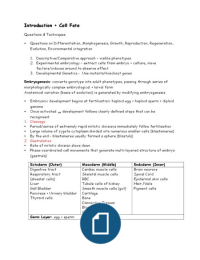
Ectoderm (Outer) Mesoderm (Middle) Endoderm (Inner)
Digestive tract Cardiac muscle cells Brain neurons
Respiratory tract Skeletal muscle cells Spinal Cord
(alveolar cells) RBC Epidermal skin cells
Liver Tubule cells of kidney Hair, Nails
Gall Bladder Smooth muscle cells (gut) Pigment cells
Pancreas + Urinary bladder Cartilage
Thyroid cells Bone
Connective Tissues
Blood vessels
Gonads
Germ Layer: egg + sperm
,3. Neurulation
Formation of an internal nervous system, which is part of surface ectoderm
following gastrulation (induced by dorsal mesoderm)
Other processes also occur: segmentation, axis determination
4. Organogenesis
Differentiation of organs + tissues so they are fully functional
CNS development and diversification
Neural crest development and migration
5. Metamorphosis
Transformation of larva into adult organism
Occurs relatively late in development and may involve major
remodelling of body
Differentiation
Cell types are not pre-formed in egg
Form by epigenesis – complexity increasing at each step or developmental process
Progressive series of developmental decisions narrowing options of cells from
totipotent pluripotent/multipotent unipotent
Main mechanism for reducing potency = embryonic induction
Cell signalling allows cells to make a choice between no. of alternative cell types
2 steps recognised in cell commitment to form a specific cell type
Specification: commitment to particular fate (can be
changed in some circumstances); labile stage
When it is capable of differentiating autonomously
(ie. by itself) in vitro – into an environment that is
neutral with respect to the developmental pathway;
capable of being reversed/changed
Eg. Xenopus mid-blastulae specified to form
ectoderm + form epidermis, an ectodermal tissue,
isolated from embryo (not fully committed to ectoderm, can form mesoderm
if incubated with activing)
Determination: commitment to a particular fate,
usually not changeable
Capable of differentiating autonomously even when
placed into another region of the embryo (a non-
neutral environment) – assumed to be irreversible
Eg. Xenopus animal hemisphere, fully committed to
ectoderm by early gastrula stage (once committed, cell
can acquire specific functional + structural characteristics differentiation)
, Three major strategies for cell commitment: based on mechanisms that apportion
certain sets of transcription factors to different cells in the early embryo
Autonomous Specification
Blastomere inherits a set of transcription factors from egg cytoplasm which
regulate gene expression, directing cell into particular path of development
No requirement for cell interaction for cell commitment
Cytoplasm is not homogenous, but contains morphogenetic determinants which
influence cell fate
a) Wilhelm Roux first proposed that determinants were unevenly distributed in the
cytoplasm (contrary to Weismann in 1883, who proposed that these factors
were in the nucleus)
Roux killed single blastomere of 2 cell frog embryo, living blastomere continue to
develop – half full formed embryo (neurula)
Transplantation studies : moving cytoplasm to new locations in embryo
Ectopic tissue will form in the transplanted region/ ablation of determinant will
result in absence of tissue
Few determinants meet all the criteria
b) Macho-1 (Ascidian mRNA) required for muscle formation (Nishida & Sawada,
2001)
RNA hybridisation to identify maternal mRNAs localised to vegetal hemisphere
Macho-1 coded a putative zinc finger (protein with protrusions coordinated by
zinc interact with other molecules – DNA, RNA, proteins etc.)
Localised to yellow cytoplasm/crescent of egg/zygote
16-, 32-, cell stages localised to blastomeres that give muscle cells
Depletion led to loss of primary muscle cells (n.b secondary muscle cells
produced by induction)
Injection caused ectopic muscle formation
Macho-1 protein is a DNA binding protein activates several muscle-specific
genes
Eg.m-actin, m-myosin, myf, Hox6 (key gene which produces ectopic muscle
development), snail (inhibits notochord differentiation in prospective muscle
cells, inhibit expression of promoting transcription factor brachyury)
c) Cytoplasmic determinants in Germ cell development
Questions & Techniques
Questions on Differentiation, Morphogenesis, Growth, Reproduction, Regeneration,
Evolution, Environmental integration
1. Descriptive/Comparative approach – visible phenotypes
2. Experimental embryology – extract cells from embryo + culture, move
factors/induces around to observe effect
3. Developmental Genetics - Use mutants/knockout genes
Embryogenesis: converts genotype into adult phenotypes, passing through series of
morphologically complex embryological + larval form
Anatomical variation (basis of evolution) is generated by modifying embryogenesis
Embryonic development begins at fertilisation: haploid egg + haploid sperm = diploid
genome
Once activated development follows clearly defined steps that can be
recognised:
1. Cleavage
Period/series of extremely rapid mitotic divisions immediately follow fertilisation
Large volume of zygote cytoplasm divided into numerous smaller cells (blastomeres)
By the end – blastomeres usually formed a sphere (blastula)
2. Gastrulation
Rate of mitotic division slows down
Phase-coordinated cell movements that generate multi-layered structure of embryo
(gastrula)
Ectoderm (Outer) Mesoderm (Middle) Endoderm (Inner)
Digestive tract Cardiac muscle cells Brain neurons
Respiratory tract Skeletal muscle cells Spinal Cord
(alveolar cells) RBC Epidermal skin cells
Liver Tubule cells of kidney Hair, Nails
Gall Bladder Smooth muscle cells (gut) Pigment cells
Pancreas + Urinary bladder Cartilage
Thyroid cells Bone
Connective Tissues
Blood vessels
Gonads
Germ Layer: egg + sperm
,3. Neurulation
Formation of an internal nervous system, which is part of surface ectoderm
following gastrulation (induced by dorsal mesoderm)
Other processes also occur: segmentation, axis determination
4. Organogenesis
Differentiation of organs + tissues so they are fully functional
CNS development and diversification
Neural crest development and migration
5. Metamorphosis
Transformation of larva into adult organism
Occurs relatively late in development and may involve major
remodelling of body
Differentiation
Cell types are not pre-formed in egg
Form by epigenesis – complexity increasing at each step or developmental process
Progressive series of developmental decisions narrowing options of cells from
totipotent pluripotent/multipotent unipotent
Main mechanism for reducing potency = embryonic induction
Cell signalling allows cells to make a choice between no. of alternative cell types
2 steps recognised in cell commitment to form a specific cell type
Specification: commitment to particular fate (can be
changed in some circumstances); labile stage
When it is capable of differentiating autonomously
(ie. by itself) in vitro – into an environment that is
neutral with respect to the developmental pathway;
capable of being reversed/changed
Eg. Xenopus mid-blastulae specified to form
ectoderm + form epidermis, an ectodermal tissue,
isolated from embryo (not fully committed to ectoderm, can form mesoderm
if incubated with activing)
Determination: commitment to a particular fate,
usually not changeable
Capable of differentiating autonomously even when
placed into another region of the embryo (a non-
neutral environment) – assumed to be irreversible
Eg. Xenopus animal hemisphere, fully committed to
ectoderm by early gastrula stage (once committed, cell
can acquire specific functional + structural characteristics differentiation)
, Three major strategies for cell commitment: based on mechanisms that apportion
certain sets of transcription factors to different cells in the early embryo
Autonomous Specification
Blastomere inherits a set of transcription factors from egg cytoplasm which
regulate gene expression, directing cell into particular path of development
No requirement for cell interaction for cell commitment
Cytoplasm is not homogenous, but contains morphogenetic determinants which
influence cell fate
a) Wilhelm Roux first proposed that determinants were unevenly distributed in the
cytoplasm (contrary to Weismann in 1883, who proposed that these factors
were in the nucleus)
Roux killed single blastomere of 2 cell frog embryo, living blastomere continue to
develop – half full formed embryo (neurula)
Transplantation studies : moving cytoplasm to new locations in embryo
Ectopic tissue will form in the transplanted region/ ablation of determinant will
result in absence of tissue
Few determinants meet all the criteria
b) Macho-1 (Ascidian mRNA) required for muscle formation (Nishida & Sawada,
2001)
RNA hybridisation to identify maternal mRNAs localised to vegetal hemisphere
Macho-1 coded a putative zinc finger (protein with protrusions coordinated by
zinc interact with other molecules – DNA, RNA, proteins etc.)
Localised to yellow cytoplasm/crescent of egg/zygote
16-, 32-, cell stages localised to blastomeres that give muscle cells
Depletion led to loss of primary muscle cells (n.b secondary muscle cells
produced by induction)
Injection caused ectopic muscle formation
Macho-1 protein is a DNA binding protein activates several muscle-specific
genes
Eg.m-actin, m-myosin, myf, Hox6 (key gene which produces ectopic muscle
development), snail (inhibits notochord differentiation in prospective muscle
cells, inhibit expression of promoting transcription factor brachyury)
c) Cytoplasmic determinants in Germ cell development