BIOLOGY SPECIFICATION NOTES
Edexcel Biology Salters-Nuffield A AS/A-Level
Core Practicals
CORE PRACTICAL 1: Investigate the effect of caffeine on heart rate in Daphnia and be able
to discuss the potential ethical issues regarding the use of invertebrates in research.
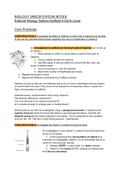
An investigation on caffeine on the heart rates of Daphnia can be set up
as follows…
1. Place strands of cotton on cavity slide to restrict movement of
Daphnia
2. Using a pipette transfer the daphnia
3. Use filter paper to remove water from around the flea. Add two
drops of distilled water.
4. Use a microscope to view the daphnia.
5. Record the number of heartbeats per minute.
6. Repeat this at least 3 times.
7. Repeat with different concentrations of caffeine solution.
Daphnia is used as they are invertebrates and so do not have a developed nervous system,
so cannot feel much pain. They must not be exposed to unnecessary stress, or given too
high a concentration of caffeine.
Potential issues: Controversial to harm living creature?
Permanently affected by experiment?
Can it be returned to its natural environment?
Is it complex enough to undergo pain or mental stress?
Blood pressure can also be investigated using a sphygmomanometer. It measures the
systolic pressure (when the blood first starts to spurt through the artery), and then the
diastolic pressure (the lowest pressure in the artery). This is presented as two numbers,
such as . 140/ 90 is a high blood pressure - hypertensive.
CORE PRACTICAL 2: Investigate the vitamin C content of food and drink.
An investigation on the vitamin C content of food and drink can
be set up as follows:
1. In this experiment the concentration of vitamin C in
fruit drinks is investigated. Vitamin C is an antioxidant and so is
useful for removing free radicals.
2. Indicator DCPIP is used which is a redox indicator
3. Vitamin C will reduce DCPIP, causing it to decolourise
from blue to colourless
, 1. Pipette 1cm3 of 1% DCPIP solution into a test tube
2. Record start volume of 1% vitamin C solution in a pipette or burette
3. Add vitamin C drop by drop into DCPIP and shake tube
4. Continue until DCPIP is colourless and record result
5. Calculate exact volume of vitamin C solution needed
6. Then repeat procedure, average the result, and then repeat with fruit juices
7. A ‘calibration curve’ is made with the 1% vitamin C solution for which the fruit juices
can be compared to
CORE PRACTICAL 3: Investigate membrane structure, including the effect of alcohol
concentration or temperature on membrane permeability.
Beetroot cells contain the red pigment betalain. The pigment is stored in the vacuoles of the
cells, but it is too large a molecule to pass through the phospholipid bilayer of the membrane
around the vacuole, and the membrane of the cell.
Heating cells causes the cell membrane to become more fluid, as the hydrophobic
interactions between the phospholipid molecules weaken. This increases the permeability
of the membrane allowing betalain to leave the cells and diffuse into the surrounding
solution. At high temperatures the proteins will also change shape.
High concentrations of alcohols dissolve the phospholipids which also increases the
permeability. A colorimeter is used to detect the change in colour of the solution.
1. Select a range of temperatures from 0 - 70 C or concentration from 0 - 70
2. Ensure beetroot discs are washed thoroughly to ensure damaged cells on surface
are removed
3. Place beetroot discs with same diameter in fixed volume of distilled water at selected
temperatures/ concentrations of alcohol.
4. For conc: Ensure temperature is maintained using a water bath.
5. Pour liquid through a sieve to remove the beetroot discs.
6. Use a colorimeter to measure the absorbance of the solution.
7. Collect repeat readings.
CORE PRACTICAL 4: Investigate the effect of enzyme and substrate concentrations on the
initial rates of reactions.
The rate of an enzyme controlled reaction can be calculated by measuring the change in the
concentration of the product or substrate. The rate of reaction can be determined by
measuring the rate of change in the concentration over time. The enzyme protease
breaks down the protein in milk.
1. Dilute stock solution of 1% protease with distilled water to make range of protease
solution with different concentrations
2. Pipette set volume of protein solution into cuvette
3. Pipette set volume of protease into cuvette
4. Mix, place cuvette in colorimeter, and start stopwatch
5. Measure absorbance of solution at set time interval for five minutes
Edexcel Biology Salters-Nuffield A AS/A-Level
Core Practicals
CORE PRACTICAL 1: Investigate the effect of caffeine on heart rate in Daphnia and be able
to discuss the potential ethical issues regarding the use of invertebrates in research.
An investigation on caffeine on the heart rates of Daphnia can be set up
as follows…
1. Place strands of cotton on cavity slide to restrict movement of
Daphnia
2. Using a pipette transfer the daphnia
3. Use filter paper to remove water from around the flea. Add two
drops of distilled water.
4. Use a microscope to view the daphnia.
5. Record the number of heartbeats per minute.
6. Repeat this at least 3 times.
7. Repeat with different concentrations of caffeine solution.
Daphnia is used as they are invertebrates and so do not have a developed nervous system,
so cannot feel much pain. They must not be exposed to unnecessary stress, or given too
high a concentration of caffeine.
Potential issues: Controversial to harm living creature?
Permanently affected by experiment?
Can it be returned to its natural environment?
Is it complex enough to undergo pain or mental stress?
Blood pressure can also be investigated using a sphygmomanometer. It measures the
systolic pressure (when the blood first starts to spurt through the artery), and then the
diastolic pressure (the lowest pressure in the artery). This is presented as two numbers,
such as . 140/ 90 is a high blood pressure - hypertensive.
CORE PRACTICAL 2: Investigate the vitamin C content of food and drink.
An investigation on the vitamin C content of food and drink can
be set up as follows:
1. In this experiment the concentration of vitamin C in
fruit drinks is investigated. Vitamin C is an antioxidant and so is
useful for removing free radicals.
2. Indicator DCPIP is used which is a redox indicator
3. Vitamin C will reduce DCPIP, causing it to decolourise
from blue to colourless
, 1. Pipette 1cm3 of 1% DCPIP solution into a test tube
2. Record start volume of 1% vitamin C solution in a pipette or burette
3. Add vitamin C drop by drop into DCPIP and shake tube
4. Continue until DCPIP is colourless and record result
5. Calculate exact volume of vitamin C solution needed
6. Then repeat procedure, average the result, and then repeat with fruit juices
7. A ‘calibration curve’ is made with the 1% vitamin C solution for which the fruit juices
can be compared to
CORE PRACTICAL 3: Investigate membrane structure, including the effect of alcohol
concentration or temperature on membrane permeability.
Beetroot cells contain the red pigment betalain. The pigment is stored in the vacuoles of the
cells, but it is too large a molecule to pass through the phospholipid bilayer of the membrane
around the vacuole, and the membrane of the cell.
Heating cells causes the cell membrane to become more fluid, as the hydrophobic
interactions between the phospholipid molecules weaken. This increases the permeability
of the membrane allowing betalain to leave the cells and diffuse into the surrounding
solution. At high temperatures the proteins will also change shape.
High concentrations of alcohols dissolve the phospholipids which also increases the
permeability. A colorimeter is used to detect the change in colour of the solution.
1. Select a range of temperatures from 0 - 70 C or concentration from 0 - 70
2. Ensure beetroot discs are washed thoroughly to ensure damaged cells on surface
are removed
3. Place beetroot discs with same diameter in fixed volume of distilled water at selected
temperatures/ concentrations of alcohol.
4. For conc: Ensure temperature is maintained using a water bath.
5. Pour liquid through a sieve to remove the beetroot discs.
6. Use a colorimeter to measure the absorbance of the solution.
7. Collect repeat readings.
CORE PRACTICAL 4: Investigate the effect of enzyme and substrate concentrations on the
initial rates of reactions.
The rate of an enzyme controlled reaction can be calculated by measuring the change in the
concentration of the product or substrate. The rate of reaction can be determined by
measuring the rate of change in the concentration over time. The enzyme protease
breaks down the protein in milk.
1. Dilute stock solution of 1% protease with distilled water to make range of protease
solution with different concentrations
2. Pipette set volume of protein solution into cuvette
3. Pipette set volume of protease into cuvette
4. Mix, place cuvette in colorimeter, and start stopwatch
5. Measure absorbance of solution at set time interval for five minutes