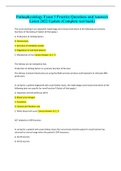
Pathophysiology Exam 3 Practice Questions and Answers Latest 2022 Update (Complete test bank)
The nurse working in an outpatient nephrology clinic knows that which of the following are primary functions of the kidneys? (Select all that apply.) A. Production of clotting factors B. Homeostasis C. Excretion of metabolic wastes D. Regulation of acid-base balance E. Metabolism of fats Correct Answer- B, C, D The kidneys do not metabolize fats. Production of clotting factors is a primary function of the liver. The kidneys maintain blood pressure using the RAAS and also produce erythropoietin to stimulate RBC production. In caring for a patient diagnosed with acute kidney injury, the nephrology nurse knows that which of the following tests are specific for renal function? (Select all that apply.) A. Aspartate aminotransferase (AST) B. Blood urea nitrogen C. Creatinine D. Glomerular filtration rate E. White blood cell count Correct Answer- B, C, D AST related to LIVER function In caring for a patient with acute kidney injury the nurse knows that the patient's renal function has returned to normal range when the patient's GFR measures: A. 30-40 mL/min B. 40-50 mL/min C. 70-90 mL/min D. 90-120 mL/min Correct Answer- D Normal GFR is 90-120 mL/min Normal Creatinine 0.6-1.1 for females and 0.6-1.2 for males Normal BUN is 10-20 mg/dL *Be sure to know these normal values, you will use them daily as a nurse The nursing working in a geriatric living facility understands that as patients age, which change in glomerular filtration rate is expected? A. Increased GFR B. Decreased GFR C. Same GFR D. No GFR Correct Answer- B Aging and renal function: Decrease in renal blood flow and GFR → altered sodium and water balance Number of nephrons decrease due to renal vascular and perfusion changes Response to acid-base changes is delayed Increased risk for drug toxicity Alterations in thirst and water intake Get dehydrated very easily; do not recognize thirst and heat Decreased muscle mass may lead to decreased creatinine values An older patient is experiencing urinary stasis. The registered nurse knows that urinary stasis may lead to which of the following? A. Increased GFR B. Hypocoagulation C. Hypertension D. Infection Correct Answer- D Urinary stasis is a risk factor for developing UTI Which of the following is classified as the most common primary mineral salt composition of kidney stones? A. Calcium B. Struvite C. Uric Acid D. Cysteine Correct Answer- A A - calcium (i.e. oxalate or phosphate) is most common *Note that a change in urine pH may lead to precipitation of stones Which of the following are risk factors for developing renal tumors? (Select all that apply.) A. Female gender B. Smoking C. Obesity D. Diabetes E. Hypertension Correct Answer- B, C, E risk factors are male gender, smoking, obesity, uncontrolled hypertension The registered nurse would expect which of the following lab values for a patient experiencing acute kidney failure? A. Creatinine 3.5 mg/dL B. Sodium 122 mEq/L C. Albumin 3.5 g/dL D. BUN 10 mg/dL Correct Answer- A the normal creatinine level is 0.6 - 1.2 This BUN is within normal range (BUN would be elevated in acute kidney failure) In caring for a patient experiencing acute kidney injury who has these lab values: urinary output 15 mL/hr, BUN 30 mg/dL, and creatinine 3.5, the nurse knows that the patient is experiencing which phase of acute kidney injury? A. Initiation phase B. Oliguric phase C. Recovery (polyuric) phase D. I don't remember the normal lab values Correct Answer- B Remember that there are phases of acute kidney injury - Initiation phase is when the injury is just beginning and prevention is still possible Next is the oliguric phase where urinary output is decreased and nitrogenous waste products are maintained (BUN and Creatinine) There is also the recovery or polyuric/diuretic phase - diuresis is common and BUN and creatinine decline A 25-year-old female is diagnosed with urinary tract obstruction. While planning care, the nurse realizes that the patient is expected to have hydronephrosis and a decreased glomerular filtration rate caused by: A. Decreased renal blood flow B. Decreased peritubular capillary pressure C. Dilation of renal pelvis and calyces proximal to blockage D. Stimulation of antidiuretic hormone Correct Answer- C Hydroureter; dilation of ureter Hydronephrosis: dilation/enlargement of renal pelvis and calyces Ureterohydronephrosis: dilation of ureter AND renal pelvis and calyces A 55-year-old male presents reporting urinary retention. Tests reveal that he has a lower urinary tract obstruction. Which of the following is of most concern to the nurse? A. Vesicoureteral reflux and pyelonephritis B. Formation of renal calculi C. Glomerulonephritis D. Increased bladder compliance Correct Answer- B urine stasis occurs with urinary tract obstruction and can lead to the formation of renal calculi and UTI A 75-year-old male reports to his primary care provider loss of urine with cough, sneezing, or laughing. Which of the following is the most likely diagnosis the nurse will observe on the chart? A. Urge incontinence B. Overflow incontinence C. Stress incontinence D. Functional incontinence Correct Answer- C
Written for
- Institution
- Pathophysiology
- Module
- Pathophysiology
Document information
- Uploaded on
- January 2, 2023
- Number of pages
- 40
- Written in
- 2022/2023
- Type
- Exam (elaborations)
- Contains
- Questions & answers
Subjects
-
pathophysiology exam 3 practice questions and answers latest 2022 update complete test bank

Also available in package deal