Making health policy - Buse, Mays & Walt (2012)
Chapter 1: The health policy framework
Epistemic community = policy community that is marked by shared political values and a shared
understanding of a problem and its causes.
Policy = decisions taken by policy makers for a given policy area at a certain level (national/local).
→ private policy: policies within companies within the boundaries of public, governmental law.
→ public policy: government policy to accomplish a purpose or goal or resolve a problem.
Policy problem = (1) gap between the ideal world and current reality, (2) unclear reason for this
difference, (3) there should be more than one possible solution to the problem.
Means = (instruments) series of intended activities with certain consequences → types: judicial
(legislation), economic (subsidies/taxes), communication (persuasion), modern (self-regulation).
Health policy = actions that affect institutions, organisations, services and funding arrangements
of health care systems → involves public and private policies.
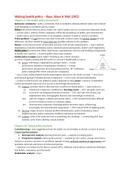
Health policy triangle ( figure right) = looking at the content of policy,
processes of policy making and how power is used in a health policy context.
(a) actors: individuals, organisations, groups, states → inside
government; members of parliament, ministers → outside
government; groups that don’t seek political power, BUT influence
policy making (FEX. NGOs and private companies).
→ macro level: political (government/municipality that steers the whole society) -> meso level:
institutional (groups of people/private companies) -> micro level: societal (individuals).
→ extent to which actors can influence policy depends on their power = mixture of individual
wealth, personality and level of or access to knowledge and authority.
(b) context: systemic factors that may have an effect on health policy → types of factors:
(i) situational: temporary conditions or focusing events → FEX. droughts and wars.
(ii) structural: unchanging elements of society → FEX. the type of economy and
employment base, demographic features and technological advances.
(iii) cultural: religion, tradition and social values → FEX. formal hierarchies, difficult
access to health services or a disease stigma.
(iv) international/exogenous: interdependence between states, influencing
sovereignty and international cooperation → FEX. help of WHO in fighting polio.
(c) process: stages of policy making; problem identification, policy formulation, policy
implementation, policy evaluation, feedback and policy termination.
(d) content: what is the issue and why is something not working? → conducting FEX. data
analysis, actor chart, labeling, causal analysis.
Chapter 10: Doing policy analysis
Crowdsourcing = raise suggestions from the public via social media to decide a course of action.
2 types of policy analysis:
1. Retrospective analysis: learning from the past → analysis of existing policy.
2. Prospective analysis: advicing the present → analysis for new policy, change and reform.
Influences of policy outcomes on: problems, agenda-setting, political windows of opportunity and
positions, interests and power of interested parties.
→ legislators are influenced by: direct contacts (FEX. lobbyists and business coalitions), ideologies
and beliefs, consumers and the media.
Stakeholder analysis = steps:
, (a) identifying policy actors: relevant actors that are likely to be affected by a policy.
(b) assessing their political resources: access to tangible (finance) and intangible (expertise)
resources increases a stakeholders’ influence in the policy process.
(c) assessing their position, interests and commitment: supportive, neutral or opposed.
→ there is a relation between power and position → actors might shift to higher and lower power
positions → especially the neutral power group.
→ downside: it only provides data on actors and reveals little about the context and process of
policy making, which plays an important role in policy change.
→ for a greater number of actors, more useful to do a social network analysis = mapping,
measuring and analysing the social relationships between people, groups and organisations.
Alternative strategy for policy change: determine the position of relevant actors, the power of
political resources, the number of players involved, and the perception of stakeholders of the
problem and solution.
Types of data for a policy analysis:
- Policy documents: that explain/predict policy change → evidence on contextual
variables, actors, content and process.
- People: through semi-structured interviews → limitation; doesn’t concern what people
actually think or do, but what they say and how they say it (subjective info).
- Social media: valuable info about stakeholders' positions, interests and commitments.
Data analysis: policy analysis triangle → review all components → analysis for policy may raise
ethical issues: FEX. can a group participate in a policy process to create a more powerful
coalition? or can you withhold info from the public for tactical purposes?
Chapter 4: Agenda setting
Agenda setting models:
- Rational model = choose what is important → BUT this may differ per group.
- Hall model = 3 features; legitimacy (have to), feasibility (can we), support (will we).
- Kingdon’s stream model = policy window = agenda setting opportunities → policies are
only taken into account by governments when 3 streams run together:
1. problem stream: perceptions of public problems that require government action.
2. policy stream: ongoing analysis of problems, proposed solutions and debates.
3. politics stream: events, like changes of government and campaigns done by
interest groups.
- Hogwood & Gunn approach = issue search, anticipate before problems turn into crisis.
- Shiffman & Smith’s model = policy making influenced by; actor power (strength of actors),
ideas (how they portray), characteristics (featuring problems) and context (environment
actors) → internal frame = policy stream, external frame = politics stream.
Agenda setting in “politics-as-usual” circumstances: response to routine, day-to-day problems.
→ requirements for an issue: (a) legitimacy (right/obligation to intervene), (b) feasibility
(potential for implementing the policy), (c) support (public support for the government).
Agenda setting in crisis circumstances: easier to get radical policies considered.
Non-policy making: FEX. radical market reforms of health care systems rarely changed the
monopoly control and cannot initiate treatment and prescribe drugs for patients.
Agenda setters: government (national and international) and the mass media (propaganda).
Factors shaping political priority: policy community cohesion - leadership - civil society
mobilisation - internal frame (community agreement) - external frame (public portrayals of an
issue) - severity - effective interventions - policy windows - global governance structure.
Chapter 1: The health policy framework
Epistemic community = policy community that is marked by shared political values and a shared
understanding of a problem and its causes.
Policy = decisions taken by policy makers for a given policy area at a certain level (national/local).
→ private policy: policies within companies within the boundaries of public, governmental law.
→ public policy: government policy to accomplish a purpose or goal or resolve a problem.
Policy problem = (1) gap between the ideal world and current reality, (2) unclear reason for this
difference, (3) there should be more than one possible solution to the problem.
Means = (instruments) series of intended activities with certain consequences → types: judicial
(legislation), economic (subsidies/taxes), communication (persuasion), modern (self-regulation).
Health policy = actions that affect institutions, organisations, services and funding arrangements
of health care systems → involves public and private policies.
Health policy triangle ( figure right) = looking at the content of policy,
processes of policy making and how power is used in a health policy context.
(a) actors: individuals, organisations, groups, states → inside
government; members of parliament, ministers → outside
government; groups that don’t seek political power, BUT influence
policy making (FEX. NGOs and private companies).
→ macro level: political (government/municipality that steers the whole society) -> meso level:
institutional (groups of people/private companies) -> micro level: societal (individuals).
→ extent to which actors can influence policy depends on their power = mixture of individual
wealth, personality and level of or access to knowledge and authority.
(b) context: systemic factors that may have an effect on health policy → types of factors:
(i) situational: temporary conditions or focusing events → FEX. droughts and wars.
(ii) structural: unchanging elements of society → FEX. the type of economy and
employment base, demographic features and technological advances.
(iii) cultural: religion, tradition and social values → FEX. formal hierarchies, difficult
access to health services or a disease stigma.
(iv) international/exogenous: interdependence between states, influencing
sovereignty and international cooperation → FEX. help of WHO in fighting polio.
(c) process: stages of policy making; problem identification, policy formulation, policy
implementation, policy evaluation, feedback and policy termination.
(d) content: what is the issue and why is something not working? → conducting FEX. data
analysis, actor chart, labeling, causal analysis.
Chapter 10: Doing policy analysis
Crowdsourcing = raise suggestions from the public via social media to decide a course of action.
2 types of policy analysis:
1. Retrospective analysis: learning from the past → analysis of existing policy.
2. Prospective analysis: advicing the present → analysis for new policy, change and reform.
Influences of policy outcomes on: problems, agenda-setting, political windows of opportunity and
positions, interests and power of interested parties.
→ legislators are influenced by: direct contacts (FEX. lobbyists and business coalitions), ideologies
and beliefs, consumers and the media.
Stakeholder analysis = steps:
, (a) identifying policy actors: relevant actors that are likely to be affected by a policy.
(b) assessing their political resources: access to tangible (finance) and intangible (expertise)
resources increases a stakeholders’ influence in the policy process.
(c) assessing their position, interests and commitment: supportive, neutral or opposed.
→ there is a relation between power and position → actors might shift to higher and lower power
positions → especially the neutral power group.
→ downside: it only provides data on actors and reveals little about the context and process of
policy making, which plays an important role in policy change.
→ for a greater number of actors, more useful to do a social network analysis = mapping,
measuring and analysing the social relationships between people, groups and organisations.
Alternative strategy for policy change: determine the position of relevant actors, the power of
political resources, the number of players involved, and the perception of stakeholders of the
problem and solution.
Types of data for a policy analysis:
- Policy documents: that explain/predict policy change → evidence on contextual
variables, actors, content and process.
- People: through semi-structured interviews → limitation; doesn’t concern what people
actually think or do, but what they say and how they say it (subjective info).
- Social media: valuable info about stakeholders' positions, interests and commitments.
Data analysis: policy analysis triangle → review all components → analysis for policy may raise
ethical issues: FEX. can a group participate in a policy process to create a more powerful
coalition? or can you withhold info from the public for tactical purposes?
Chapter 4: Agenda setting
Agenda setting models:
- Rational model = choose what is important → BUT this may differ per group.
- Hall model = 3 features; legitimacy (have to), feasibility (can we), support (will we).
- Kingdon’s stream model = policy window = agenda setting opportunities → policies are
only taken into account by governments when 3 streams run together:
1. problem stream: perceptions of public problems that require government action.
2. policy stream: ongoing analysis of problems, proposed solutions and debates.
3. politics stream: events, like changes of government and campaigns done by
interest groups.
- Hogwood & Gunn approach = issue search, anticipate before problems turn into crisis.
- Shiffman & Smith’s model = policy making influenced by; actor power (strength of actors),
ideas (how they portray), characteristics (featuring problems) and context (environment
actors) → internal frame = policy stream, external frame = politics stream.
Agenda setting in “politics-as-usual” circumstances: response to routine, day-to-day problems.
→ requirements for an issue: (a) legitimacy (right/obligation to intervene), (b) feasibility
(potential for implementing the policy), (c) support (public support for the government).
Agenda setting in crisis circumstances: easier to get radical policies considered.
Non-policy making: FEX. radical market reforms of health care systems rarely changed the
monopoly control and cannot initiate treatment and prescribe drugs for patients.
Agenda setters: government (national and international) and the mass media (propaganda).
Factors shaping political priority: policy community cohesion - leadership - civil society
mobilisation - internal frame (community agreement) - external frame (public portrayals of an
issue) - severity - effective interventions - policy windows - global governance structure.