CGP Topic 1 (12-23)
Motion and Forces
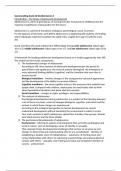
speed (m/s) = distance (m) ÷ time (s)
s=d/t
acceleration (m/s2) = change in velocity (m/s) ÷ time taken (s)
a = v-u/t
Force (N) = mass (kg) × acceleration (m/s2)
F=ma
Weight (N) = mass (kg) × gravitational field strength (N/kg)
W=mg
Momentum (kg m/s) = mass (kg) × velocity (m/s)
p = mv
(final velocity)2 (m/s)2 – (initial velocity)2 (m/s)2 = 2 × acceleration (m/s2) × distance (m)
v2= u2 = 2ax
force (N) = change in momentum (kg m/s) ÷ time (s)
F= (mv-mu)/t
Vectors and Scalars Scalar Vector
Scalar quantity has magnitude Distance Displacement
Vector quantity has both magnitude and direction. Speed Velocity
Mass Weight
Energy Force
Temperature Acceleration
Time Momentum
Distance – how far you travelled
Displacement –
Direct direction between given points
in a specific direction.
Inertial mass equals force over acceleration.
(is a measure of how difficult it is to change the velocity of an object) Speed (m/s) Speed (mph)
Conservation of momentum: Total momentum before Walking 1.5 3
collision/explosion = total momentum after in a closed system
(moving left is -ve) Running 5 10
Cycling 7 15
1 mile per hour is approximately equal to 0.5 m/s
Car 13-30 29-67
Plane (jet) 250 500
Sound 330 767
Motion and Forces
speed (m/s) = distance (m) ÷ time (s)
s=d/t
acceleration (m/s2) = change in velocity (m/s) ÷ time taken (s)
a = v-u/t
Force (N) = mass (kg) × acceleration (m/s2)
F=ma
Weight (N) = mass (kg) × gravitational field strength (N/kg)
W=mg
Momentum (kg m/s) = mass (kg) × velocity (m/s)
p = mv
(final velocity)2 (m/s)2 – (initial velocity)2 (m/s)2 = 2 × acceleration (m/s2) × distance (m)
v2= u2 = 2ax
force (N) = change in momentum (kg m/s) ÷ time (s)
F= (mv-mu)/t
Vectors and Scalars Scalar Vector
Scalar quantity has magnitude Distance Displacement
Vector quantity has both magnitude and direction. Speed Velocity
Mass Weight
Energy Force
Temperature Acceleration
Time Momentum
Distance – how far you travelled
Displacement –
Direct direction between given points
in a specific direction.
Inertial mass equals force over acceleration.
(is a measure of how difficult it is to change the velocity of an object) Speed (m/s) Speed (mph)
Conservation of momentum: Total momentum before Walking 1.5 3
collision/explosion = total momentum after in a closed system
(moving left is -ve) Running 5 10
Cycling 7 15
1 mile per hour is approximately equal to 0.5 m/s
Car 13-30 29-67
Plane (jet) 250 500
Sound 330 767