Key Concepts in Biology
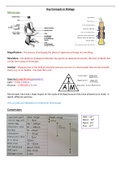
Microscopy
Magnification – the process of enlarging the physical appearance/image of something.
Resolution – the ability to distinguish between two points as separate structures, the level of detail that
can be seen using a microscope.
Artefact – thing you see in the field of view (the area you can see in a microscope) that are not actually
there; e.g. an air bubble may look like a cell.
Maximum magnification/resolution:
Light – 1500x / 200nm
Electron – 2,000,000x / 0.2nm
Microscopes have had a large impact on the study of biology because they have allowed us to study, in
depth, different particles.
You can only see ribosomes in an electron microscope.
Conversions
Milli – 10-3
Micro - 10-6
Nano - 10-9
Pico - 10-12
, Cells
Found only in plants:
• Chloroplasts
• Cell wall
• Vacuole
Found only in animals:
• Centriole
Found in animal and plant:
• Nucleus
• Cytoplasm
• Ribosome
• Mitochondria
Bacteria - Facts
• 10x more bacteria
cells in your body
than human cells. Is
2-3% of your mass
• 40 million bacteria cells in a gram of soil
• 1 million bacteria cells in a ml of freshwater
• only bacteria produce vitamin B12 needed for cells to function
• Bacteria allows us to digest our own food
• 5x1030 mass of bacteria on earth
Eukaryotes have a nucleus, like animal and plant cells, while prokaryotes, like bacteria, do not.
Bacteria cell
Chromosomal DNA – giant loops of DNA
containing most of the genetic material but
no nucleus.
Plasmid DNA – small loops of DNA that carry
extra information
Flagella – long whip like structure that allows
the bacterium to move
Bacteria grow by binary vision – multiplying
Bacteria have cell walls but are much softer and are made of peptidoglycan (murein)
There are about 200 different types of cells in the human body.
Microscopy
Magnification – the process of enlarging the physical appearance/image of something.
Resolution – the ability to distinguish between two points as separate structures, the level of detail that
can be seen using a microscope.
Artefact – thing you see in the field of view (the area you can see in a microscope) that are not actually
there; e.g. an air bubble may look like a cell.
Maximum magnification/resolution:
Light – 1500x / 200nm
Electron – 2,000,000x / 0.2nm
Microscopes have had a large impact on the study of biology because they have allowed us to study, in
depth, different particles.
You can only see ribosomes in an electron microscope.
Conversions
Milli – 10-3
Micro - 10-6
Nano - 10-9
Pico - 10-12
, Cells
Found only in plants:
• Chloroplasts
• Cell wall
• Vacuole
Found only in animals:
• Centriole
Found in animal and plant:
• Nucleus
• Cytoplasm
• Ribosome
• Mitochondria
Bacteria - Facts
• 10x more bacteria
cells in your body
than human cells. Is
2-3% of your mass
• 40 million bacteria cells in a gram of soil
• 1 million bacteria cells in a ml of freshwater
• only bacteria produce vitamin B12 needed for cells to function
• Bacteria allows us to digest our own food
• 5x1030 mass of bacteria on earth
Eukaryotes have a nucleus, like animal and plant cells, while prokaryotes, like bacteria, do not.
Bacteria cell
Chromosomal DNA – giant loops of DNA
containing most of the genetic material but
no nucleus.
Plasmid DNA – small loops of DNA that carry
extra information
Flagella – long whip like structure that allows
the bacterium to move
Bacteria grow by binary vision – multiplying
Bacteria have cell walls but are much softer and are made of peptidoglycan (murein)
There are about 200 different types of cells in the human body.