100% satisfaction guarantee Immediately available after payment Both online and in PDF No strings attached 4.6 TrustPilot
logo-home
Exam (elaborations)

CALT Exam Study Guide 2022/2023 with 100% correct answers

Rating
-
Sold
-
Pages
9
Grade
A+
Uploaded on
21-12-2022
Written in
2022/2023

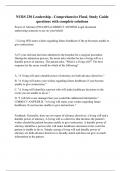
Rhyming One of the first phonological awareness skills to develop Blending & segmenting at syllable level Develops at 3-4 years Segmenting phonemes Develops at 4-5 years Isolating beginning sound in words, segmenting phonemes in CVC words Develops in kindergarten Segmenting words with consonant blends Develops in first grade Receptive oral language Listening Expressive oral language Speaking Receptive written language Reading Expressive written language Writing __ letters representing __ phonemes 26, 44 5 vowel letters, __ vowel sounds 15 Long vowels Tense Vowels. (Beet, bait, boat, boot, bite, boy, bout) (a, e, i, o, u, oy, ou, oo) 00:05 01:19 Short vowels Lax vowels - pat, pet, pit, pot, put, putt (a, e, i ,o, u, oo) Fricatives produced by a constant flow of air through the vocal tract (f and v) Affricates ch/j Glides W, y Liquids l, r Alphabetic principle an understanding that letters and letter patterns represent the sounds of spoken language Six syllable types closed, open, VCe, C+le, R controlled, vowel pairs Semantics Language content— meaning of words and the relationship between and among words Pragmatics Language use— reasons, codes/styles, conversation rules Phonology the study of speech sounds in language Morphology units of meaning involved in word formation Syntax the rules for combining words into grammatically sensible sentences in a given language Teutonic Invasion Shifted the balance of power in Central Europe leading up to the Christianizing of Britain Norman Conquest Began in 1066. Led by William the Conquerer. His military victory at the Battle of Hastings led to Norman control of England. This control would influence England more with continental Europe than Scandinavian culture. Would also lead to rivalry between England and France for the next millenium. Renaissance "rebirth"; following the Middle Ages, a movement that centered on the revival of interest in the classical learning of Greece and Rome The Great Vowel Shift a phonetic shift in the way that long vowels were pronounced in English Dyslexia A specific learning disability that is neurological in origin. It is a deficit in the phonological component of language and is characterized by poor spelling and decoding abilities. Inferior frontal gyrus Broca's area — articulation and word analysis Parieto-temporal area Brain part responsible for word analysis Occipito-temporal region The vision center — word form Angular gyrus transforms visual representations into an auditory code Wernicke's area controls language reception - a brain area involved in language comprehension and expression; in the parieto-temporal lobe Decode Determine pronunciation of a word by breaking it down into sounds Encode To spell Child pretends to read, can name letters of alphabet (6 mos-6 yrs) Jean Chall's stages of reading development, Stage 0-pre-reading Child learns relation btwn letters and sounds, printed and spoken words; can read simple text (grades 1-2.5) Jean Chall's Stages of Reading Development, stage 1-initial reading and decoding Child reads simple stories with increasing fluency (grades 2.5-3) Jean Chall's Stages of Reading Development, stage 2-confirmation and fluency Reading is a tool for acquiring new knowledge (grades 4-8) Jean Chall's stage 3 - Reading for New Learning Child reads critically from a broad range of complex materials (high school) Jean Chall's stage 4- Reading from Multiple Viewpoints Reading is used for one's own needs and purposes and is rapid and efficient (college and beyond) Jean Chall's stage 5- Construction and Reconstruction Prephonetic Stage of spelling development Not all sounds of the words are represented by letters (example: js for dress) Semiphonetic Stage of Spelling Development Child strings together consonants to represent speech sounds (example: ntr for enter) phonetic stage of spelling development Every sound is represented but lacking the complete knowledge of conventional orthography (example: sede for seed) Writing Stage 1 Imitation (preschool-first grade)— pretending to write, can organize letters and shapes in a line Writing Stage 3 Progressive Incorporation (late second to fourth grade)—students gradually incorporate standards of mechanics; little advanced planning Writing Stage 2 Graphic presentation (first and second grade)—Students are adept at printing letters, preoccupied with appearance of letters, likely to make reversals, invented spellers Writing Stage 4 Automatization (fourth-seventh grade)— students apply rules of mechanics automatically, sentences become more sophisticated, begin to assess their own writing Writing Stage 5 Elaboration (seventh-ninth grade)—writing to express a viewpoint, synthesizing, writing level exceeds their own speech Writing Stage 6 Personalization-Diversification (ninth grade and beyond)—use of different writing styles, creative, complex, sophisticated vocabulary Phonological processing Umbrella term for broad category of oral language processing abilities related to sounds in words and associated with the ability to read well Phonological memory ability to remember speech sounds briefly Phonological awareness the ability to reflect on and manipulate the sound segments in words; phonemic awareness is one component Naming speed The rate at which a child can recite "overlearned" stimuli such as letters and single-digit numbers. Dysarthria the inability to use speech that is distinct and connected because of a loss of muscle control after damage to the peripheral or central nervous system Dyspraxia Sensorimotor disruption in which the motor signals to the muscles, such as those necessary for speech production, are not consistently or efficiently received (a person is born with dyspraxia) Apraxia A disorder that prevents certain complex muscular movements, caused by damage to the brain Echolalia The uncontrollable and immediate repetition of words spoken by another person Dysphasia Difficulty in learning both listening and speaking skills despite adequate hearing, intelligence, and opportunity otitis media inflammation of the middle ear that can lead to hearing loss Alexia the loss of the ability to read, usually the result of brain injury Alveolar Articulation made with the ridge behind the teeth Palatal Articulation made with the roof of the mouth Velar Articulation made at the back of the mouth Glottal Articulation made from the throat Major syllable division patterns VCCV, VCV, VCCCV, VV Root A word part that carries meaning and provides the base for an affix Stem A bound morpheme/word part that must have an affix Base word The simplest form of an English word Morpheme The smallest meaningful linguistic unit Free morpheme Unbound word part, can stand alone as a word Inflectional endings suffixes that express plurality or possession when added to a noun (e.g. girls, girl's), tense when added to a verb (e.g. walked, walking), or comparison when added to an adjective (e.g. happier, happiest). Derivational endings Endings that change the meaning and part of speech of a word. Example: er, ism, its, ful, able, ation, ness, ment, ify, ly (teach, teacher) Old English The Anglo-Saxon language spoken from approximately 450 to 1066 A.D. in what is now Great Britain. Middle English The language spoken in England roughly between 1066 and 1500 A.D. Word blindness 1877- Kussmaul used this early term for people who couldn't read despite having normal vision; then Samuel T. Orton coined the term in the 1920s. Professor Berlin A Stuttgart professor who first used the term dyslexia in 1887 Congenital word blindness Dr. W. Pringle Morgan and Dr. James Hinshelwood used this term to describe an inability to learn to read despite no injury or illness — 1896 strephosymbolia term meaning "twisted symbols" coined by Dr. Samuel T. Orton to describe specific dyslexia Specific language disability Anna Gillingham used this term in 1955 and June Orton used it in 1962 Samuel T. Orton Father of Dyslexia, used the term strephosymbolia, determined that dyslexia was not a visual problem but a language problem Simple View of Reading Philip Gough's idea that reading is comprised of two components: decoding and listening comprehension 85% The percentage of LD students who have a primary learning disability in reading and language processing 15-20% Percentage of people who have symptoms of dyslexia Norm-referenced tests standardized tests that compare an individual child's score to the average score of others her age (Woodcock-Johnson) Criterion-referenced tests Tests where the student's performance is compared to a standard or criterion. The student's score is not based on how he/she compared with other students, but rather on how the student did as measured by the criteria or standards. (Dibels, TPRI, STAAR, SAT)

Show more Read less
Institution
CALT Study
Module
CALT Study


Whoops! We can’t load your doc right now. Try again or contact support.

Written for

Institution
CALT Study
Module
CALT Study

Document information

Uploaded on
December 21, 2022
Number of pages
9
Written in
2022/2023
Type
Exam (elaborations)
Contains
Questions & answers

Subjects

Content preview

CALT Exam Study Guide

Rhyming correct answer One of the first phonological awareness skills to develop


Blending & segmenting at syllable level correct answer Develops at 3-4 years


Segmenting phonemes correct answer Develops at 4-5 years


Isolating beginning sound in words, segmenting phonemes in CVC words correct answer Develops in
kindergarten


Segmenting words with consonant blends correct answer Develops in first grade


Receptive oral language correct answer Listening


Expressive oral language correct answer Speaking


Receptive written language correct answer Reading


Expressive written language correct answer Writing


__ letters representing __ phonemes correct answer 26, 44


5 vowel letters, __ vowel sounds correct answer 15


Long vowels correct answer Tense Vowels. (Beet, bait, boat, boot, bite, boy, bout) (a, e, i, o, u, oy, ou,
oo)

, Short vowels correct answer Lax vowels - pat, pet, pit, pot, put, putt (a, e, i ,o, u, oo)


Fricatives correct answer produced by a constant flow of air through the vocal tract (f and v)


Affricates correct answer ch/j


Glides correct answer W, y


Liquids correct answer l, r


Alphabetic principle correct answer an understanding that letters and letter patterns represent the
sounds of spoken language


Six syllable types correct answer closed, open, VCe, C+le, R controlled, vowel pairs


Semantics correct answer Language content— meaning of words and the relationship between and
among words


Pragmatics correct answer Language use— reasons, codes/styles, conversation rules


Phonology correct answer the study of speech sounds in language


Morphology correct answer units of meaning involved in word formation


Syntax correct answer the rules for combining words into grammatically sensible sentences in a given
language


Teutonic Invasion correct answer Shifted the balance of power in Central Europe leading up to the
Christianizing of Britain

£6.89
Get access to the full document:

100% satisfaction guarantee
Immediately available after payment
Both online and in PDF
No strings attached


Also available in package deal

Get to know the seller

Seller avatar
Reputation scores are based on the amount of documents a seller has sold for a fee and the reviews they have received for those documents. There are three levels: Bronze, Silver and Gold. The better the reputation, the more your can rely on the quality of the sellers work.
Bensuda Oxford University
Follow You need to be logged in order to follow users or courses
Sold
846
Member since
3 year
Number of followers
445
Documents
21415
Last sold
1 day ago
ECONOMICS,NURSING,BIOLOGY AND ALL REVISION MATERIALS

DEDICATED TO PROVIDE YOU WITH THE BEST LEARNING MATERIALS THAT WILL IMPROVE YOUR GRADES ,WELCOME TO ALIZGRADES AND LETS DO IT TOGETHER!!! GOODLUCK!!!!!!!

3.7

158 reviews

5
74
4
24
3
25
2
11
1
24

Recently viewed by you

Why students choose Stuvia

Created by fellow students, verified by reviews

Quality you can trust: written by students who passed their exams and reviewed by others who've used these revision notes.

Didn't get what you expected? Choose another document

No problem! You can straightaway pick a different document that better suits what you're after.

Pay as you like, start learning straight away

No subscription, no commitments. Pay the way you're used to via credit card and download your PDF document instantly.

Student with book image

“Bought, downloaded, and smashed it. It really can be that simple.”

Alisha Student

Frequently asked questions