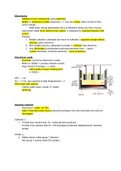
Electrolysis
- Splitting of ionic compounds using electricity
- Molten or dissolved in water (aqueous) —> ions are mobile; allow current to flow
(carry charge)
- Solid state; strong electrostatic force of attraction stops ions from moving
- Used when metal more reactive than carbon; X extracted by reduction/reaction with
carbon
- Process
1. Metals/ cations(+) attracted and move to cathode(-) (opposite charge attract);
reduced; gains electrons
2. Non-metals/ anions(-) attracted to anode(+); oxidised; lose electrons
3. Ions discharged at electrodes producing elements (ions → atom)
(carbon electrode; conducts electricity + inert/ unreactive)
Aluminium oxide
- Insoluble; cannot be dissolved in water
- Melts at ~2000C + produce electric current;
large amount of energy —> costly
- Add cryolite to lower melting point
(~1000C)
Al3+ —> Al
O2- —> O2; very reactive at high temperatures —>
CO2 (react with carbon)
- Carbon eaten away; anode (+) needs
replacing
Aqueous solution
- Dissolved in water; H+ OH-
- water molecules break down producing hydrogen ions and hydroxide ions that are
discharged
Cathode (-)
1. If metal less reactive than H+, metal element produced
If metal more reactive than H+, H2 (hydrogen) produced (displacement; reactivity
series)
Anode (-)
2. Halide anions make group 7 element
Non group 7 anions make O2 (oxides)
- Splitting of ionic compounds using electricity
- Molten or dissolved in water (aqueous) —> ions are mobile; allow current to flow
(carry charge)
- Solid state; strong electrostatic force of attraction stops ions from moving
- Used when metal more reactive than carbon; X extracted by reduction/reaction with
carbon
- Process
1. Metals/ cations(+) attracted and move to cathode(-) (opposite charge attract);
reduced; gains electrons
2. Non-metals/ anions(-) attracted to anode(+); oxidised; lose electrons
3. Ions discharged at electrodes producing elements (ions → atom)
(carbon electrode; conducts electricity + inert/ unreactive)
Aluminium oxide
- Insoluble; cannot be dissolved in water
- Melts at ~2000C + produce electric current;
large amount of energy —> costly
- Add cryolite to lower melting point
(~1000C)
Al3+ —> Al
O2- —> O2; very reactive at high temperatures —>
CO2 (react with carbon)
- Carbon eaten away; anode (+) needs
replacing
Aqueous solution
- Dissolved in water; H+ OH-
- water molecules break down producing hydrogen ions and hydroxide ions that are
discharged
Cathode (-)
1. If metal less reactive than H+, metal element produced
If metal more reactive than H+, H2 (hydrogen) produced (displacement; reactivity
series)
Anode (-)
2. Halide anions make group 7 element
Non group 7 anions make O2 (oxides)