Critical educational policy studies
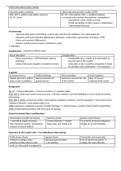
Education policy scientists Critical educational policy studies (CEPS)
After WO II: welfare state (policy sciences) 80’-90’: crisis welfare state → neoliberal policies
60’-70’: boom → minimal state (market: deregulation, competition)
- Educational, social, moral concerns
- Broad conception of policy (power relationships)
- Critical policy advocacy
4 frameworks
- Historical ideal types (centralizing, central state and diversity initiatives, non-interventionist)
- Education policy periodisation (Distributive-allocative, constructive, government at distance 1970)
- Policy cycle analysis (Wielemens)
- Division of labour (Government, institutions, scale)
7 challenges
Neoliberalism = reaction to welfare state
Classic liberalism Neoliberalism
- Homo-economicus = self-interested, rational - Manipulable man = needs to be stimulated to
individual become part of the market
- Laissez-faire state: negative conception of state - State plats a role (= positive conception of state)
- No problem with cartelisation → Privatisation
4 aspects
Economic theory Political ideology Policy paradigm Social imaginary
Market generates welfare Market allocation of Policies to increase the role Ideas of how we
State creates conditions goods/services of the market understand the world
Background
18-19th = Classical liberalism → homo-economicus (= negative state)
After WO II: State more control over economy → Keynes: market is not self-stabilising, in crisis not the necessary
information
After WO II (1970): emergence welfare state/welfare capitalism: market is not self-regulating → need state-action
→Based on Keynes → but double sided crisis
1980: Emergence neoliberal economic & politic ideology (>< welfare state) → positive role of state (competition)
1990: Neoliberalism dominant with first marks of damage
General economic idea’s neoliberalism
Monetarism (reaction on Keynes) Austrian school Human capital theory
= controlling supply of money Central planning → market To all forms of human behaviour
Free enterprise society, privatisation State plays role (minimum) Weight of cost and benefits
Critique on liberal welfare
Expansion of the market rules → to institutional restructuring
Public choice theory Agency theory Transaction cost economics
Critique on welfare state, Principal-agent problem Cost of whole transaction →
collective entities doesn’t exist → all relations making this more effective
Leads to: New public management
Education policy scientists Critical educational policy studies (CEPS)
After WO II: welfare state (policy sciences) 80’-90’: crisis welfare state → neoliberal policies
60’-70’: boom → minimal state (market: deregulation, competition)
- Educational, social, moral concerns
- Broad conception of policy (power relationships)
- Critical policy advocacy
4 frameworks
- Historical ideal types (centralizing, central state and diversity initiatives, non-interventionist)
- Education policy periodisation (Distributive-allocative, constructive, government at distance 1970)
- Policy cycle analysis (Wielemens)
- Division of labour (Government, institutions, scale)
7 challenges
Neoliberalism = reaction to welfare state
Classic liberalism Neoliberalism
- Homo-economicus = self-interested, rational - Manipulable man = needs to be stimulated to
individual become part of the market
- Laissez-faire state: negative conception of state - State plats a role (= positive conception of state)
- No problem with cartelisation → Privatisation
4 aspects
Economic theory Political ideology Policy paradigm Social imaginary
Market generates welfare Market allocation of Policies to increase the role Ideas of how we
State creates conditions goods/services of the market understand the world
Background
18-19th = Classical liberalism → homo-economicus (= negative state)
After WO II: State more control over economy → Keynes: market is not self-stabilising, in crisis not the necessary
information
After WO II (1970): emergence welfare state/welfare capitalism: market is not self-regulating → need state-action
→Based on Keynes → but double sided crisis
1980: Emergence neoliberal economic & politic ideology (>< welfare state) → positive role of state (competition)
1990: Neoliberalism dominant with first marks of damage
General economic idea’s neoliberalism
Monetarism (reaction on Keynes) Austrian school Human capital theory
= controlling supply of money Central planning → market To all forms of human behaviour
Free enterprise society, privatisation State plays role (minimum) Weight of cost and benefits
Critique on liberal welfare
Expansion of the market rules → to institutional restructuring
Public choice theory Agency theory Transaction cost economics
Critique on welfare state, Principal-agent problem Cost of whole transaction →
collective entities doesn’t exist → all relations making this more effective
Leads to: New public management