NHA CCMA Study Guide/ NHA certification Study Guide for CCMA 2022
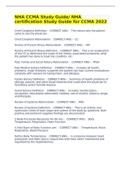
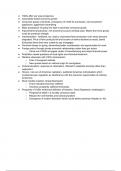
NHA CCMA Study Guide/ NHA cerChief Complaint Definition CORRECT ANS:- The reason why the patient came to see the physician. Chief Complaint Abbreviation CORRECT ANS:- CC History of Present Illness Abbreviation CORRECT ANS:- HPI History of Present Illness Definition CORRECT ANS:- This is an explanation of the CC to determine the onset of the illness; associated symptoms; what the patient has done to treat the condition, etc. Past, Family and Social History Abbreviation CORRECT ANS:- PFSH Past Medical History Definition CORRECT ANS:- Includes all health problems, major illnesses, surgeries the patient has had, current medications complete with reasons for taking them, and allergies. Family History Definition CORRECT ANS:- Summary of health problems of siblings, parents, and other blood relatives that could alert the physician to hereditary and/or familial disease. Social History Definition CORRECT ANS:- Includes marital status, occupation, educational attainment, hobbies, use of alcohol, tobacco, drugs, and lifestyles. Review of Systems Abbreviation CORRECT ANS:- ROS Review of Systems Definition CORRECT ANS:- This is an orderly and systematic check of each organ and system of the body by questions. Both positive and pertinent negative findings are documented. 3 Body Processes Necessary for life are: CORRECT ANS:- Body Temperature, Respiration, Heart Function 4 Vital Signs of Body Function are: CORRECT ANS:- Temperature, Pulse, Respiration, Blood Pressure Define Body Temperature CORRECT ANS:- Is a balance between heart production and heart loss in conjunction with each other, maintained and regulated by the hypothalamus. Thermometers CORRECT ANS:- Are used to measure temperature using the Fahrenheit and Centigrade or Celsius scale. Temperature Sites CORRECT ANS:- Mouth, Rectum, Ear (Tympanic Membrane), and the axilla (underarm). Normal Temperature Range for Rectal CORRECT ANS:- 98.6F to 100.6F 37.0C to 38.1C Normal Temperature Range for Oral CORRECT ANS:- 97.6F to 99.6F 36.5C to 37.5C Normal Temperature Range for Axillary CORRECT ANS:- 96.6F to 98.6F 35.9C to 37.0C Normal Temperature Range for Tympanic Membrane CORRECT ANS:- 98.6 F 37 C Define Febrile CORRECT ANS:- Presence of Fever Define Afebrile CORRECT ANS:- Absence of Fever Define Fever CORRECT ANS:- Elevated body temperature beyond normal range. Intermittent Fever CORRECT ANS:- Fluctuating fever that returns to or below baseline then rises again. Remittent Fever CORRECT ANS:- Fluctuating fever that remains elevated; it does not return to baseline temperature. Continuous Fever CORRECT ANS:- A fever that remains constant above the baseline; it does not fluctuate. Oral Temperature CORRECT ANS:- Is the most common method of measurement. Oral Temperature is not taken from what patients: CORRECT ANS:- -infants and children less than six years old -patients who has had surgery or facial, neck, nose, or mouth injury -those receiving oxygen -those with nasogastric tubes -patients with convulsive seizure -hemiplegic patients -patients with altered mental status How long after a patient eats, smokes or drinks do you wait to take an oral temperature? CORRECT ANS:- 30 minutes When taking an oral temperature how long do you leave the thermometer in the patient's mouth? CORRECT ANS:- 3-5 minutes Rectal Temperature CORRECT ANS:- Is taken when oral temperature is not feasible. Rectal Temperature is not taken from what patients: CORRECT ANS:- -patient's with heart disease -patients with rectal disease or disorder or has had rectal surgery -patients with diarrhea Axillary Temperature CORRECT ANS:- Is the least accurate and is taken only when no other temperature site can be used. When taking an axillary temperature how long should the thermometer be held in place? CORRECT ANS:- 5-10 minutes Tympanic Temperature CORRECT ANS:- Is useful for children and confused patients because of the speed of operation. Tympanic Temperature is not taken from what patients: CORRECT ANS:- -patients with an ear disorder or ear drainage When taking a Tympanic Temperature: CORRECT ANS:- A covered probe is gently inserted into the ear canal and temperature is measured with seconds (1-3 seconds). What is the normal range for an adult pulse: CORRECT ANS:- 60 to 100 beats per minute The site most commonly used for taking a pulse is: CORRECT ANS:- The radial artery (found in the wrist on the same side as the thumb). When taking a pulse at the radial artery it is felt with the: CORRECT ANS:- First two or three fingers (never with the thumb) and usually taken for 30 seconds multiplied by two to get the rate per minute. (Taking a pulse at the radial artery) If the rate is unusually fast or slow then: CORRECT ANS:- Count it for 60 seconds The _____ _____ is a more accurate measurement of the heart rate and it is taken over the apex of the heart by auscultation using the stethoscope. CORRECT ANS:- Apical Pulse Taking an apical pulse is used for patients with: CORRECT ANS:- Irregular heart rate and for infants and small children. Respiratory Characteristics CORRECT ANS:- Rate, Rhythm, and Depth tification Study Guide for CCMA 2022
Written for
- Institution
- Nha ccma
- Module
- Nha ccma
Document information
- Uploaded on
- December 4, 2022
- Number of pages
- 63
- Written in
- 2022/2023
- Type
- Exam (elaborations)
- Contains
- Questions & answers
Subjects
-
nha ccma study guide nha certification study guide for ccma 2022chief complaint definition correct ans the reason why the patient came to see the physician chief complaint abbreviation co

Also available in package deal