
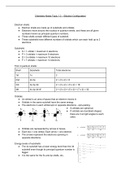
Chemistry Notes Topic 1.3 - Electron Configuration
Electron shells:
● Electron shells are made up of subshells and orbitals.
● Electrons move around the nucleus in quantum shells, and these are all given
numbers known as principal quantum numbers.
● These shells contain different types of subshell.
● These subshells have different numbers of orbitals which can each hold up to 2
electrons.
Subshells:
● S = 1 orbital = maximum 2 electrons
● P = 3 orbitals = maximum 6 electrons
● D = 5 orbitals = maximum 10 electrons
● F = 7 orbitals = maximum 14 electrons
First 4 quantum shells:
Shell Subshells Total electrons
1st 1s 2
2nd 2s 2p 2 + (3 x 2) = 8
3rd 3s 3p 3d 2 + (3 x 2) + (5 x 2) = 18
4th 4s 4p 4d 4f 2 + (3 x 2) + (5 x 2) + (7 x 2) = 32
Orbitals:
● An orbital is an area of space that an electron moves in.
● Orbitals in the same subshell have the same energy.
● The electrons in each orbital spin in opposite directions - spin-pairing.
● S-orbitals are spherical.
● P-orbitals are dumbbell shaped,
there are 3 at right angles to each
other.
● Orbitals are represented by arrows in boxes.
● Each box = one orbital. Each arrow = one electron.
● The arrows represent the electrons spinning in
opposite directions.
Energy levels of subshells:
● The 4s subshell has a lower energy level than the 3d
subshell even though its principal quantum number is
bigger.
● It is the same for the 5s and 4p shells, etc,
Electron shells:
● Electron shells are made up of subshells and orbitals.
● Electrons move around the nucleus in quantum shells, and these are all given
numbers known as principal quantum numbers.
● These shells contain different types of subshell.
● These subshells have different numbers of orbitals which can each hold up to 2
electrons.
Subshells:
● S = 1 orbital = maximum 2 electrons
● P = 3 orbitals = maximum 6 electrons
● D = 5 orbitals = maximum 10 electrons
● F = 7 orbitals = maximum 14 electrons
First 4 quantum shells:
Shell Subshells Total electrons
1st 1s 2
2nd 2s 2p 2 + (3 x 2) = 8
3rd 3s 3p 3d 2 + (3 x 2) + (5 x 2) = 18
4th 4s 4p 4d 4f 2 + (3 x 2) + (5 x 2) + (7 x 2) = 32
Orbitals:
● An orbital is an area of space that an electron moves in.
● Orbitals in the same subshell have the same energy.
● The electrons in each orbital spin in opposite directions - spin-pairing.
● S-orbitals are spherical.
● P-orbitals are dumbbell shaped,
there are 3 at right angles to each
other.
● Orbitals are represented by arrows in boxes.
● Each box = one orbital. Each arrow = one electron.
● The arrows represent the electrons spinning in
opposite directions.
Energy levels of subshells:
● The 4s subshell has a lower energy level than the 3d
subshell even though its principal quantum number is
bigger.
● It is the same for the 5s and 4p shells, etc,


