
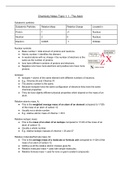
Chemistry Notes Topic 1.1 - The Atom
Subatomic particles:
Subatomic Particles Relative Mass Relative Charge Located in
Proton 1 +1 Nucleus
Neutron 2 0 Nucleus
Electron 0.0005 -1 Orbitals
Nuclear symbols:
● Mass number = total amount of protons and neutrons.
● Atomic number = identifies the element.
● In neutral atoms with no charge = the number of electrons is the
same as the number of protons.
● Ions have different numbers of protons and electrons.
● Negative ions have more electrons and positive ions have more
protons.
Isotopes:
● Isotopes = atoms of the same element with different numbers of neutrons.
● E.g. Chlorine-35 and Chlorine-37.
● The atomic number is the same.
● Because isotopes have the same configuration of electrons they have the same
chemical properties.
● They do have slightly different physical properties which depend on the mass of an
atom.
Relative atomic mass, Ar:
● This is the weighted average mass of an atom of an element compared to 1/12th
of the mass of an atom of carbon-12.
● Usually not a whole number.
● E.g. relative atomic mass of chlorine = 35.5
Relative isotopic mass:
● This is the mass of an atom of an isotope compared to 1/12th of the mass of an
atom of carbon-12.
● Usually a whole number.
● E.g. relative isotopic masses of chlorine = 35 and 37
Relative molecular/formula mass, Mr:
● This is the average mass of a molecule or formula unit compared to 1/12th of the
mass of an atom of carbon-12.
● Adding up all the relative atomic masses gives Mr.
● Relative molecular mass = used with simple molecules.
● Relative formula mass = used for ionic or giant covalent compounds
Subatomic particles:
Subatomic Particles Relative Mass Relative Charge Located in
Proton 1 +1 Nucleus
Neutron 2 0 Nucleus
Electron 0.0005 -1 Orbitals
Nuclear symbols:
● Mass number = total amount of protons and neutrons.
● Atomic number = identifies the element.
● In neutral atoms with no charge = the number of electrons is the
same as the number of protons.
● Ions have different numbers of protons and electrons.
● Negative ions have more electrons and positive ions have more
protons.
Isotopes:
● Isotopes = atoms of the same element with different numbers of neutrons.
● E.g. Chlorine-35 and Chlorine-37.
● The atomic number is the same.
● Because isotopes have the same configuration of electrons they have the same
chemical properties.
● They do have slightly different physical properties which depend on the mass of an
atom.
Relative atomic mass, Ar:
● This is the weighted average mass of an atom of an element compared to 1/12th
of the mass of an atom of carbon-12.
● Usually not a whole number.
● E.g. relative atomic mass of chlorine = 35.5
Relative isotopic mass:
● This is the mass of an atom of an isotope compared to 1/12th of the mass of an
atom of carbon-12.
● Usually a whole number.
● E.g. relative isotopic masses of chlorine = 35 and 37
Relative molecular/formula mass, Mr:
● This is the average mass of a molecule or formula unit compared to 1/12th of the
mass of an atom of carbon-12.
● Adding up all the relative atomic masses gives Mr.
● Relative molecular mass = used with simple molecules.
● Relative formula mass = used for ionic or giant covalent compounds


