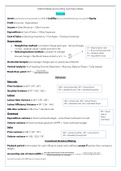
Intermediate Accounting Summary Notes
Formula
Assets (cash/bank/inventory/trade rec./PPE) = Liability (loan/overdraft/trade pay./accruals) + Equity
Profit = Income – Expenditure
Income = Sales Revenue + Other Income
Expenditure = Cost of Sales + Other Expenses
Cost of Sales = Opening Inventories + Purchases – Closing Inventories
Depreciation:
• Straight line method: a constant charge each year – Annual charge
= (cost – residual value) / useful economic life d = depreciation rate
n = # accounting periods
• Reducing balance method: (constant % change)
R = residual value
𝑛 𝑅
Annual change = Net Book Value at start x ( 𝑑 = 1 − √𝐴 ) A = acquisition cost
Horizontal Analysis: percentage change year on year [(new-old)/old]
Vertical Analysis: % of heading (Income Statement = Revenue, Balance Sheet = Total Assets)
𝑓𝑖𝑥𝑒𝑑 𝑐𝑜𝑠𝑡𝑠
Break-Even point: BEP = 𝑐𝑜𝑛𝑡𝑟𝑖𝑏𝑢𝑡𝑖𝑜𝑛/𝑢𝑛𝑖𝑡
Variances
Materials
Price Variance = AQ * ( SP – AP ) AQ = actual quantity, AP = actual price,
SP = standard price, SQ = standard quantity
Quantity Variance = SP * ( SQ – AQ )
Labour
Labour Rate Variance = AH * ( SR – AR ) AR = actual rate, AH = actual hours,
SR = standard rate, SH = standard hours
Labour Efficiency Variance = SR * ( SH – AH )
Idle time variance = Idle time * standard rate
FR = fixed
Overhead rate or
fixed
Expenditure variance = fixed overhead budget – actual fixed overhead incurred
overhead
Volume variance = fixed overhead applied ( AH*FR ) – fixed overhead budget
Sales
Price variance = AQ * ( AP – SP ) AQ = actual quantity , AP = actual price ,
SP = standard price/profit
Volume variance = ( AQ – SQ ) * SP
Investment Decision Making
Payback period = time taken for cash inflows to equal cash outflows (accept if quicker than company’s
target)
average annual profit from investment
Accounting rate of return (ARR) = initial investment (or average)
[average =
initial overlay+scrap value
2
]
(accept all projects with ARR above company target)
Formula
Assets (cash/bank/inventory/trade rec./PPE) = Liability (loan/overdraft/trade pay./accruals) + Equity
Profit = Income – Expenditure
Income = Sales Revenue + Other Income
Expenditure = Cost of Sales + Other Expenses
Cost of Sales = Opening Inventories + Purchases – Closing Inventories
Depreciation:
• Straight line method: a constant charge each year – Annual charge
= (cost – residual value) / useful economic life d = depreciation rate
n = # accounting periods
• Reducing balance method: (constant % change)
R = residual value
𝑛 𝑅
Annual change = Net Book Value at start x ( 𝑑 = 1 − √𝐴 ) A = acquisition cost
Horizontal Analysis: percentage change year on year [(new-old)/old]
Vertical Analysis: % of heading (Income Statement = Revenue, Balance Sheet = Total Assets)
𝑓𝑖𝑥𝑒𝑑 𝑐𝑜𝑠𝑡𝑠
Break-Even point: BEP = 𝑐𝑜𝑛𝑡𝑟𝑖𝑏𝑢𝑡𝑖𝑜𝑛/𝑢𝑛𝑖𝑡
Variances
Materials
Price Variance = AQ * ( SP – AP ) AQ = actual quantity, AP = actual price,
SP = standard price, SQ = standard quantity
Quantity Variance = SP * ( SQ – AQ )
Labour
Labour Rate Variance = AH * ( SR – AR ) AR = actual rate, AH = actual hours,
SR = standard rate, SH = standard hours
Labour Efficiency Variance = SR * ( SH – AH )
Idle time variance = Idle time * standard rate
FR = fixed
Overhead rate or
fixed
Expenditure variance = fixed overhead budget – actual fixed overhead incurred
overhead
Volume variance = fixed overhead applied ( AH*FR ) – fixed overhead budget
Sales
Price variance = AQ * ( AP – SP ) AQ = actual quantity , AP = actual price ,
SP = standard price/profit
Volume variance = ( AQ – SQ ) * SP
Investment Decision Making
Payback period = time taken for cash inflows to equal cash outflows (accept if quicker than company’s
target)
average annual profit from investment
Accounting rate of return (ARR) = initial investment (or average)
[average =
initial overlay+scrap value
2
]
(accept all projects with ARR above company target)