14A Functional group chemistry for designer molecules.
Section 1:
Functional groups are mostly known as reactive groups within hydrocarbon chains bonded through
covalent bonds. These can be one or more in the hydrocarbon chain so it determines what reactions
can occur with that chain. Chain length of the hydrocarbon does not affect its reactivity. The
functional groups are often named after their suffix and general functional group. Functional groups
can be carbonyl and non-carbonyl.
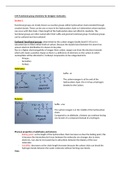
Carbonyl functional groups: determined by the carbon-oxygen double bond (C=O) so it is
saturated due to filled orbital shells of carbon. Because the double bond between the atoms has
uneven electron distribution it is known to be polar.
Due to a higher electronegativity of oxygen than carbon, oxygen can draw the electrons towards
which will create a positive charge so there is a deficiency of electrons on the carbon to which
nucleophiles will be attracted to. Carbonyl compounds can be categorised into:
- Primary
- Secondary
- Tertiary
Aldehydes:
Suffix: -al
The carbon=oxygen is at the end of the
hydrocarbon chain. The C=O has a Hydrogen
bonded to the Carbon.
Ketones:
Suffix: -one
The carbon=oxygen is in the middle of the hydrocarbon
chain.
Compared to an aldehyde, a ketone can continue having
one branch of a compound instead of a hydrogen.
Physical properties of aldehydes and ketones:
- Boiling point: as the length of the hydrocarbon chain increases so does the boiling point, this
is because the intermolecular forces between the molecules are stronger due to more
electrons. Can also be increased due to attractions between the dipoles of the near
molecules.
- Solubility: decreases as the chain length increases because the carbon chain can break the
hydrogen bonds between the water molecules without forming new bonds.
Uses:
Section 1:
Functional groups are mostly known as reactive groups within hydrocarbon chains bonded through
covalent bonds. These can be one or more in the hydrocarbon chain so it determines what reactions
can occur with that chain. Chain length of the hydrocarbon does not affect its reactivity. The
functional groups are often named after their suffix and general functional group. Functional groups
can be carbonyl and non-carbonyl.
Carbonyl functional groups: determined by the carbon-oxygen double bond (C=O) so it is
saturated due to filled orbital shells of carbon. Because the double bond between the atoms has
uneven electron distribution it is known to be polar.
Due to a higher electronegativity of oxygen than carbon, oxygen can draw the electrons towards
which will create a positive charge so there is a deficiency of electrons on the carbon to which
nucleophiles will be attracted to. Carbonyl compounds can be categorised into:
- Primary
- Secondary
- Tertiary
Aldehydes:
Suffix: -al
The carbon=oxygen is at the end of the
hydrocarbon chain. The C=O has a Hydrogen
bonded to the Carbon.
Ketones:
Suffix: -one
The carbon=oxygen is in the middle of the hydrocarbon
chain.
Compared to an aldehyde, a ketone can continue having
one branch of a compound instead of a hydrogen.
Physical properties of aldehydes and ketones:
- Boiling point: as the length of the hydrocarbon chain increases so does the boiling point, this
is because the intermolecular forces between the molecules are stronger due to more
electrons. Can also be increased due to attractions between the dipoles of the near
molecules.
- Solubility: decreases as the chain length increases because the carbon chain can break the
hydrogen bonds between the water molecules without forming new bonds.
Uses: