The correct answer for each question is indicated by a .
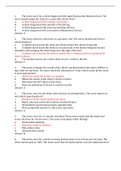
1 CORRECT
The remarkable oral tradition of sub-Saharan Africa was preserved primarily by
A
Muslim African scholars.
)
B)
professional singers and griots.
C
village chiefs and diviners.
)
D
women.
)
E)
None of these answers is correct.
2 CORRECT
The story of Sundiata was about
A
the heroic deeds of the lion prince in establishing the Mali empire.
)
B)
the misery of slaves captured and traded in the Mediterranean basin network.
C
the coming of Islam as a dominant faith in sub-Saharan societies.
)
D
the rise of the Swahili city-states.
)
E)
None of these answers is correct.
3
INCORRECT Trade and communications networks were slower to penetrate sub-Saharan
Africa compared to other regions because
A
Africans had little contact with each other.
)
B)
Africans did not have any goods that others wanted to trade for.
C
there was a language barrier.
)
D
there were formidable geographic barriers to overcome.
)
E)
All these answers are correct.
4 CORRECT
The earliest Bantu migrants were
A
aggressive warriors.
)
B)
hunting and gathering peoples.
, C
fishing peoples.
)
D
agriculturalists.
)
E)
horsemen.
5 CORRECT
All of the following stimulated African migrations EXCEPT
A
iron metallurgy.
)
B)
bubonic plague.
C
bananas.
)
D
population pressure.
)
E)
agriculture.
6 CORRECT
Before the tenth century, the dominant form of social organization in sub-
Saharan Africa was the
A
city-state.
)
B)
empire.
C
kin-based system.
)
D
kingdom.
)
E)
theocracy.
7
INCORRECT Which of the following statements describes a typical kin-based society?
A
Male heads of families presided over village affairs.
)
B)
The most prominent of the family heads acted as chief.
C
A group of villages constituted a district.
)
D
Ethnic loyalties were focused at the district level.
)
E)
All these answers are correct.
1 CORRECT
The remarkable oral tradition of sub-Saharan Africa was preserved primarily by
A
Muslim African scholars.
)
B)
professional singers and griots.
C
village chiefs and diviners.
)
D
women.
)
E)
None of these answers is correct.
2 CORRECT
The story of Sundiata was about
A
the heroic deeds of the lion prince in establishing the Mali empire.
)
B)
the misery of slaves captured and traded in the Mediterranean basin network.
C
the coming of Islam as a dominant faith in sub-Saharan societies.
)
D
the rise of the Swahili city-states.
)
E)
None of these answers is correct.
3
INCORRECT Trade and communications networks were slower to penetrate sub-Saharan
Africa compared to other regions because
A
Africans had little contact with each other.
)
B)
Africans did not have any goods that others wanted to trade for.
C
there was a language barrier.
)
D
there were formidable geographic barriers to overcome.
)
E)
All these answers are correct.
4 CORRECT
The earliest Bantu migrants were
A
aggressive warriors.
)
B)
hunting and gathering peoples.
, C
fishing peoples.
)
D
agriculturalists.
)
E)
horsemen.
5 CORRECT
All of the following stimulated African migrations EXCEPT
A
iron metallurgy.
)
B)
bubonic plague.
C
bananas.
)
D
population pressure.
)
E)
agriculture.
6 CORRECT
Before the tenth century, the dominant form of social organization in sub-
Saharan Africa was the
A
city-state.
)
B)
empire.
C
kin-based system.
)
D
kingdom.
)
E)
theocracy.
7
INCORRECT Which of the following statements describes a typical kin-based society?
A
Male heads of families presided over village affairs.
)
B)
The most prominent of the family heads acted as chief.
C
A group of villages constituted a district.
)
D
Ethnic loyalties were focused at the district level.
)
E)
All these answers are correct.