PLP SGS 1 — Title Investigation
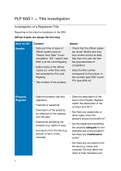
Investigation of a Registered Title
Reporting to the client is mandatory in the SRA
Official Copies are always the first step
Item on OC Content Issues
Header - Date and time of issue of - Check that the official copies
official copies (used as are recent (ideally less than
“Search from Date” in pre- two months old but at least
completion ‘OS1’ search (see less than one year old from
SGS 4) at the Land Registry) the proposed date of
completion)
- Edition Date of the official
copies (i.e. when they were - Does the title number
last amended by the Land correspond to that shown in
Registry) the contract (see SGS 3) and
TR1 (see SGS 4)?
- Title number of the property
Property - Date the property was first - Does the description of the
Register registered land in the Property Register
match the description in the
- Freehold or leasehold
contract and TR1?
- Description of the property
- Are there any easements or
by reference to the address
other rights which the
and title plan
property enjoys the benefit of?
- Easements benefiting the
- Are the easements benefiting
property (e.g. rights of way)
the property adequate for the
- Exclusions from the title (e.g. intended use of the property?
parcels of land, mines, Are there any maintenance
minerals) costs?
- Are there any exclusions from
the land e.g. mines and
minerals? Do they affect the
client or their intended use?
1
,Proprietorship - Class of title (e.g. title - Check that the class of title is
Register absolute) absolute (see s.9(2) LRA
2002).
- Registered proprietor/s
- Is the seller in the contract
- An indemnity covenant entry
also the registered proprietor?
(if relevant)
If not, who is?
- Restrictions (if relevant)
- Is the seller a company? If so,
check the company number
www.companieshouse.gov.uk
to check the current company
name and that it matches with
the seller in the contract.
- Is there an indemnity
covenant? What is its effect?
- Are there any Restrictions (we
only look at the mortgage
restriction and the tenancy in
common restriction on the
LPC)? What is their effect?
Charges - Easements burdening the - Are there any easements or
covenants burdening the property
Register property
which will affect the buyer’s
- Restrictive covenants intended use of the property?
- Positive covenants - Are there any restrictive covenants
which have been breached by the
- Mortgages seller? Will any restrictive covenants
affect the buyer’s plans?
- Registered Leases
- Are there any positive covenants
which the buyer is going to be
bound by? (Check for an indemnity
covenant entry in the Proprietorship
Register.) Have any binding positive
covenants been breached by the
seller? Will any binding positive
covenants affect the buyer’s plans?
- Are there any mortgages? How will
these be discharged?
- Are there any leases? Is the buyer
buying subject to these leases?
2
,Title Plan Map of the Land — Check that - Does the land being sold in
it includes everything the client the contract match the title
thinks they’re buying and send plan?
it to them so they’re sure too
- Check any colouring, hatching
or coding on the plan which
may indicate boundary
responsibility, easements or
land which has previously
been removed from the title
Other - Are there any documents
referred to on the register but
not extracted in the register
which you need to inspect?
Are official copies of these
documents available?
Can’t just rely on the register, because there are overriding
interests too, so must make enquiries on the seller and inspect
the property.
CPSEs — General Enquiries on the Seller
CON 29 — Enquiries on Local Authority
• Roads and public rights of way
• Clarifies whether roadways, footpaths and footways are public highways (roads
maintainable by a local authority at public expense)
• If the road that gives access to the property is not listed as a public highway
then it will be a private one and need to make sure that there is a right of way
• Also clarifies whether any private road is due to be adopted by a local authority
and who will be responsible for financing this and the making u (the client
should be informed that costs of such works can be very expensive and
may be borne by frontagers)
• May also need to carry out a highways search
SIM & SIMR
• A search of the property and neighbouring properties
3
, • Done in order to determine which land is registered and unregistered to check
burdens and benefits
• If the burdened land is unregistered, check to see if a caution against
registration had been entered against it and if not all their solicitor to register a
caution against first registration
Identify Issues of Key Concern to the Buyer & Why it is a Concern
Applying the above to facts and past & future/intended use
- Spot the issue
- Why is it an issue (apply to facts)
- Resolve the issue — solutions and advice
- Check that seller’s name and registered proprietor’s name is the same. If not, will
need evidence of change of name, etc. Check this through the registered number
of the company
- Mortgage
• It will be an issue because it will have to be paid off by the seller and removed
from the charges register or the buyer will buy subject to the mortgage
• See SGS 4
• If they sell the whole of the property, the mortgagee restriction of the
Proprietorship Register will be automatically removed by the land registry when
they receive the DS1 so their consent won’t be needed to sell the property.
• If they sell part of it, though, then their consent will be needed
Refer to the person who owns the covenants as PWB
- Positive Covenants
• The burden of the positive covenant doesn’t run with the land. If there is no
indemnity covenant in the proprietorship register then it won’t matter. If there is,
the current seller will expect the buyer to give a similar indemnity covenant
4
Investigation of a Registered Title
Reporting to the client is mandatory in the SRA
Official Copies are always the first step
Item on OC Content Issues
Header - Date and time of issue of - Check that the official copies
official copies (used as are recent (ideally less than
“Search from Date” in pre- two months old but at least
completion ‘OS1’ search (see less than one year old from
SGS 4) at the Land Registry) the proposed date of
completion)
- Edition Date of the official
copies (i.e. when they were - Does the title number
last amended by the Land correspond to that shown in
Registry) the contract (see SGS 3) and
TR1 (see SGS 4)?
- Title number of the property
Property - Date the property was first - Does the description of the
Register registered land in the Property Register
match the description in the
- Freehold or leasehold
contract and TR1?
- Description of the property
- Are there any easements or
by reference to the address
other rights which the
and title plan
property enjoys the benefit of?
- Easements benefiting the
- Are the easements benefiting
property (e.g. rights of way)
the property adequate for the
- Exclusions from the title (e.g. intended use of the property?
parcels of land, mines, Are there any maintenance
minerals) costs?
- Are there any exclusions from
the land e.g. mines and
minerals? Do they affect the
client or their intended use?
1
,Proprietorship - Class of title (e.g. title - Check that the class of title is
Register absolute) absolute (see s.9(2) LRA
2002).
- Registered proprietor/s
- Is the seller in the contract
- An indemnity covenant entry
also the registered proprietor?
(if relevant)
If not, who is?
- Restrictions (if relevant)
- Is the seller a company? If so,
check the company number
www.companieshouse.gov.uk
to check the current company
name and that it matches with
the seller in the contract.
- Is there an indemnity
covenant? What is its effect?
- Are there any Restrictions (we
only look at the mortgage
restriction and the tenancy in
common restriction on the
LPC)? What is their effect?
Charges - Easements burdening the - Are there any easements or
covenants burdening the property
Register property
which will affect the buyer’s
- Restrictive covenants intended use of the property?
- Positive covenants - Are there any restrictive covenants
which have been breached by the
- Mortgages seller? Will any restrictive covenants
affect the buyer’s plans?
- Registered Leases
- Are there any positive covenants
which the buyer is going to be
bound by? (Check for an indemnity
covenant entry in the Proprietorship
Register.) Have any binding positive
covenants been breached by the
seller? Will any binding positive
covenants affect the buyer’s plans?
- Are there any mortgages? How will
these be discharged?
- Are there any leases? Is the buyer
buying subject to these leases?
2
,Title Plan Map of the Land — Check that - Does the land being sold in
it includes everything the client the contract match the title
thinks they’re buying and send plan?
it to them so they’re sure too
- Check any colouring, hatching
or coding on the plan which
may indicate boundary
responsibility, easements or
land which has previously
been removed from the title
Other - Are there any documents
referred to on the register but
not extracted in the register
which you need to inspect?
Are official copies of these
documents available?
Can’t just rely on the register, because there are overriding
interests too, so must make enquiries on the seller and inspect
the property.
CPSEs — General Enquiries on the Seller
CON 29 — Enquiries on Local Authority
• Roads and public rights of way
• Clarifies whether roadways, footpaths and footways are public highways (roads
maintainable by a local authority at public expense)
• If the road that gives access to the property is not listed as a public highway
then it will be a private one and need to make sure that there is a right of way
• Also clarifies whether any private road is due to be adopted by a local authority
and who will be responsible for financing this and the making u (the client
should be informed that costs of such works can be very expensive and
may be borne by frontagers)
• May also need to carry out a highways search
SIM & SIMR
• A search of the property and neighbouring properties
3
, • Done in order to determine which land is registered and unregistered to check
burdens and benefits
• If the burdened land is unregistered, check to see if a caution against
registration had been entered against it and if not all their solicitor to register a
caution against first registration
Identify Issues of Key Concern to the Buyer & Why it is a Concern
Applying the above to facts and past & future/intended use
- Spot the issue
- Why is it an issue (apply to facts)
- Resolve the issue — solutions and advice
- Check that seller’s name and registered proprietor’s name is the same. If not, will
need evidence of change of name, etc. Check this through the registered number
of the company
- Mortgage
• It will be an issue because it will have to be paid off by the seller and removed
from the charges register or the buyer will buy subject to the mortgage
• See SGS 4
• If they sell the whole of the property, the mortgagee restriction of the
Proprietorship Register will be automatically removed by the land registry when
they receive the DS1 so their consent won’t be needed to sell the property.
• If they sell part of it, though, then their consent will be needed
Refer to the person who owns the covenants as PWB
- Positive Covenants
• The burden of the positive covenant doesn’t run with the land. If there is no
indemnity covenant in the proprietorship register then it won’t matter. If there is,
the current seller will expect the buyer to give a similar indemnity covenant
4