KQ5 Revision Notes
The Korean War
What was the significance of the Korean War?
First Hotspot of the Cold War.
First real test for the new United Nations. Determined to show itself stronger than the
League
First time that the Cold War had spread outside of Europe. Previous conflicts in Eastern
Europe and Berlin
What was the 38th Parallel in relation to the Korean War?
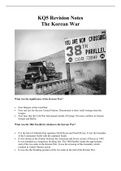
It is the line (of latitude) that separates North Korea and South Korea. It was the boundary
of the Communist North with the capitalist South.
It was chosen as the frontier between the American and Soviet sectors of Korea in 1945.
It was intended as a temporary dividing line. The 38th Parallel marks the approximate
start of the two sides in the Korean War. It was the crossing of this boundary which
resulted in United Nations action.
It was also the finishing position of the two sides at the end of the Korean War.
, Why did North Korea invade South Korea in June 1950?
South: Democratic. Syngman Rhee. Seoul.
North: Communist. Kim Il Sung. Pyongyang
1949: USA / USSR pull out troops; creates instability.
1949: China falls to communists under Mao Zedong.
Kim Il-Sung wanted to unite Korea under Communist rule. He thought this was possible
because he had the support of fellow Communist leaders, Stalin and Mao Zedong, and
Kim thought it was unlikely that the USA would respond.
North Korea thought it was the legitimate government of Korea.
North Korea’s armed forces were stronger than South Korea’s forces.
1950: Syngman Rhee threatens North Korea. North invades South.
Why did the UN become involved in the Korean War?
The UN had been involved in the establishment of the new anti-Communist government
of South Korea.
Both the Communist North Korea and the anti-Communist South Korea governments
claimed to be the legitimate government of the whole of Korea.
Kim Il Sung wanted to unite Korea under Communist rule. If the UN had failed to oppose
the action of North Korea, the Americans would have.
US President Truman put enormous pressure on the UN Security Council to condemn the
North Korean actions and call for a withdrawal.
When the resolution was passed, the USSR was not represented at the meeting to use its
veto. The UN committed itself to using members’ armies.
What was the response of the United Nations Organisation to events in Korea in June
1950?
A meeting of the Security Council was organised immediately. The UN Security Council
decided that the North Koreans had broken world peace. They passed a resolution calling
on North Korea to withdraw their armed forces.
The UN called on North Korea to withdraw to the 38th Parallel.’
A second resolution in June asked UN members to help South Korea. The US was asked
to take command of the UN operation. The UN organised troops from the US and 15
other countries.
Why did the USA oppose the North Korean invasion of South Korea?
The US believed that a successful conquest of South Korea would encourage a Chinese
attack on Formosa. If South Korea and Formosa both fell to the Communists then Japan
could be threatened. If this happened, the US believed it would represent a major shift in
the power balance between the Communist and Capitalist world.
President Truman was interested in the Far East. Europe was not the only place where
Communists were coming to power. In the Far East, too, they were getting powerful –
China turned Communist in 1949. Truman believed that, if one country fell to
The Korean War
What was the significance of the Korean War?
First Hotspot of the Cold War.
First real test for the new United Nations. Determined to show itself stronger than the
League
First time that the Cold War had spread outside of Europe. Previous conflicts in Eastern
Europe and Berlin
What was the 38th Parallel in relation to the Korean War?
It is the line (of latitude) that separates North Korea and South Korea. It was the boundary
of the Communist North with the capitalist South.
It was chosen as the frontier between the American and Soviet sectors of Korea in 1945.
It was intended as a temporary dividing line. The 38th Parallel marks the approximate
start of the two sides in the Korean War. It was the crossing of this boundary which
resulted in United Nations action.
It was also the finishing position of the two sides at the end of the Korean War.
, Why did North Korea invade South Korea in June 1950?
South: Democratic. Syngman Rhee. Seoul.
North: Communist. Kim Il Sung. Pyongyang
1949: USA / USSR pull out troops; creates instability.
1949: China falls to communists under Mao Zedong.
Kim Il-Sung wanted to unite Korea under Communist rule. He thought this was possible
because he had the support of fellow Communist leaders, Stalin and Mao Zedong, and
Kim thought it was unlikely that the USA would respond.
North Korea thought it was the legitimate government of Korea.
North Korea’s armed forces were stronger than South Korea’s forces.
1950: Syngman Rhee threatens North Korea. North invades South.
Why did the UN become involved in the Korean War?
The UN had been involved in the establishment of the new anti-Communist government
of South Korea.
Both the Communist North Korea and the anti-Communist South Korea governments
claimed to be the legitimate government of the whole of Korea.
Kim Il Sung wanted to unite Korea under Communist rule. If the UN had failed to oppose
the action of North Korea, the Americans would have.
US President Truman put enormous pressure on the UN Security Council to condemn the
North Korean actions and call for a withdrawal.
When the resolution was passed, the USSR was not represented at the meeting to use its
veto. The UN committed itself to using members’ armies.
What was the response of the United Nations Organisation to events in Korea in June
1950?
A meeting of the Security Council was organised immediately. The UN Security Council
decided that the North Koreans had broken world peace. They passed a resolution calling
on North Korea to withdraw their armed forces.
The UN called on North Korea to withdraw to the 38th Parallel.’
A second resolution in June asked UN members to help South Korea. The US was asked
to take command of the UN operation. The UN organised troops from the US and 15
other countries.
Why did the USA oppose the North Korean invasion of South Korea?
The US believed that a successful conquest of South Korea would encourage a Chinese
attack on Formosa. If South Korea and Formosa both fell to the Communists then Japan
could be threatened. If this happened, the US believed it would represent a major shift in
the power balance between the Communist and Capitalist world.
President Truman was interested in the Far East. Europe was not the only place where
Communists were coming to power. In the Far East, too, they were getting powerful –
China turned Communist in 1949. Truman believed that, if one country fell to