

BLP WS1 Alice Hick
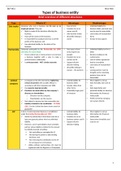
Types of business entity
Brief overview of different structures
Type What is it? Advantages Disadvantages
Sole trader Someone who runs a business on his own as an Easy to form Unlimited liability for
employed person. They are: Freedom to run as business debts: personal ones
Right to make all the decisions affecting the owner sees fit may be used to repay debts
business; Sole decision-maker Lacks status of incorporated
Owns all the assets of the business; All profits belong to forms
Is responsible for paying income tax on all the owner No day-to-day support
profits of the business; and
Has unlimited liability for the debts of the
business.
Partnership Governed principally by the Partnership Act 1890: Very easy to form Unlimited liability for firm’s
see below for more detail. (only require two debts
Occurs where two or more persons run and own people) Decision making can be
a business together with a view to make a Freedom to run as cumbersome
profit=business relationship. owners see fit Lack of written agreement
Is unincorporated – NOT a body corporate Support of joint lead to uncertainty
decision making Lack status of incorporated
All profits belong to forms
owners – the partners Leaving partner must be
brought out by remaining
partners (may not be
favourable)
Limited A company in the UK is formed by registering Limited liability for Must register to set up
company certain documents with a public official, in business debts Extra formality and costs to
accordance with the Companies Act 2006. Greater status than run
Has separate legal personality other forms Extra legal duties and
Decisions are made either by the company’s Potentially larger pool potential liability for directors
directors or shareholders. of investors Information (inc finances)
o Directors run the company. made public
o Shareholders are the owners. Profits earned by company,
Not subject to income tax, but corporation tax not owners directly
Liability is limited to its constitution – CA 2006,
s3(1). Can be: Limited by shares (more usual) or
guarantee
LLP A form of unincorporated business is established Limited liability for Must register to set up
under the Limited Partnerships Act 1907. business debts Information (inc finances)
Similar to partnership in that there must be at Freedom to run as made public
least one general partner who has unlimited business owners see fit Some extra formalities and
liability. Support of joint costs to run
However, an LP is permitted to have a limited decision-making
partner whose liability is limited to the amount
he initially invested, providing:
Not controlling or managing the LP
Not having the power to take binding
decisions; and
Not removing his contribution to the LP
for as long as he is in business.
Unlike ordinary partnerships, LPs must be
registered with the Registrar of Companies.
1
Types of business entity
Brief overview of different structures
Type What is it? Advantages Disadvantages
Sole trader Someone who runs a business on his own as an Easy to form Unlimited liability for
employed person. They are: Freedom to run as business debts: personal ones
Right to make all the decisions affecting the owner sees fit may be used to repay debts
business; Sole decision-maker Lacks status of incorporated
Owns all the assets of the business; All profits belong to forms
Is responsible for paying income tax on all the owner No day-to-day support
profits of the business; and
Has unlimited liability for the debts of the
business.
Partnership Governed principally by the Partnership Act 1890: Very easy to form Unlimited liability for firm’s
see below for more detail. (only require two debts
Occurs where two or more persons run and own people) Decision making can be
a business together with a view to make a Freedom to run as cumbersome
profit=business relationship. owners see fit Lack of written agreement
Is unincorporated – NOT a body corporate Support of joint lead to uncertainty
decision making Lack status of incorporated
All profits belong to forms
owners – the partners Leaving partner must be
brought out by remaining
partners (may not be
favourable)
Limited A company in the UK is formed by registering Limited liability for Must register to set up
company certain documents with a public official, in business debts Extra formality and costs to
accordance with the Companies Act 2006. Greater status than run
Has separate legal personality other forms Extra legal duties and
Decisions are made either by the company’s Potentially larger pool potential liability for directors
directors or shareholders. of investors Information (inc finances)
o Directors run the company. made public
o Shareholders are the owners. Profits earned by company,
Not subject to income tax, but corporation tax not owners directly
Liability is limited to its constitution – CA 2006,
s3(1). Can be: Limited by shares (more usual) or
guarantee
LLP A form of unincorporated business is established Limited liability for Must register to set up
under the Limited Partnerships Act 1907. business debts Information (inc finances)
Similar to partnership in that there must be at Freedom to run as made public
least one general partner who has unlimited business owners see fit Some extra formalities and
liability. Support of joint costs to run
However, an LP is permitted to have a limited decision-making
partner whose liability is limited to the amount
he initially invested, providing:
Not controlling or managing the LP
Not having the power to take binding
decisions; and
Not removing his contribution to the LP
for as long as he is in business.
Unlike ordinary partnerships, LPs must be
registered with the Registrar of Companies.
1


