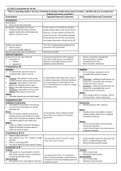
IC3 OSCE Cranial Nerves VII-XII
“This is a neurology station. You have 5 minutes to examine cranial nerves seven to twelve. I will then ask you to present your
findings and answer a question.”
Examination Expected/Normal Comments Potential/Abnormal Comments
Introduction
Hand hygiene
• Cleans hands with alcohol gel
Introduction, explanation and consent ‘Hi my name is X. I’m a third year medical
• Introduces self with name and level, student at RCSI. What’s your name? Nice to
explains what he/she will be doing and meet you. I’ve been asked to examine the
obtains consent for same
nerves in your face. This involves assessing
the movements of your face, your hearing
and tongue movements. Would that be ok?’
Position and exposure ‘Mr/Mrs A is appropriately positioned and
• Patient seated exposed for this examination.’
• Arms and shoulders exposed
Enquires about pain prior to examining ‘Are you in any pain?’
General Inspection
Performed from the end of the bed ‘On general inspection Mr/Mrs A appears • Glasses, enucleation, hearing aids
Comments on well, with normal posture, no peripheral • Facial asymmetry, wasting
o Patient stigmata of neurological disease and no • Craniotomy/facial scars
o Equipment equipment around the bed.’ • Ptosis, Proptosis, Anisocoria
Cranial Nerve VII
Inspection Inspection
• For facial droop, asymmetry, loss of R/L facial droop, asymmetry, loss of
nasolabial fold, vesicles on pinna nasolabial fold, vesicles on pinna
Motor Motor
Temporal- Asks patient to look up and ‘On examination of the facial nerve, there is
no obvious asymmetry of the face and there UMN lesion – Ipsilateral mouth droop, eye
wrinkle forehead, while pushing forehead droop, loss of nasolabial fold, sparing of
Zygomatic -Asks patient to close eyes is no normal power in all branches of the
nerve. The patient does not reports a change forehead and brow muscles
tightly then attempts to force open LMN lesion - Ipsilateral mouth droop, eye
Buccal- Asks patient to blow out cheeks in hearing or taste’
droop, loss of nasolabial fold, loss of
Mandibular- Asks patient to show teeth forehead & brow movements
Cervical- Asks patient to tense neck Sensory
Sensory
Taste change anterior 2/3 tongue, vesicles
Ask about hyperacusis and taste change
of Ramsay-Hunt - pinna, hyperacusis
Cranial Nerve VIII
Establishes if hearing issue Hearing Issue
Asks patient if any problem with hearing • Hearing reduced in left / right ear
Covers one ear and whispers a number
into other ear. Rinne’s
Rinne’s Vibration note is not audible at external
Base of 512Hz (or 256Hz) tuning fork at ‘On examination of the vestibulocochlear
auditory meatus, Rinne’s test is negative
mastoid process until vibration no longer nerve, there is no evidence of a hearing
(conduction deafness)
heard, then fork placed at auditory meatus impairment.’
and patient asked if sound still heard
Weber’s
Weber’s
Sound is heard louder in the normal ear-
512Hz (or 256Hz) Tuning fork vibrating in
sensorineural deafness
middle of forehead and asks patient in
Sound is heard louder in the abnormal ear-
which ear sound is louder
conduction deafness
Cranial Nerve IX & X
Inspects palate and uvula
Asks patient to say “ah”, checks for uvular ‘On inspection of the 9th and 10th cranial Uvular deviation away from abnormal side
deviation nerve, the uvula is central.’ Absent / exaggerated gag reflex
Offers to assess gag reflex Abnormal taste posterior tongue
Asks about abnormal taste posterior tongue
Cranial Nerve XI
Trapezius Trapezius
Asks patient to shrug shoulders, feels the Loss of muscle bulk
bulk of the trapezius muscles and attempt Weakness/reduced power
‘On assessment of the 11th cranial nerve,
to push the shoulders down. Sternomastoids
there is normal symmetry, muscle bulk and
Sternomastoids Loss of muscle bulk
movements of the sternocleidomastoid and
Asks patient to turn head against resistance, Weakness/reduced power
trapezius muscles.’
“This is a neurology station. You have 5 minutes to examine cranial nerves seven to twelve. I will then ask you to present your
findings and answer a question.”
Examination Expected/Normal Comments Potential/Abnormal Comments
Introduction
Hand hygiene
• Cleans hands with alcohol gel
Introduction, explanation and consent ‘Hi my name is X. I’m a third year medical
• Introduces self with name and level, student at RCSI. What’s your name? Nice to
explains what he/she will be doing and meet you. I’ve been asked to examine the
obtains consent for same
nerves in your face. This involves assessing
the movements of your face, your hearing
and tongue movements. Would that be ok?’
Position and exposure ‘Mr/Mrs A is appropriately positioned and
• Patient seated exposed for this examination.’
• Arms and shoulders exposed
Enquires about pain prior to examining ‘Are you in any pain?’
General Inspection
Performed from the end of the bed ‘On general inspection Mr/Mrs A appears • Glasses, enucleation, hearing aids
Comments on well, with normal posture, no peripheral • Facial asymmetry, wasting
o Patient stigmata of neurological disease and no • Craniotomy/facial scars
o Equipment equipment around the bed.’ • Ptosis, Proptosis, Anisocoria
Cranial Nerve VII
Inspection Inspection
• For facial droop, asymmetry, loss of R/L facial droop, asymmetry, loss of
nasolabial fold, vesicles on pinna nasolabial fold, vesicles on pinna
Motor Motor
Temporal- Asks patient to look up and ‘On examination of the facial nerve, there is
no obvious asymmetry of the face and there UMN lesion – Ipsilateral mouth droop, eye
wrinkle forehead, while pushing forehead droop, loss of nasolabial fold, sparing of
Zygomatic -Asks patient to close eyes is no normal power in all branches of the
nerve. The patient does not reports a change forehead and brow muscles
tightly then attempts to force open LMN lesion - Ipsilateral mouth droop, eye
Buccal- Asks patient to blow out cheeks in hearing or taste’
droop, loss of nasolabial fold, loss of
Mandibular- Asks patient to show teeth forehead & brow movements
Cervical- Asks patient to tense neck Sensory
Sensory
Taste change anterior 2/3 tongue, vesicles
Ask about hyperacusis and taste change
of Ramsay-Hunt - pinna, hyperacusis
Cranial Nerve VIII
Establishes if hearing issue Hearing Issue
Asks patient if any problem with hearing • Hearing reduced in left / right ear
Covers one ear and whispers a number
into other ear. Rinne’s
Rinne’s Vibration note is not audible at external
Base of 512Hz (or 256Hz) tuning fork at ‘On examination of the vestibulocochlear
auditory meatus, Rinne’s test is negative
mastoid process until vibration no longer nerve, there is no evidence of a hearing
(conduction deafness)
heard, then fork placed at auditory meatus impairment.’
and patient asked if sound still heard
Weber’s
Weber’s
Sound is heard louder in the normal ear-
512Hz (or 256Hz) Tuning fork vibrating in
sensorineural deafness
middle of forehead and asks patient in
Sound is heard louder in the abnormal ear-
which ear sound is louder
conduction deafness
Cranial Nerve IX & X
Inspects palate and uvula
Asks patient to say “ah”, checks for uvular ‘On inspection of the 9th and 10th cranial Uvular deviation away from abnormal side
deviation nerve, the uvula is central.’ Absent / exaggerated gag reflex
Offers to assess gag reflex Abnormal taste posterior tongue
Asks about abnormal taste posterior tongue
Cranial Nerve XI
Trapezius Trapezius
Asks patient to shrug shoulders, feels the Loss of muscle bulk
bulk of the trapezius muscles and attempt Weakness/reduced power
‘On assessment of the 11th cranial nerve,
to push the shoulders down. Sternomastoids
there is normal symmetry, muscle bulk and
Sternomastoids Loss of muscle bulk
movements of the sternocleidomastoid and
Asks patient to turn head against resistance, Weakness/reduced power
trapezius muscles.’