ASE A4 Steering and Suspension Exam(Questions And Answers)
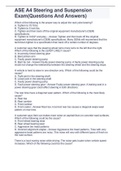
Which of the following is the proper way to adjust the rack yoke bearing? A. Tighten to 75 ft lbs. B. Tighten to 5 inch lbs. C. Tighten and then back off the original equipment manufacturer's (OEM) specifications. D. Tighten to 0.002" end-play. Tighten and then back off the originial equipment manufacturer's (OEM) specifications. Many OEMs will recommend that the technician tighten to a specification then back off a certain number of degrees. A customer says that the steering wheel turns more turns to the left than the right. Which of the following is the LEAST LIKELY cause? A. Incorrectly timed steering gear B. Bent pitman arm C. Faulty power steering pump D. Bent tie rod Faulty power steering pump. A faulty power steering pump would not change the relationship between the steering wheel and the steering stops. A vehicle is hard to steer in one direction only. Which of the following could be the cause? A. Tight joint in the steering shaft B. Loose joint in the steering shaft C. Faulty power steering pump D. Fault power steering gear Faulty power steering gear. A leaking seal in a power steering gear could affect steering in both directions. The rear tires have a diagonal wear pattern. Which of the following is the most likely cause? A. Rear toe B. Rear camber C. Front camber D. Front caster Rear toe. Incorrect rear toe causes a diagonal swipe wear pattern on rear tires. A customer says their car makes more noise on asphalt than on concrete road surfaces. Which of the following could be the cause? A. Front wheel bearing wear B. Rear wheel bearing wear C. Aggrresive tire tread patterns D. Incorrect alignment angles Aggressive tire tread patterns. Tires with very aggressive tread patterns are noisy. This noise will vary with different types of finish on the road surface. There is a loud roaring noise while driving. The noise gets louder when vehicle speed increases. Which of the following could be the cause? A. Worn power steering pump B. Worn wheel bearing C. Worn ball joint D. Worn power steering gear Worn wheel bearing. This is a typical wheel bearing diagnosis. A setback condition is found during an alignment. Which of the following could be the cause? A. Worn spring shackle B. Worn spring eye bushing C. Worn tie rod end D. Worn pitman arm Worn spring eye bushing. A worn spring eye bushing could allow the rear axle to shift and setback to occur. There is a whining noise heard only when turning. Which of the following could be the cause? A. Leaking internal seals in the steering gear B. Worn ball joint C. Worn power steering gear D. Worn power steering pump Worn power steering pump. A worn power steering pump can cause noise while turning. The front leaf springs have been replaced on a vehicle. Which of the following operations must also be performed. A. Vehicle alignment B. Tire rotation C. Tire balance D. Rear spring replacement Vehicle alignment. After the springs are replaced, the vehicle alignment will be changed. Therefore, the vehicle must be aligned. A vehicle has worn jounce bumpers. Which of the following could be the cause? A. Leaking shocks B. Leaking power steering pump C. Leaking power steering gear D. Worn strut bearings Leaking shocks. Leaking shocks can allow the vehicle to bottom out on rough road surfaces. A worn idler arm would affect which alignment angle? A. Camber B. Caster C. Toe D. SAI Toe. Toe is directly affected by the idler arm. A worn idler arm would allow toe to change while traveling down the road. A shifted front cradle could affect any of these EXCEPT: A. Front camber. B. Front caster. C. Thrust line. D. Thrust angle. Thrust line. The thrust line is the direction the rear wheels are pointing; this would not be affected by a shifted front cradle. There is a pull on acceleration and deceleration. Technician A says spring eye bushings could be the cause. Technician B says worn strut rod bushings could be the cause. Who is right? Both Technicians are correct. Spring eye bushings and worn strut rod bushings can both allow the control arm to move when the vehicle is driven. A composite leaf spring is being installed in a vehicle. Which of the following is correct? A. The spring can be installed using a pry bar. B. The spring can be compressed with vise grips. C. The spring should be painted after installation. D. The spring should not be scratched during installation. The spring should not be scratched during installation. The spring needs to be handled with care. If the spring is dented or scratched, it will be weakened and break. Which of the following alignment specification would most likely need a steering damper. A. 6 degrees caster. B. 2 degrees camber C. 2 degrees caster D. 6 degres camber 6 degrees caster. Vehicles with high caster settings are most likely to use a steering damper to help control front-wheel shimmy. A customer complains of a popping noise while turning the steering wheel. Which of the following is the most likely cause? A. Rear shock mounts B. Rear toe adjusters C. Front shock mounts D. Front tie rods Front tie rods. Worn front tie roads can make a popping noise when the steering wheel is rocked back and forth. A power steering pump hose is leaking on a vehicle. Which of the following is the most likely cause? A. Separated motor mounts B. Loose drive belt C. Air in the fluid D. Broken pump mounts Separated motor mounts. It is possible that separated motor mounts could cause the hoses to be stretched and leak. Which angle has the greatest affect on steering wheel return? A. Camber B. SAI C. Toe D. Caster Caster. Caster greatly affects steering wheel return. There is a vibration which can be felt in the steering wheel at speeds above 30 mph. Which of the following could be the cause? A. Front wheels out of balance B. Rear wheels out of balance C. Caster D. Camber Front wheels out of balance. A vibration felt in the steering wheel is most likely caused by the front wheels being out of balance. The hole in the steering knuckle into which the ball joint stud goes is out of round. Which of the following is the best method of repair. A. Measure the wear and check against manufacturer's specifications. B. Replace the steering knuckle C. Ream the hole. D. Shim the hole. Replace the steering knuckle. The steering knuckle must be replaced. The left front tire on a vehicle shows outside tread wear. Which of the following is the most likely cause? A. Worn shock absorbers B. Tires overinflated C. Camber adjustment incorrect D. Caster adjustment incorrect Camber adjustment incorrect. Excessive positive camber will cause cupping across the tire tread. Which of the following would cause toe-out-on-turns to be out of specification? A. Bent tie rods B. Bent steering arm C. Bent lower control arm D. Bent upper control arm Bent steering arm. A bent steering arm would change toe-out-on-turns. A vehicle is dog-trcking. Which alignment angle is most likely the cause? A. Rear toe B. Front toe C. Rear camber D. Front camber Rear toe. Rear toe sets the thrust line, which will affect dog-tracking. A vehicle is equipped with an air ride suspension. The vehicle will not lower when necessary. Which of the following could cause this problem? A. Compressor relay B. Compressor C. Sensor D. Fuse Sensor. The sensor is responsible for sending a signal that the rear is too high. Which of the following is the correct way to adjust tapered roller bearings? A. Torque and the back off OEM specification B. Torque to OEM specification C. Adjust to a minimum of .150 " (3.80mm) end-play. D. Torque to 50 ft lbs. Torque and then back off OEM specification. It is typical to torque the bearing while rotating the wheel and then back off the nut a certain amount. A vehicle has a crooked steering wheel when driving down the road. Technician A says this could be caused by failure to install the steering wheel correctly. Technician B says this could be caused by rear toe being out of adjustment. Who is correct? Both Technicians are correct. Rear toe being out of proper adjustment will cause a thrust angle to exist which will cause crooked steering wheel. Also, a steering wheel which was installed one spline off could cause a crooked steering wheel. When does a positive camber angle exist? A. When the top of the tire leans outward B. When the top of the tire leans inward C. When the upper ball joint is rearward of the lower ball joint as viewed from the side D. When the rear axle is crooked When the top of the tire leans outward. The top of the tire leans out with positive camber. Why is the camber angle important? A. Because it directly affects ride stiffness B. Because it is a tire wearing angle and it affects steering control C. Because it can cause vibration D. Because it affects the operation of the brakes Because it is a tire wearing angle and it affects steering control. Camber is a tire wear angle and can cause a pull in the steering. The caster angle on the left front wheel has been set at 1 degree negative. The right front caster angle has been set at 1 degree positive. What would be the most likely result? A. The car would pull to the right B. The car would pull to the left C. The car would travel straight ahead D. The left tire would show second rib wear The car would pull to the left. A car will usually pull to the most negative caster setting. Technician A says that camber and SAI make up the included angle. Technician B says that the purpose of the turning angle is to reduce tire scuffing during cornering. Who is right? Both A and B. Both Technicians are correct. Included angle is found by combining camber and SAI. The purpose of the turn angle is to allow the front tires to travel through a turn in different circles. Tire scuffing during cornering is controlled by toe-out-on-turns or turning angle. Technician A says that shims are sometimes used to adjust rear toe and camber. Technician B says that strut rods are sometimes used to adjust rear toe and camber. Who is right? Both A and B. Both Technicians are correct. Shims can be installed behind the bearing assembly to change the rear toe. Strut rods can also be used to change rear toe on some models. When the rear of the rear tires are closer together than at the front, the tires have: Toe-out. Toe-out has the front of the tires farther apart than the rear. The jounce bumpers on the rear of a vehicle are severely worn. Which of the following is the LEAST LIKELY cause? A. Worn rear springs B. Excessive care in the trunk C. Worn front springs D. Worn rear shocks Worn front springs are the least likely cause of worn rear jounce bumpers. A customer has a noise concern coming from the rear of the vehicle. Any of these could be the cause EXCEPT: A. Worn rear wheel bearings B. Rear tires out of balance C. Missing spring separators D. Worn spring eye bushings Rear tires out of balance would cause a vibration but not a noise. Which of the following is true concerning torsion bar front suspension. A. Torsion bars must always be replaced in pairs. B. Torsion bars are non-adjustable. C. When torsion bars are reinstalled, they can be installed in either side. D. Torsion bars can be used on SLA suspensions. SLA suspensions often use torsion bars instead of coil springs. Which of the following could cause poor returnability? A. Thrust angle B. Toe-out-on-turns C. Tire pressure D. Power steering pump pressure Low tire pressure will cause poor returnability and is a common problem. Which of the following alignment angles is most likely to be the cause of a steering returnability concern. A. Front toe B. Caster C. Camber D. Rear toe Caster has the greatest affect on returnability. Technician A says the SAI/KPI (steering axis inclination/key performance indicator) angle can be used to diagnose a bent strut. Technician B says the SAI/KPI angle can be used to diagnose a bent steering arm. Who is correct? Only technician A is correct. SAI/KPI is very useful when trying to identify a bent strut. Any of these would be an indication of a front cradle out of alignment EXCEPT: A. SAI/KPI varies 2 degrees side to side B. Camber positive on the left side and negative on the right side. C. Camber negative on the left side and positive on the right side. D. Thrust angle of 0.1 degrees A thrust angle of 0.1 degrees is well within specifications and would not indicate a misaligned cradle
Written for
- Institution
- ASE
- Module
- ASE
Document information
- Uploaded on
- October 10, 2022
- Number of pages
- 30
- Written in
- 2022/2023
- Type
- Exam (elaborations)
- Contains
- Questions & answers
Subjects
-
ase a4 steering and suspension examquestions and answers
-
which of the following is the proper way to adjust the rack yoke bearing
-
a customer says that the steering wheel turns more turns to the lef

Also available in package deal