

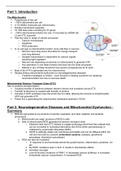
Part 1: Introduction
The Mitochondria
Powerhouse of the cell
~1000 mitochondria per cell
2-10 mtDNA molecules per mitochondria
Double-membraned organelle
16, 569 base pairs encoding for 37 genes
~1500 mitochondrial proteins but only 13 encoded by mtDNA (all
13 are ETC subunits)
Play key roles in range of cellular processes
o Calcium homeostasis
o Apoptosis
o ROS production
In no cell type is mitochondrial function more vital than in neurons
o Neurons have long axons that allow for energy transport
over long distance
o Synaptic transmission is dependent on calcium signals
requiring tight regulation
o Neurons are depending exclusively on mitochondria to generate ATP
o Any aberration in one feeds forward and back into the other processes
o Defects in any of these functions have severe consequences for th ecell
Most of the ATP is generated into the mitochondria
Studies linking mitochondrial dysfunction to neurodegenerative diseases
o Treatment strategies is limited – more focused in treating symptoms by replacing
neurotransmitters lost due to neuronal death
Mitochondrial Electron Transport Chain (ETC)
Site of oxidative phosphorylation
Coupling transfer of electrons between electron donors and acceptors across ETC
Transfer of electrons is coupled with transfer of protons
Complex 5 (ATP synthase) uses the proton flux to rotate, allowing the enzyme to phosphorylate
ADP and generate ATP
Proton flux is generating the mitochondrial membrane potential (-70mV)
Part 2: Neurodegenerative Diseases and Mitochondrial Dysfunction -
Summary
1. ROS are generated as by-products of aerobic respiration and other catabolic and anabolic
productions
a. Mitochondria are major producer of ROS in cells
b. Bulk of mitochondrial ROS generated at electron transport chain
i. Electrons leak from ETC directly to oxygen producing short-lived free radicals that
can be converted to nonradical derivatives like H2O2 either spontaneously or
catalysed by superoxide dismutase (SOD)
ii. H2O2 is relatively stable and membrane permeable and can be diffused within the
cell and removed by cytosolic antioxidant systems (catalase, glutathione
peroxidase, thioredoxin peroxidase)
c. ROS can also be increased
i. In response to environmental stimuli like growth factors, inflammatory cytokines, UV,
etc
ii. By SOD1 mutations seen in ALS results in downstream effects
iii. Activated micorglia
iv. Loss-of-function mutations of PINK1 decreased calcium buffering increased
intracellular calcium concentration increased ROS
, 1. Calcium conc increased in the cytoplasm which can be toxic and lead to
degeneration of ROS (which can damage the glucose transporter – less
glucose – less glycolysis – less ATP generation)
2. Gandhi et al., 2009
v. Mutation in Htt gene
2. Once produced, ROS reacts with lipids, proteins and nucleic acids causing oxidative damage
a. ROS readily attack DNA and generate DNA lesions (oxidised DNA bases, abasic sites and
DNA strand breaks) leading to genomic instability
i. E.g., 8-oxo-dG is one of the most abundant and well-characterised DNA lesion
caused by ROS that results in G:C to T:A transversions
b. ROS-generated DNA lesions can be repaired by base excision repair and other DNA repair
pathways like nucleotide excision repair, double-strand break repair, and mismatch repeair
c. The damaging effects of ROS can be neutralised via elevated antioxidant defence
(superoxide dismutase, catalase, and glutathione peroxidase to scavenge ROS to nontoxic
forms)
3. Free-radical theory of aging:
a. Over time, the older mitochondria produce less ATP, more ROS, and fewer antioxidants to
neutralise them
b. When there is an accumulation of ROS due to dysfunctional mitochondria, this results in a
cycle whereby mtDNA mutations impair the function of the ETC
c. This will interfere with the electron transfer between complexes and increasing superoxide
produced by electrons leaking from the chain and reacting with the molecular oxygen
d. This causes increased generation of ROS, further facilitating mtDNA damage self-
amplifying deterioration
e. This cycle is thought to underlie the aging process
4. Damage of the ETC will lead to more leakage of electrons, more ROS’s and a loss of mitochondrial
membrane potentials, and therefore loss of ATP due to impairment of electrochemical and proton
gradients
5. The damaged and depolarised mitochondria will undergo fission, the process where the unhealthy
mitochondria will divide into 2 separate (one healthy, smaller mitochondria and another highly
depolarised damaged mitochondria)
6. Following fission, the new healthy mitochondria will undergo fusion to fuse the small healthy
mitochondria together
a. A shift towards mitochondrial fission in aged cells encourages oxidative damage (Arnold Y.
Seo et al., 2010) and bioenergetic defects this means that the healthy mitochondria are
unable to fuse resulting in mitochondrial build-up
i. You need a good balance between fission and fusion
ii. In aged cells, there is a shift towards mitochondrial fission which encourages
oxidative damage
iii. Aged cells have morphologically abnormal mitochondria indicative of inhibition of
fusion (Yen et al., 2008)
7. The unhealthy mitochondria produced from fission will then undergo mitophagy which
selectively degrades the damaged mitochondria
a. PINK1 detects damaged mitochondria using a mitochondrial targeting sequence (MTS) that
is recruited to mitochondria
b. In unhealthy mitochondria, the IMM is depolarised so PINK1 can no longer be imported into
the inner membrane causing PINK1 conc to increase in the OMM
c. PINK1 recruits Parkin (cytosolic E3 ubiquitin ligase) and phosphorylates Parkin at S65 which
initiates Parkin recruitment at mitochondria
i. Kondapalli et al., 2012: discovered that PINK1 directly phosphorylates E2
ligase Parkin at Ser65
1. PINK1 is specifically activated by mitochondrial membrane potential
depolairsation
2. Phosphorylation of Parkin leads to activation of E3 ligase activity
3. This process is prevented by mutations of Ser65 or inactivation of PINK12
4. Once activated, PINK1 autophosphorylates at several residucews (Thr257)
accompanied by electrophoretic band-shift
5. Provides evidence that PINK1 is activated following mitochondrial membrane
depolarisation PINK1 directly phosphorylates and activates parkin
The Mitochondria
Powerhouse of the cell
~1000 mitochondria per cell
2-10 mtDNA molecules per mitochondria
Double-membraned organelle
16, 569 base pairs encoding for 37 genes
~1500 mitochondrial proteins but only 13 encoded by mtDNA (all
13 are ETC subunits)
Play key roles in range of cellular processes
o Calcium homeostasis
o Apoptosis
o ROS production
In no cell type is mitochondrial function more vital than in neurons
o Neurons have long axons that allow for energy transport
over long distance
o Synaptic transmission is dependent on calcium signals
requiring tight regulation
o Neurons are depending exclusively on mitochondria to generate ATP
o Any aberration in one feeds forward and back into the other processes
o Defects in any of these functions have severe consequences for th ecell
Most of the ATP is generated into the mitochondria
Studies linking mitochondrial dysfunction to neurodegenerative diseases
o Treatment strategies is limited – more focused in treating symptoms by replacing
neurotransmitters lost due to neuronal death
Mitochondrial Electron Transport Chain (ETC)
Site of oxidative phosphorylation
Coupling transfer of electrons between electron donors and acceptors across ETC
Transfer of electrons is coupled with transfer of protons
Complex 5 (ATP synthase) uses the proton flux to rotate, allowing the enzyme to phosphorylate
ADP and generate ATP
Proton flux is generating the mitochondrial membrane potential (-70mV)
Part 2: Neurodegenerative Diseases and Mitochondrial Dysfunction -
Summary
1. ROS are generated as by-products of aerobic respiration and other catabolic and anabolic
productions
a. Mitochondria are major producer of ROS in cells
b. Bulk of mitochondrial ROS generated at electron transport chain
i. Electrons leak from ETC directly to oxygen producing short-lived free radicals that
can be converted to nonradical derivatives like H2O2 either spontaneously or
catalysed by superoxide dismutase (SOD)
ii. H2O2 is relatively stable and membrane permeable and can be diffused within the
cell and removed by cytosolic antioxidant systems (catalase, glutathione
peroxidase, thioredoxin peroxidase)
c. ROS can also be increased
i. In response to environmental stimuli like growth factors, inflammatory cytokines, UV,
etc
ii. By SOD1 mutations seen in ALS results in downstream effects
iii. Activated micorglia
iv. Loss-of-function mutations of PINK1 decreased calcium buffering increased
intracellular calcium concentration increased ROS
, 1. Calcium conc increased in the cytoplasm which can be toxic and lead to
degeneration of ROS (which can damage the glucose transporter – less
glucose – less glycolysis – less ATP generation)
2. Gandhi et al., 2009
v. Mutation in Htt gene
2. Once produced, ROS reacts with lipids, proteins and nucleic acids causing oxidative damage
a. ROS readily attack DNA and generate DNA lesions (oxidised DNA bases, abasic sites and
DNA strand breaks) leading to genomic instability
i. E.g., 8-oxo-dG is one of the most abundant and well-characterised DNA lesion
caused by ROS that results in G:C to T:A transversions
b. ROS-generated DNA lesions can be repaired by base excision repair and other DNA repair
pathways like nucleotide excision repair, double-strand break repair, and mismatch repeair
c. The damaging effects of ROS can be neutralised via elevated antioxidant defence
(superoxide dismutase, catalase, and glutathione peroxidase to scavenge ROS to nontoxic
forms)
3. Free-radical theory of aging:
a. Over time, the older mitochondria produce less ATP, more ROS, and fewer antioxidants to
neutralise them
b. When there is an accumulation of ROS due to dysfunctional mitochondria, this results in a
cycle whereby mtDNA mutations impair the function of the ETC
c. This will interfere with the electron transfer between complexes and increasing superoxide
produced by electrons leaking from the chain and reacting with the molecular oxygen
d. This causes increased generation of ROS, further facilitating mtDNA damage self-
amplifying deterioration
e. This cycle is thought to underlie the aging process
4. Damage of the ETC will lead to more leakage of electrons, more ROS’s and a loss of mitochondrial
membrane potentials, and therefore loss of ATP due to impairment of electrochemical and proton
gradients
5. The damaged and depolarised mitochondria will undergo fission, the process where the unhealthy
mitochondria will divide into 2 separate (one healthy, smaller mitochondria and another highly
depolarised damaged mitochondria)
6. Following fission, the new healthy mitochondria will undergo fusion to fuse the small healthy
mitochondria together
a. A shift towards mitochondrial fission in aged cells encourages oxidative damage (Arnold Y.
Seo et al., 2010) and bioenergetic defects this means that the healthy mitochondria are
unable to fuse resulting in mitochondrial build-up
i. You need a good balance between fission and fusion
ii. In aged cells, there is a shift towards mitochondrial fission which encourages
oxidative damage
iii. Aged cells have morphologically abnormal mitochondria indicative of inhibition of
fusion (Yen et al., 2008)
7. The unhealthy mitochondria produced from fission will then undergo mitophagy which
selectively degrades the damaged mitochondria
a. PINK1 detects damaged mitochondria using a mitochondrial targeting sequence (MTS) that
is recruited to mitochondria
b. In unhealthy mitochondria, the IMM is depolarised so PINK1 can no longer be imported into
the inner membrane causing PINK1 conc to increase in the OMM
c. PINK1 recruits Parkin (cytosolic E3 ubiquitin ligase) and phosphorylates Parkin at S65 which
initiates Parkin recruitment at mitochondria
i. Kondapalli et al., 2012: discovered that PINK1 directly phosphorylates E2
ligase Parkin at Ser65
1. PINK1 is specifically activated by mitochondrial membrane potential
depolairsation
2. Phosphorylation of Parkin leads to activation of E3 ligase activity
3. This process is prevented by mutations of Ser65 or inactivation of PINK12
4. Once activated, PINK1 autophosphorylates at several residucews (Thr257)
accompanied by electrophoretic band-shift
5. Provides evidence that PINK1 is activated following mitochondrial membrane
depolarisation PINK1 directly phosphorylates and activates parkin


