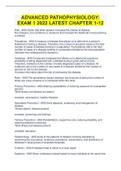
ADVANCED PATHOPHYSIOLOGY: EXAM 1 2022 LATEST CHAPTER 1-12
ADVANCED PATHOPHYSIOLOGY: EXAM 1 2022 LATEST CHAPTER 1-12 Risk - ANS-Factor that when present increases the chance of disease Not stressors, but conditions or situations that increase the likelihood of encountering a stressor Prevalence - ANS-A measure of disease that allows us to determine a person's likelihood of having a disease. Therefore, the number of prevalent cases is the total number of cases of disease existing in a population. A prevalence rate is the total number of cases of a disease existing in a population divided by the total population Indicates how widespread the disease is Incidence - ANS-A measure of disease that allows us to determine a person's probability of being diagnosed with a disease during a given period of time. Therefore, incidence is the number of newly diagnosed cases of a disease. An incidence rate is the number of new cases of a disease divided by the number of persons at risk for the disease. Conveys information about the risk of contracting the disease. Ratio - ANS-The quantitative relation between two amounts showing the number of times one value contains or is contained within the other. Primary Prevention - ANS-Altering susceptibility or reducing exposure for susceptible persons *Both illness and disease are absent example: vaccinations, healthy lifestyles Secondary Prevention - ANS-Early detection, screening, and management of disease *Illness absent, disease present example: screenings and testings Tertiary Prevention - ANS-Rehabilitation, supportive care, reducing disability, and restoring effective functioning *Both illness and disease present example: education Epidemiology - ANS-study of the patterns of disease involving populations; examining the occurrence, incidence, prevalence, transmission, and distribution of diseases in large groups of populations/people Endemic - ANS-A disease theat is native to a local region Epidemic - ANS-When a disease is disseninated to many individals at the same time (spread to many people at the same time) Pandemic - ANS-Epidemics that affect large geographic regions, perhaps spreading worldwide. (spread to large geographic areas) *CHAPTER 2: HOMEOSTASIS AND ADAPTIVE RESPONSES TO STRESSORS* Homeostasis - ANS-A state of being in which all systems are in balance around a articular ideal "set-point" Exhausation - ANS-Point where body can no longer return to homeostasis following a prolonged exposure to noxious agents Allostatic Overload - ANS-"Cost" of body's organs and tissues for an excessive or ineffectively regulated allostatic response; effect of "wear and tear" on the body Adaptation - ANS-Adaptation: biopsychosocial process of change in response to new or altered circumstances, internal or external in origin Coping: behavioral adaptive response to a stressor using culturally based coping mechanisms Adaptation and coping: terms used interchangeably Arousal - ANS-Includes alterations in responsiveness to homeostatic pressures, sensory stimuli and emotional reactivity, and to changes in motor activity Function of Cortisol - ANS-Primary glucocorticoid Affects protein metabolism Promotes appetite and food-seeking behaviors Has anti-inflammatory effects Chemical mediator in the inflammation response of the body Adrenal corticosteroid critical to maintenance of homeostasis May synergize or antagonize effects of catecholamines *CHAPTER 3: CELL STRUCTURE AND FUNCTION* Endocrine Communication - ANS-Hormones traveling in the bloodstream Long range signaling Neurocrine Communication - ANS-Neurons firing information through synapses Signals travel a very small distance between neuron and target cell Paracrine Communcation - ANS-Signaling through the extraceullar fluid between cells in a tissue Localized areas of communication Autocrine Communcation - ANS-Localized signaling in which the secreting cell is also the target cell Feedback to self Describe an Action Potential - ANS-Rapid, self-propagating electrical excitations of the membrane Mediated by voltage-gated ion channels that open (sodium flows into the cell) and close in response to voltage changes across the membrane Triggered by membrane depolarization Propagated by sequential opening of voltage-gated sodium channels in adjacent sections of membrane. The action potential is regenerated in adjacent sections of membrane as more sodium channels open. The initial segment repolarizes as sodium channels close and potassium ions move out. Cardiac muscles: repolarization is prolonged from calcium influx *Na+* initiates the action potential *Only cells with voltage-gated channels have action potentials (not nerve cells)* Describe a Resting Action Potential - ANS-Electrical charge when there is no net ion movement across plasma membrane Major determinant: Ratio of Internal-to-External [K+] This is dominated by potassium (K+) Take Home Message About Action Potentials - ANS-Resting Membrane Potential Dominated by K+ Upstroke of Action Potential -- Na+ Repolarization -- K+ In cardiac tissue, plateau -- Ca++ Depolarization - ANS-As the sodium rushes back into the cell the positive sodium ions raise the charge inside the cell from negative to positive. Once the interior of the cell becomes positively charged, depolarization of the cell is complete. This triggers the action potential Repolarization - ANS-Sodium inflow is stopped and potassium efflux increases In cardiac muscles repolarization is prolonged from calcium influx Hyperkalemia on Resting Membrane Potential - ANS-Depolarizes the cell Makes the membrane more negative Hypokalemia on Resting Membrane Potential - ANS-Hyperpolarizes the cell Makes the membrane less negative (more positive) *CHAPTER 4: CELL INJURY, AGING, AND DEATH* Hyperplasia - ANS-Increase in functional capacity related to an increase in cell number due to mitotic division -Usually in response to increased physiologic demands or hormonal stimulation -Other causes: persistent cell injury, chronic irritation of epithelial cells -Usually result from increased functional demand Hypertrophy - ANS-Increase in cell mass accompanied by an augmented functional capacity in response to physiologic and pathophysiologic demands -General cause:increased cellular protein content -Usually result from increased functional demand Dysplasia - ANS-Disorganized appearance of cells because of abnormal variations in size, shape, and arrangement -Represents an adaptive effort gone astray -Significant potential to transform into cancerous cells (preneoplastic lesions) -Result from a persistant injury Metaplasia - ANS-Replacement of one differentiated cell type with another -Common cause: adaptation to persistent injury, with replacement of a cell type that is better suited to tolerate injurious stimulation -Fully reversible when injurious stimulation is removed -Result from persistent injury Necrosis - ANS-Usually occurs as a consequence of ischemia or toxic injury Necrosis occurs when the injury is too severe or prolonged to allow adaptation -Usually from a disruption in blood supply Local and systemic indicators of cell death -Pain -Elevated serum enzyme levels -Inflammation (fever, increased WBC, malaise) -Loss of function Coagulation Necrosis - ANS-Most common type of necrosis Process that begins with ischemia Ends with degradation of plasma membrane Caused by ischemia/infarction Atrophy - ANS-Cells shrink and reduce their differentiated functions in response to normal and injurious factors -General causes: disuse, denervation, ischemia, interruption of endocrine signals, persistent cell injury -Results from decreased functional demand or chronic ischemia Results from decreased functional demand or chronic ischemia Proliferation - ANS-A rapid and often excessive spread or increase Cell Differentiation - ANS-How generic embryonic cells become specialized cells. This occurs through a process called gene expression. Gene expression is the specific combination of genes that are turned on or off (expressed or repressed), and this is what dictates how a cell functions. Endocytosis - ANS-The process of capturing a substance or particle from outside the cell by engulfing it with the cell membrane. The membrane folds over the substance and it becomes completely enclosed by the membrane. At this point a membrane-bound sac, or vesicle, pinches off and moves the substance into the cytosol. There are two main kinds of endocytosis: (1) Phagocytosis, or cellular eating, occurs when the dissolved materials enter the cell. The plasma membrane engulfs the solid material, forming a phagocytic vesicle. (2) Pinocytosis, or cellular drinking, occurs when the plasma membrane folds inward to form a channel allowing dissolved substances to enter the cell Exocytosis - ANS-The process of vesicles fusing with the plasma membrane and releasing their contents to the outside of the cell Exocytosis occurs when a cell produces substances for export, such as a protein, or when the cell is getting rid of a waste product or a toxin. Newly made membrane proteins and membrane lipids are moved on top the plasma membrane by exocytosis. Mitosis - ANS-A type of cell division in which one cell (the mother) divides to produce two new cells (the daughters) that are genetically identical to itself. In the context of the cell cycle, mitosis is the part of the division process in which the DNA of the cell's nucleus is split into two equal sets of chromosomes. *CHAPTER 5: GENOME STRUCTURE, REGULATION, & TISSUE DIFFERENTIATION * Gene - ANS-Invisible, information-containing elements that exist in cells and are passed on to daughter cells when cells divide What do genes do? - ANS-Contains approximately 25,000 genes encoded by only four different deoxyribonucleotides What is the primary role of genes? - ANS-Directs synthesis of a protein *CHAPTER 6: GENETIC AND DEVELOPMENTAL DISORDERS* Chromosomal Disorders - ANS-Usually due to breakage and loss or rearrangement of chromosome pieces during meiosis or mitosis Meiosis Crossing over errors: chromosome portions lost, attached upside-down, or attached to wrong chromosome Mitosis Opportunities for chromosomal breakage & rearrangement Generally due to an abnormal number of chromosomes and/or alterations to the structure of one or more chromosomes Usually a result of separation during meiosis Monosomy - ANS-Daughter cell with a deficiency of 1 chromosome Usually not compatible with life...
Written for
- Institution
- ADVANCED PATHOPHYSIOLOGY 2022
- Module
- ADVANCED PATHOPHYSIOLOGY 2022
Document information
- Uploaded on
- October 7, 2022
- Number of pages
- 23
- Written in
- 2022/2023
- Type
- Exam (elaborations)
- Contains
- Questions & answers
Subjects
-
risk
-
prevalence
-
primary prevention
-
endemic
-
advanced pathophysiology exam 1 2022 latest chapter 1 12
-
advanced pathophysiology exam 1 2022
-
chapter 2 homeostasis and adaptive responses to stressors

Also available in package deal