1.4 Important points
Problem 1
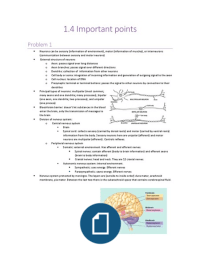
Neurons can be sensory (information of environment), motor (information of muscles), or interneurons
(communication between sensory and motor neurons)
External structure of neurons
o Axon: passes signal over long distances
o Axon branches: passes signal over different directions
o Dendrite: collection of information from other neurons
o Cell body or soma: integration of incoming information and generation of outgoing signal to the axon
o Cell nucleus: location of DNA
o Presynaptic terminal or terminal buttons: passes the signal to other neurons by connection to their
dendrites
Principal types of neurons: multipolar (most common;
many axons and one dendrite; many processes), bipolar
(one axon, one dendrite; two processes), and unipolar
(one process)
Blood-brain barrier: doesn’t let substances in the blood
enter the brain, only the transmission of messages to
the brain
Division of nervous system:
o Central nervous system
Brain
Spinal cord: collects sensory (carried by dorsal roots) and motor (carried by ventral roots)
information from the body. Sensory neurons here are unipolar (afferent) and motor
neurons are multipolar (efferent). Controls reflexes.
o Peripheral nervous system
Somatic: external environment. Has afferent and efferent nerves.
Spinal nerves: contain afferent (body to brain information) and efferent axons
(brain to body information)
Cranial nerves: head and neck. They are 12 cranial nerves.
Autonomic nervous system: internal environment.
Sympathetic: uses energy. Efferent nerves
Parasympathetic: saves energy. Efferent nerves
Nervous system protected by meninges. The layers are (outside to inside order) dura mater, arachnoid
membrane, pia mater. Between the last two there is the subarachnoid space that contains cerebrospinal fluid.
Problem 1
Neurons can be sensory (information of environment), motor (information of muscles), or interneurons
(communication between sensory and motor neurons)
External structure of neurons
o Axon: passes signal over long distances
o Axon branches: passes signal over different directions
o Dendrite: collection of information from other neurons
o Cell body or soma: integration of incoming information and generation of outgoing signal to the axon
o Cell nucleus: location of DNA
o Presynaptic terminal or terminal buttons: passes the signal to other neurons by connection to their
dendrites
Principal types of neurons: multipolar (most common;
many axons and one dendrite; many processes), bipolar
(one axon, one dendrite; two processes), and unipolar
(one process)
Blood-brain barrier: doesn’t let substances in the blood
enter the brain, only the transmission of messages to
the brain
Division of nervous system:
o Central nervous system
Brain
Spinal cord: collects sensory (carried by dorsal roots) and motor (carried by ventral roots)
information from the body. Sensory neurons here are unipolar (afferent) and motor
neurons are multipolar (efferent). Controls reflexes.
o Peripheral nervous system
Somatic: external environment. Has afferent and efferent nerves.
Spinal nerves: contain afferent (body to brain information) and efferent axons
(brain to body information)
Cranial nerves: head and neck. They are 12 cranial nerves.
Autonomic nervous system: internal environment.
Sympathetic: uses energy. Efferent nerves
Parasympathetic: saves energy. Efferent nerves
Nervous system protected by meninges. The layers are (outside to inside order) dura mater, arachnoid
membrane, pia mater. Between the last two there is the subarachnoid space that contains cerebrospinal fluid.