LIFE OF PI
Yann Martel
Context
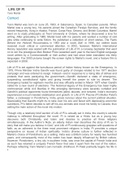
Yann Martel was born on June 25, 1963, in Salamanca, Spain, to Canadian parents. When
Martel was a young boy, his parents joined the Canadian Foreign Services, and the family
moved frequently, living in Alaska, France, Costa Rica, Ontario, and British Columbia. Martel
went on to study philosophy at Trent University in Ontario, where he discovered a love for
writing. After graduating in 1985, Martel lived with his parents and worked a number of odd
jobs while continuing to write fiction. He published a collection of short stories, The Facts
Behind the Helsinki Roccamatios, in 1993 and a novel, Self, in 1996, but neither book
received much critical or commercial attention. In 2002, however, Martel’s international
literary reputation was sealed with the publication of Life of Pi, a runaway bestseller that went
on to win the prestigious Man Booker Prize (awarded each year to the best English-language
novel written by a Commonwealth or Irish author) and had since been translated into thirty
languages. Fox 2000 pictures bought the screen rights to Martel’s novel, and a feature film is
expected in 2008.
Life of Pi is set against the tumultuous period of Indian history known as the Emergency. In
1975, Prime Minister Indira Gandhi was found guilty of charges related to her 1971 election
campaign and was ordered to resign. Instead—and in response to a rising tide of strikes and
protests that were paralyzing the government—Gandhi declared a state of emergency,
suspending constitutional rights and giving herself the power to rule by decree. The
Emergency lasted for eighteen months and was officially ended in March 1977 when Gandhi
called for a new round of elections. The historical legacy of the Emergency has been highly
controversial: while civil liberties in this emerging democracy were severely curtailed and
Gandhi’s political opponents found themselves jailed, abused, and tortured, India’s economy
experienced a much-needed stabilization and growth. In Life of Pi, Piscine (Pi) Molitor Patel’s
father, a zookeeper in Pondicherry, India, grows nervous about the current political situation.
Speculating that Gandhi might try to take over his zoo and faced with depressing economic
conditions, Pi’s father decides to sell off his zoo animals and move his family to Canada, thus
setting the main action of the novel into motion.
Though only a relatively brief section of Life of Pi is actually set in India, the country’s eclectic
makeup is reflected throughout the novel. Pi is raised as a Hindu but as a young boy
discovers both Christianity and Islam and decides to practice all three religions
simultaneously. In the Author’s Note, an elderly Indian man describes the story of Pi as “a
story that will make you believe in God,” and Life of Pi continuously grapples with questions of
faith; as an adherent to the three most prominent religions in India, Pi provides a unique
perspective on issues of Indian spirituality. India’s diverse culture is further reflected in
Martel’s choice of Pondicherry as a setting. India was a British colony for nearly two hundred
years, and consequently most of the nation has been deeply influenced by British culture.
However, Pondicherry, a tiny city in southern India, was once the capital of French India and
as such has retained a uniquely French flavor that sets it apart from the rest of the nation.
Perhaps reflecting Yann Martel’s own nomadic childhood, Pi Patel pointedly begins his life in
1
Yann Martel
Context
Yann Martel was born on June 25, 1963, in Salamanca, Spain, to Canadian parents. When
Martel was a young boy, his parents joined the Canadian Foreign Services, and the family
moved frequently, living in Alaska, France, Costa Rica, Ontario, and British Columbia. Martel
went on to study philosophy at Trent University in Ontario, where he discovered a love for
writing. After graduating in 1985, Martel lived with his parents and worked a number of odd
jobs while continuing to write fiction. He published a collection of short stories, The Facts
Behind the Helsinki Roccamatios, in 1993 and a novel, Self, in 1996, but neither book
received much critical or commercial attention. In 2002, however, Martel’s international
literary reputation was sealed with the publication of Life of Pi, a runaway bestseller that went
on to win the prestigious Man Booker Prize (awarded each year to the best English-language
novel written by a Commonwealth or Irish author) and had since been translated into thirty
languages. Fox 2000 pictures bought the screen rights to Martel’s novel, and a feature film is
expected in 2008.
Life of Pi is set against the tumultuous period of Indian history known as the Emergency. In
1975, Prime Minister Indira Gandhi was found guilty of charges related to her 1971 election
campaign and was ordered to resign. Instead—and in response to a rising tide of strikes and
protests that were paralyzing the government—Gandhi declared a state of emergency,
suspending constitutional rights and giving herself the power to rule by decree. The
Emergency lasted for eighteen months and was officially ended in March 1977 when Gandhi
called for a new round of elections. The historical legacy of the Emergency has been highly
controversial: while civil liberties in this emerging democracy were severely curtailed and
Gandhi’s political opponents found themselves jailed, abused, and tortured, India’s economy
experienced a much-needed stabilization and growth. In Life of Pi, Piscine (Pi) Molitor Patel’s
father, a zookeeper in Pondicherry, India, grows nervous about the current political situation.
Speculating that Gandhi might try to take over his zoo and faced with depressing economic
conditions, Pi’s father decides to sell off his zoo animals and move his family to Canada, thus
setting the main action of the novel into motion.
Though only a relatively brief section of Life of Pi is actually set in India, the country’s eclectic
makeup is reflected throughout the novel. Pi is raised as a Hindu but as a young boy
discovers both Christianity and Islam and decides to practice all three religions
simultaneously. In the Author’s Note, an elderly Indian man describes the story of Pi as “a
story that will make you believe in God,” and Life of Pi continuously grapples with questions of
faith; as an adherent to the three most prominent religions in India, Pi provides a unique
perspective on issues of Indian spirituality. India’s diverse culture is further reflected in
Martel’s choice of Pondicherry as a setting. India was a British colony for nearly two hundred
years, and consequently most of the nation has been deeply influenced by British culture.
However, Pondicherry, a tiny city in southern India, was once the capital of French India and
as such has retained a uniquely French flavor that sets it apart from the rest of the nation.
Perhaps reflecting Yann Martel’s own nomadic childhood, Pi Patel pointedly begins his life in
1