TOPIC 3: MOVEMENT IN AND OUT OF CELLS
3.1 DIFFUSION
→Diffusion: the net movement of the particles from a region of higher concentration to a region of lower concentration down a
concentration gradient, as a result of their random movement.
-The higher the temperature the faster they (atoms, molecules and ions) move.
-Energy for diffusion comes from the kinetic energy of the random movement of molecules and ions (collisions).
→DIFFUSION IN SOLIDS: particles cannot move far as are attracted to each other by forces (held together).
→DIFFUSION IN LIQUIDS: particles can move freely, knocking into each other.
→DIFFUSION IN GASES: even freer and atoms / molecules aren’t attracted to each other.
In living organisms:
-Substances move in and out of cells by diffusion through the cell membrane.
-Living cell is surrounded by a cell membrane → can restrict the free movement of the molecules (as its partially permeable).
-Diffusion helps living organisms to: →obtain many of their requirements
→get rid of many of their waste products
→carry out gas exchange for respiration
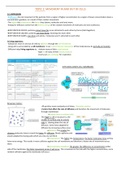
DIFFUSION ACROSS CELL MEMBRANE:
high concentration inside leaf
and low concentration outside
leaf: concentration gradient.
high concentration outside leaf
and low concentration inside
leaf: concentration gradient
Brownian motion:
-All particles move randomly at all times: Brownian motion.
-Factors that affect the rate of diffusion and therefore the movement of molecules
through membranes:
→Surface area to volume ratio:
The bigger a cell or structure is, the
smaller its surface area to volume
ratio is, slowing down the rate of
diffusion. Some have adapted for
diffusion by increasing surface area:
→Distance: The smaller the
distance molecules have to travel the faster the diffusion. Blood capillaries and
alveoli adapted by having walls which are only one cell thick.
→Temperature: The higher the temperature, the faster molecules move as they
have more energy. This results in more collisions against the cell membrane and therefore a faster rate of movement across
them.
→Concentration Gradient: The greater the difference in concentration either
side of the membrane, the faster movement across it will occur. This is because on the side with the higher concentration, more
random collisions against the membrane will occur.
3.1 DIFFUSION
→Diffusion: the net movement of the particles from a region of higher concentration to a region of lower concentration down a
concentration gradient, as a result of their random movement.
-The higher the temperature the faster they (atoms, molecules and ions) move.
-Energy for diffusion comes from the kinetic energy of the random movement of molecules and ions (collisions).
→DIFFUSION IN SOLIDS: particles cannot move far as are attracted to each other by forces (held together).
→DIFFUSION IN LIQUIDS: particles can move freely, knocking into each other.
→DIFFUSION IN GASES: even freer and atoms / molecules aren’t attracted to each other.
In living organisms:
-Substances move in and out of cells by diffusion through the cell membrane.
-Living cell is surrounded by a cell membrane → can restrict the free movement of the molecules (as its partially permeable).
-Diffusion helps living organisms to: →obtain many of their requirements
→get rid of many of their waste products
→carry out gas exchange for respiration
DIFFUSION ACROSS CELL MEMBRANE:
high concentration inside leaf
and low concentration outside
leaf: concentration gradient.
high concentration outside leaf
and low concentration inside
leaf: concentration gradient
Brownian motion:
-All particles move randomly at all times: Brownian motion.
-Factors that affect the rate of diffusion and therefore the movement of molecules
through membranes:
→Surface area to volume ratio:
The bigger a cell or structure is, the
smaller its surface area to volume
ratio is, slowing down the rate of
diffusion. Some have adapted for
diffusion by increasing surface area:
→Distance: The smaller the
distance molecules have to travel the faster the diffusion. Blood capillaries and
alveoli adapted by having walls which are only one cell thick.
→Temperature: The higher the temperature, the faster molecules move as they
have more energy. This results in more collisions against the cell membrane and therefore a faster rate of movement across
them.
→Concentration Gradient: The greater the difference in concentration either
side of the membrane, the faster movement across it will occur. This is because on the side with the higher concentration, more
random collisions against the membrane will occur.