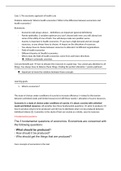
Case 1: The economic approach of health care
Problem statement: What is health economics? What is the difference between economics and
health economics?
Brainstorm:
- Economics talk always about…. Definitions are important (general definitions)
- Pareto-optimality; 2 variables optimum you can’t choose both even; you will always lose
some of the utility of one of both. You will always make one position worse.
- Scarcity is important in health economics you have a high demand and not enough
resources, so you always have to choose impact on the allocation of resources.
- You always have to choose between resources to allocate it to different organisations.
- Field of health economics
- Different theories of (health) economics
- Where does the field of health economics come from and future directions
William’s schematic overview.
Cost and benefit part how to allocate the resources in a good way. You cannot pay attention to all
things. You always have to balance these things. Finding the perfect allocation = pareto-optimum.
Important to know the relations between these concepts
Learning goals:
1. What is economics?
The study of choices under conditions of scarcity to increase efficiency (= related to the tension
between unlimited needs and limited resources to fulfil these needs) / allocation of scarce resources.
Economics is a study of choices under conditions of scarcity. It’s about a society with unlimited
needs and limited resources. All societies face three fundamental questions: (1) what to produce; (2)
how to produce what is to be produced; and (3) how to distribute what is to be produced between
individual citizens [2]. Economics is the study of how our society as a whole, uses its resources
3 fundamental questions
The 3 fundamental questions of economics. Economists are concerned with
the following questions:
- What should be produced?
- How should it be produced?
- Who should get the things that are produced?
Core concepts of economics in the text
,Scarcity
Scarcity refers to the tension between our limited resources and our unlimited wants/needs. If
resources are insufficient to meet all demands, they are scarce.
So:
• all resource uses have an opportunity cost;
Opportunity costs represent the potential benefits an individual, investor, or business
misses out on when choosing one alternative over another. Because by definition they
are unseen, opportunity costs can be easily overlooked.
• health and health care demands appear to be infinite (oneindig);
• resources available for health care are finite. Economists study society.
Preferences
- Based on your preferences you make choices
- Alternative that maximizes your utility by looking at preferences and making choices.
You want the choice which gives the most utility
More on the level of individuals.
Certain characteristics any consumer wants to have in a good or service that makes it preferable to
them. For example, Coca Cola made it more preferable to make a Light version.
Choices
Because there is scarcity, you have to make choices. We believe that society (macro-level) is the
result of choices of e.g. individuals (microlevel). Therefore, economics is a study of choices. We
assume people make rational decisions. This does not necessarily mean that people choose the
smartest option, but rather that people choose what they think is smartest.
Allocation
Resources have to be allocated/divided, because of scarcity. Economics are concerned with the
allocation of scarce resources among competing demands
Efficiency
The lowest amount of inputs to create the greatest amount of outputs. Efficiency relates to the use
of all inputs in producing any given output, including personal time and energy. Being efficient simply
means reducing the amount of wasted inputs
Competition
There are two extreme forms of market structure: monopoly and, its opposite, perfect competition. -
- Perfect competition is characterized by many buyers and sellers, homogenous product, perfect
information and free entry and exit. Thus, producers in a perfectly competitive market are subject to
the prices determined by the market and do not have any leverages (optimal allocation)
- If some is not fulfilled there is market failure and the government has to ingrijpen.
- If you have a perfect competition is leads directly to pareto optimum
If you have perfect competition you have high efficiency
, If you have a market failure/insufficient market you have inference of the government.
Utility
Total utility is the aggregate sum of satisfaction or benefit that an individual gains from consuming a
given amount of goods or services in an economy. The amount of a person's total utility corresponds
to the person's level of consumption. Usually, the more the person consumes, the larger his or her
total utility will be. In health, an unit of utility is QUALY’S. or DALY’S.
- Measurement for cost-effectiveness
Choices lead to utility
costs and benefits
The benefits (pro) of a given situation or business-related action are summed and then the costs
(con) associated with taking that action are subtracted.
Pareto-optimum
There is no other allocation of resources to services which will make all participants in the market
better off. In other words; there is no allocation of resources or services which make will participants
better off without making at least one person worse off. You can’t reach this in healthcare since there
is no perfect competition there (there will always be market failures).
- Allocation of resources where no one can be made better off or worse off
Allocation
Choices
Utility
Opportunity costs
Preferences
In economics there is a study of scarcity, because there are unlimited needs and limited resources.
That means that we have to make choices based on preferences of society and individual level. We
have to allocate the resources so that we have the highest utility for all individuals. But, by making
Problem statement: What is health economics? What is the difference between economics and
health economics?
Brainstorm:
- Economics talk always about…. Definitions are important (general definitions)
- Pareto-optimality; 2 variables optimum you can’t choose both even; you will always lose
some of the utility of one of both. You will always make one position worse.
- Scarcity is important in health economics you have a high demand and not enough
resources, so you always have to choose impact on the allocation of resources.
- You always have to choose between resources to allocate it to different organisations.
- Field of health economics
- Different theories of (health) economics
- Where does the field of health economics come from and future directions
William’s schematic overview.
Cost and benefit part how to allocate the resources in a good way. You cannot pay attention to all
things. You always have to balance these things. Finding the perfect allocation = pareto-optimum.
Important to know the relations between these concepts
Learning goals:
1. What is economics?
The study of choices under conditions of scarcity to increase efficiency (= related to the tension
between unlimited needs and limited resources to fulfil these needs) / allocation of scarce resources.
Economics is a study of choices under conditions of scarcity. It’s about a society with unlimited
needs and limited resources. All societies face three fundamental questions: (1) what to produce; (2)
how to produce what is to be produced; and (3) how to distribute what is to be produced between
individual citizens [2]. Economics is the study of how our society as a whole, uses its resources
3 fundamental questions
The 3 fundamental questions of economics. Economists are concerned with
the following questions:
- What should be produced?
- How should it be produced?
- Who should get the things that are produced?
Core concepts of economics in the text
,Scarcity
Scarcity refers to the tension between our limited resources and our unlimited wants/needs. If
resources are insufficient to meet all demands, they are scarce.
So:
• all resource uses have an opportunity cost;
Opportunity costs represent the potential benefits an individual, investor, or business
misses out on when choosing one alternative over another. Because by definition they
are unseen, opportunity costs can be easily overlooked.
• health and health care demands appear to be infinite (oneindig);
• resources available for health care are finite. Economists study society.
Preferences
- Based on your preferences you make choices
- Alternative that maximizes your utility by looking at preferences and making choices.
You want the choice which gives the most utility
More on the level of individuals.
Certain characteristics any consumer wants to have in a good or service that makes it preferable to
them. For example, Coca Cola made it more preferable to make a Light version.
Choices
Because there is scarcity, you have to make choices. We believe that society (macro-level) is the
result of choices of e.g. individuals (microlevel). Therefore, economics is a study of choices. We
assume people make rational decisions. This does not necessarily mean that people choose the
smartest option, but rather that people choose what they think is smartest.
Allocation
Resources have to be allocated/divided, because of scarcity. Economics are concerned with the
allocation of scarce resources among competing demands
Efficiency
The lowest amount of inputs to create the greatest amount of outputs. Efficiency relates to the use
of all inputs in producing any given output, including personal time and energy. Being efficient simply
means reducing the amount of wasted inputs
Competition
There are two extreme forms of market structure: monopoly and, its opposite, perfect competition. -
- Perfect competition is characterized by many buyers and sellers, homogenous product, perfect
information and free entry and exit. Thus, producers in a perfectly competitive market are subject to
the prices determined by the market and do not have any leverages (optimal allocation)
- If some is not fulfilled there is market failure and the government has to ingrijpen.
- If you have a perfect competition is leads directly to pareto optimum
If you have perfect competition you have high efficiency
, If you have a market failure/insufficient market you have inference of the government.
Utility
Total utility is the aggregate sum of satisfaction or benefit that an individual gains from consuming a
given amount of goods or services in an economy. The amount of a person's total utility corresponds
to the person's level of consumption. Usually, the more the person consumes, the larger his or her
total utility will be. In health, an unit of utility is QUALY’S. or DALY’S.
- Measurement for cost-effectiveness
Choices lead to utility
costs and benefits
The benefits (pro) of a given situation or business-related action are summed and then the costs
(con) associated with taking that action are subtracted.
Pareto-optimum
There is no other allocation of resources to services which will make all participants in the market
better off. In other words; there is no allocation of resources or services which make will participants
better off without making at least one person worse off. You can’t reach this in healthcare since there
is no perfect competition there (there will always be market failures).
- Allocation of resources where no one can be made better off or worse off
Allocation
Choices
Utility
Opportunity costs
Preferences
In economics there is a study of scarcity, because there are unlimited needs and limited resources.
That means that we have to make choices based on preferences of society and individual level. We
have to allocate the resources so that we have the highest utility for all individuals. But, by making