How does Shakespeare make this moment so significant?
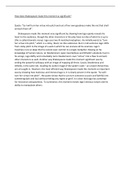
Quote: “So I will turn her virtue into pitch and out of her own goodness make the net that shall
enmesh them all”.
Shakespeare made this moment very significant by showing how Iago openly reveals his
heart to the audience, though the other characters in the play have no idea of what he is up to
(this is called dramatic irony). Iago uses two ill-matched metaphors. He initially wants to “turn
her virtue into pitch,” which is a sticky, black, tar-like substance. But in mid-sentence Iago shifts
from sticky pitch to the image of a web in which he can ensnare all his enemies. Iago’s
treachery runs so deep that he cannot even commit to a single metaphor. Relying on his
knowledge of human nature, on Desdemona’s open-heartedness and Othello’s absolute trust in
his ensign, Iago deftly and remarkably turns Desdemona’s own “virtue” into a flaw to enmesh
other characters as well. Another way Shakespeare made this moment significant was by
ending the powerful soliloquy with an image of trapping all three, Cassio, Desdemona and
Othello, in the same net, recalling his earlier image of the spider’s web – an unseen threat they
are all caught in. However, the most efficient way Shakespeare made this moment so important
was by showing how malicious and immoral Iago is. It is clearly proven in the quote: “So will I
turn her virtue into pitch”, the quote shows that he can turn someone so pure and faithful into
something dark and foul without feeling any regret or grief. It is clear that Iago has contempt
for innocence and goodness. To summarize, this moment reveals Iago's devious nature and his
ability to manipulate others.
Quote: “So I will turn her virtue into pitch and out of her own goodness make the net that shall
enmesh them all”.
Shakespeare made this moment very significant by showing how Iago openly reveals his
heart to the audience, though the other characters in the play have no idea of what he is up to
(this is called dramatic irony). Iago uses two ill-matched metaphors. He initially wants to “turn
her virtue into pitch,” which is a sticky, black, tar-like substance. But in mid-sentence Iago shifts
from sticky pitch to the image of a web in which he can ensnare all his enemies. Iago’s
treachery runs so deep that he cannot even commit to a single metaphor. Relying on his
knowledge of human nature, on Desdemona’s open-heartedness and Othello’s absolute trust in
his ensign, Iago deftly and remarkably turns Desdemona’s own “virtue” into a flaw to enmesh
other characters as well. Another way Shakespeare made this moment significant was by
ending the powerful soliloquy with an image of trapping all three, Cassio, Desdemona and
Othello, in the same net, recalling his earlier image of the spider’s web – an unseen threat they
are all caught in. However, the most efficient way Shakespeare made this moment so important
was by showing how malicious and immoral Iago is. It is clearly proven in the quote: “So will I
turn her virtue into pitch”, the quote shows that he can turn someone so pure and faithful into
something dark and foul without feeling any regret or grief. It is clear that Iago has contempt
for innocence and goodness. To summarize, this moment reveals Iago's devious nature and his
ability to manipulate others.