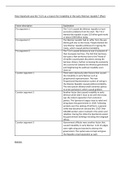
How important was the T.O.V as a reason for instability in the early Weimar republic? (Plan)
Factor description Explanation
Pro argument 1 The T.O.V caused the Weimar republic to have
economic problems from the start. The T.O.V
wanted the republic to pay 132 billion gold marks
or about $269 billion today.
Pro argument 2 The Weimar republic had to suffer from the war
blame guilt due to the treaty. People blamed the
new Weimar republic politicians for signing the
treaty, which caused political instability.
Pro argument 3 The T.O.V caused Germany to lose 13 precent of
their European territory. The fact that Germany
lost quite a few territories due to the Treaty of
Versailles caused great discontent among the
German citizens, further increasing the animosity
the country felt towards the Weimar government
and heightening the political instability even
more so.
Counter argument 1 There were obviously other factors that caused
the instability in early Weimar such as
proportional representation. The new
Proportional Representation system of voting in
the Weimar Republic caused political instability.
The new system allowed small extremist parties
to enter parliament, which caused gridlock.
Counter argument 2 Another factor that caused instability in early
Weimar which didn’t have to do with the treaty
was the violent opposition from extremist
parties. The Spartacist League tried to rebel and
bring down the government in 1919. Following
protests over the sacking of Eichhorn, a general
strike was declared on January 6th, 1919. Over
100,000 workers were involved in the action and
rebellion. During the strike the Spartacists seized
key government buildings including the telegraph
offices.
Counter argument 3 Government officials were another factor that
caused instability in early Weimar. A lot of judges
were right-wing and wanted to destroy the
government. The system was corrupt and gave
the Republic a bad reputation as well.
Sources:
Factor description Explanation
Pro argument 1 The T.O.V caused the Weimar republic to have
economic problems from the start. The T.O.V
wanted the republic to pay 132 billion gold marks
or about $269 billion today.
Pro argument 2 The Weimar republic had to suffer from the war
blame guilt due to the treaty. People blamed the
new Weimar republic politicians for signing the
treaty, which caused political instability.
Pro argument 3 The T.O.V caused Germany to lose 13 precent of
their European territory. The fact that Germany
lost quite a few territories due to the Treaty of
Versailles caused great discontent among the
German citizens, further increasing the animosity
the country felt towards the Weimar government
and heightening the political instability even
more so.
Counter argument 1 There were obviously other factors that caused
the instability in early Weimar such as
proportional representation. The new
Proportional Representation system of voting in
the Weimar Republic caused political instability.
The new system allowed small extremist parties
to enter parliament, which caused gridlock.
Counter argument 2 Another factor that caused instability in early
Weimar which didn’t have to do with the treaty
was the violent opposition from extremist
parties. The Spartacist League tried to rebel and
bring down the government in 1919. Following
protests over the sacking of Eichhorn, a general
strike was declared on January 6th, 1919. Over
100,000 workers were involved in the action and
rebellion. During the strike the Spartacists seized
key government buildings including the telegraph
offices.
Counter argument 3 Government officials were another factor that
caused instability in early Weimar. A lot of judges
were right-wing and wanted to destroy the
government. The system was corrupt and gave
the Republic a bad reputation as well.
Sources: