DESIGNING MOLECULES
UNIT 14 ASSIGNMENT C
C: Understand the types, structures, reactions, uses and properties of isomers.
ISOMERS
Isomerism refers to the presence of molecules with the same number of atoms
of the same type (and thus the same formula) but different chemical and
physical properties.
ISOMERISM
FORMULAS [Molecular and Empirical]
The number of each type of atom present in one molecule of a substance is
shown in the molecular formula.
The simplest ratio of the atoms present is shown in the empirical formular of a
compound.
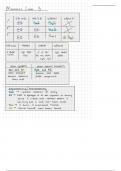
The formula of a compound displayed reveals the atoms in a molecule as well
as all of the bonds. A single line represents a single bond, two lines for double
bonds, and three lines for triple bonds. Different structures of compounds with
the same molecular formulas can be seen in the shown formular.
STRUCTURAL ISOMERISM
Isomers are molecules with the same molecular formular, but in which the
atoms are arranged in a different way. There are two main categories of
isomerism: structural isomerism and stereoisomerism.
There are three structural types of isomers, chain, positional and functional.
, The structural formula of a compound illustrates how the atoms in a molecule
are organised, as well as which functional groups are present. Structural
formulae, unlike displayed formulae, do not indicate single bonds, albeit
double/triple bonds may be shown. The bonds between carbon atoms are shown
in the skeletal formula of a compound, but not the atoms themselves. Hydrogen
atoms are removed as well, but other atoms are depicted.
Functional isomers, when the odd form of functional groups with the same
chemical formula coexist, this is known as functional group isomerism.
Functional isomerism is defined as a substance that has two distinct structures
but the same chemical formula. e.g., propanal and propanone (acetone)
Chain isomerism, A change in the atomic arrangement of the carbon to the
carbon chain of a molecule is known as chain isomerism. Chain isomerism is a
phenomenon that occurs when two or more compounds have the same type of
chemical formula but different primary chains. e.g., pentane, 2-methylbutane
and 2,2-dimethylpropane.
UNIT 14 ASSIGNMENT C
C: Understand the types, structures, reactions, uses and properties of isomers.
ISOMERS
Isomerism refers to the presence of molecules with the same number of atoms
of the same type (and thus the same formula) but different chemical and
physical properties.
ISOMERISM
FORMULAS [Molecular and Empirical]
The number of each type of atom present in one molecule of a substance is
shown in the molecular formula.
The simplest ratio of the atoms present is shown in the empirical formular of a
compound.
The formula of a compound displayed reveals the atoms in a molecule as well
as all of the bonds. A single line represents a single bond, two lines for double
bonds, and three lines for triple bonds. Different structures of compounds with
the same molecular formulas can be seen in the shown formular.
STRUCTURAL ISOMERISM
Isomers are molecules with the same molecular formular, but in which the
atoms are arranged in a different way. There are two main categories of
isomerism: structural isomerism and stereoisomerism.
There are three structural types of isomers, chain, positional and functional.
, The structural formula of a compound illustrates how the atoms in a molecule
are organised, as well as which functional groups are present. Structural
formulae, unlike displayed formulae, do not indicate single bonds, albeit
double/triple bonds may be shown. The bonds between carbon atoms are shown
in the skeletal formula of a compound, but not the atoms themselves. Hydrogen
atoms are removed as well, but other atoms are depicted.
Functional isomers, when the odd form of functional groups with the same
chemical formula coexist, this is known as functional group isomerism.
Functional isomerism is defined as a substance that has two distinct structures
but the same chemical formula. e.g., propanal and propanone (acetone)
Chain isomerism, A change in the atomic arrangement of the carbon to the
carbon chain of a molecule is known as chain isomerism. Chain isomerism is a
phenomenon that occurs when two or more compounds have the same type of
chemical formula but different primary chains. e.g., pentane, 2-methylbutane
and 2,2-dimethylpropane.