Ambition
You are advised to spend about 40 minutes on this question.
You should use the extract below and your knowledge of the whole play to answer this question.
How does Shakespeare present the theme of ambition throughout the play?
In your response you should:
refer to the extract and the play as a whole;
show your understanding of characters and events in the play.[25]
5 of this question’s marks are allocated for accuracy in spelling, punctuation and the use of
vocabulary and sentence structures
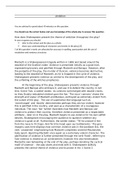
Macbeth is a Shakespearean tragedy written in 1606 and based around the
downfall of the Scottish noble. Violence is presented initially as a good trait,
representing bravery and glorified through Macbeth and Banquo. However, after
the peripetia of the play, the murder of Duncan, violence becomes destructive,
leading to the downfall of Macbeth, as he is trapped in the cycle of violence.
Shakespeare presents violence as central to the development of the play, and
the unfolding of the witches prophecies.
At the beginning of the play, Shakespeare presents violence through
Macbeth and Banquo who embrace it, and use it to defend the country. In Act
One, Scene Two, a soldier states: ‘as cannons overcharged with double cracks,
so they Doubly redoubled stroked upon the foe.’ The noun ‘cannons’ shows the
strength and vigour of Macbeth and Banquo, portrayed as extremely violent from
the outset of the play. The use of superlative-like language such as
‘overcharged’ and ‘doubly’ demonstrates perhaps they are too violent, however
this is glorified in the country, and seen as a characteristic of a courageous
individual. The noun ‘foe’ further illustrates how Macbeth and Banquo use
violence to protect their country, therefore violence presented as a respectable
attribute – later on in the play, Macbeth begins to use violence for his own selfish
desires, Shakespeare encouraging the audience to question whether any
violence is good at all. Furthermore, the soldier states: ‘Till he unseam’d him
from the nave to th’chops. And fix’d his head upon our battlements.’ The gory
imagery uses here displays how common violence was in the Jacobean Era, the
verb ‘unseamed’ emphasising how Macbeth completely severed Macdonalds
body apart, depicting Macbeth once again as a extremely violent character. The
glorification of violence is further presented through the verb ‘fixed’, referring to
how violence is viewed as an achievement, however this also foreshadows
Macbeths own beheading at the end of the play, perhaps denoting the cyclical
motif of violence - the play starts and ends with it. Shakespeare skilfully
presents the central theme of violence and its praise in Act 1 Scene 2.
You are advised to spend about 40 minutes on this question.
You should use the extract below and your knowledge of the whole play to answer this question.
How does Shakespeare present the theme of ambition throughout the play?
In your response you should:
refer to the extract and the play as a whole;
show your understanding of characters and events in the play.[25]
5 of this question’s marks are allocated for accuracy in spelling, punctuation and the use of
vocabulary and sentence structures
Macbeth is a Shakespearean tragedy written in 1606 and based around the
downfall of the Scottish noble. Violence is presented initially as a good trait,
representing bravery and glorified through Macbeth and Banquo. However, after
the peripetia of the play, the murder of Duncan, violence becomes destructive,
leading to the downfall of Macbeth, as he is trapped in the cycle of violence.
Shakespeare presents violence as central to the development of the play, and
the unfolding of the witches prophecies.
At the beginning of the play, Shakespeare presents violence through
Macbeth and Banquo who embrace it, and use it to defend the country. In Act
One, Scene Two, a soldier states: ‘as cannons overcharged with double cracks,
so they Doubly redoubled stroked upon the foe.’ The noun ‘cannons’ shows the
strength and vigour of Macbeth and Banquo, portrayed as extremely violent from
the outset of the play. The use of superlative-like language such as
‘overcharged’ and ‘doubly’ demonstrates perhaps they are too violent, however
this is glorified in the country, and seen as a characteristic of a courageous
individual. The noun ‘foe’ further illustrates how Macbeth and Banquo use
violence to protect their country, therefore violence presented as a respectable
attribute – later on in the play, Macbeth begins to use violence for his own selfish
desires, Shakespeare encouraging the audience to question whether any
violence is good at all. Furthermore, the soldier states: ‘Till he unseam’d him
from the nave to th’chops. And fix’d his head upon our battlements.’ The gory
imagery uses here displays how common violence was in the Jacobean Era, the
verb ‘unseamed’ emphasising how Macbeth completely severed Macdonalds
body apart, depicting Macbeth once again as a extremely violent character. The
glorification of violence is further presented through the verb ‘fixed’, referring to
how violence is viewed as an achievement, however this also foreshadows
Macbeths own beheading at the end of the play, perhaps denoting the cyclical
motif of violence - the play starts and ends with it. Shakespeare skilfully
presents the central theme of violence and its praise in Act 1 Scene 2.