5.2: Energy for biological processes
5.2.1: Photosynthesis
Links to lots of other topics - tissues/organs for leaves, plant transport, carbon cycle, cell structure and
ultrastructure, membranes
● Photosynthesis: the process whereby light energy from the sun is converted into chemical
potential energy that can be used to synthesise complex organic molecules
- Anabolic reaction
- Endothermic reaction - gain energy overall
● Autotrophs: organisms that synthesise complex organic molecules from inorganic molecules +
an energy source (organisms that photosynthesise are autotrophic)
- Photoautotrophs: use light and CO2 to create sugars and then complex carbohydrates
(eg. plants)
● Heterotrophs: organisms that obtain complex organic molecules by eating other organisms
(heterotrophs/autotrophs)
Both autotrophic and heterotrophic organisms then break down these complex organic molecules during
the process of respiration
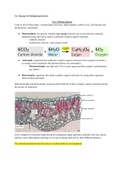
Leaf is adapted for maximum light absorption (transparent upper epidermis, palisade cells near surface
and have more chloroplasts) and large SA for gas exchange (thin leaf so short diffusion distance)
The interrelationship between the process of photosynthesis and respiration
,Energy:
- Living organisms have to be active in order to survive (eg. growth, respond to changes in
environment incl threats, find or make food, reproduce) → all activity depends on metabolic
activities (processes + reactions - eg. active transport, anabolic reactions, movement), which are
continually occurring within individual cells
- All metabolic activities require ENERGY
- Energy cannot be created and destroyed - is transferred in an energy flow between organisms.
Radiation from the Sun is used to fuel the metabolic activities necessary to keep organisms alive
→ is eventually transferred back to the atmosphere as heat
Photosynthesis = light energy trapped in chlorophyll molecules → energy used to drive synthesis of
glucose (large organic molecule) from CO2 + H20. LIGHT ENERGY IS TRANSFORMED INTO
CHEMICAL ENERGY → there is energy trapped in the bonds of these organic molecules → organisms
use this energy during respiration, when organic molecules are broken down into inorganic molecules
(CO2 + H20). The breaking of these bonds releases the energy stored within them → this energy is then
used to synthesis ATP
- The energy required to form a particular type of bond = the energy released when the bond is
broken
- Bond energy = +kJ/mol when bond BROKEN
- Bond energy = -kJ/mol when bond FORMED
- Exothermic: reaction releases energy overall
- Endothermic: reaction takes in energy overall
Whether an overall reaction is exothermic or endothermic depends on the total number and strength of
bonds that are broken or formed during the reaction
- Small inorganic molecules eg. CO2 + H20
- Atoms making up these molecules are joined by strong bonds that release a lot of
energy when they form
- Yet strong → require a lot of energy to break
- Large organic molecules eg. glucose, amino acids
- Many more bonds joining the atoms making these organisms (larger)
[__ cont large nos of carbon--hydrogen bonds (particularly in lipids)
- Carbon and hydrogen share e-s almost equally in the covalent bonds that
form between them → even distribution of charge → results in a
nonpolar bond which does not require a lot of energy to break
- However these bonds are weaker compared with those in organic molecules and
therefore release energy when they form and require less energy to be broken
[__ TMT since in respiration large organic molecules are broken down → to
form small inorganic molecules, the total energy required to break all the bonds
in a complex organic molecule is LESS than the total energy released in the
formation of all the bonds in the smaller organic molecules
- The carbon and hydrogen released from the breakdown of large organic
molecules form strong bonds with oxygen atoms → forms CO2 and H20
, - Therefore there is EXCESS energy released - this is the energy used to
synthesise ATP
The relationship between the raw materials and products of photosynthesis and respiration:
1) Photosynthesis is the process behind the prod of most of the biomass on earth
- Large organic molecules are made from small inorganic molecules - the Sun
provides the energy to build these molecules
2) Respiration is the process by which organisms break down biomass in order to provide
the ATP required to fuel the metabolic activities within the cell
- The raw materials for one reaction = the products of the other reaction
[__ therefore the two reactions are intimately linked - interrelated throughout the living world
- Photosynthesis is vitally important to ensure that the balance of O2 and CO2 in the atmosphere is
maintained at a constant level
- Photosynthesis forms the basis of many food chains - provide energy on which consumers and
decomposers depend. Is the most vital process on earth because all other life depends on it either
directly or indirectly as a source of energy
The structure of a chloroplast and the sites of the two main stages of photosynthesis
Photosynthesis almost certainly evolved in free-living prokaryotes. At some time some of these were
taken into eukaryotic cells by endosymbiosis → prokaryotes became incorporated into the cells as
chloroplasts (in the same way that other prokaryotes were incorporated as mitochondria)
Evidence to support endosymbiosis:
- Chloroplasts are only produced from division of other chloroplasts, which is a separate process
from plant cell division
- Chloroplasts have their own genome consisting of a circular loop of DNA, much as is present in
prokaryotes today (nucleoid)
- Chloroplasts have their own ribosomes (known as 70S ribosomes) and their own protein synthesis
mechanism, which is related to the mechanism found in prokaryotes and which produces some of
the proteins used by chloroplasts
- Chloroplasts contain similar pigments to photosynthesising cyanobacteria. The similarity of
chloroplasts to these prokaryotes suggests that they were once separate organisms that at some
time became incorporated into plant cells and ultimately became cell organelles
(in plant cells and some protoctista) photosynthesis takes place in the chloroplasts
The structure of a chloroplast:
● About 2-10 micrometres - larger than mitochondria
● Chloroplast envelope: double membrane enclosing chloroplast
- Outer membrane allows many small ions and molecules to pass through into the
chloroplast
- Inner membrane relies on transport proteins to allow transport of certain chemicals -
controls molecules entering or leaving/moving between stroma and cytosol
[__ this inner membrane is not folded into cristae like the mitochondrial inner membrane.
Instead, chloroplasts have a THIRD internal system of membranes:
5.2.1: Photosynthesis
Links to lots of other topics - tissues/organs for leaves, plant transport, carbon cycle, cell structure and
ultrastructure, membranes
● Photosynthesis: the process whereby light energy from the sun is converted into chemical
potential energy that can be used to synthesise complex organic molecules
- Anabolic reaction
- Endothermic reaction - gain energy overall
● Autotrophs: organisms that synthesise complex organic molecules from inorganic molecules +
an energy source (organisms that photosynthesise are autotrophic)
- Photoautotrophs: use light and CO2 to create sugars and then complex carbohydrates
(eg. plants)
● Heterotrophs: organisms that obtain complex organic molecules by eating other organisms
(heterotrophs/autotrophs)
Both autotrophic and heterotrophic organisms then break down these complex organic molecules during
the process of respiration
Leaf is adapted for maximum light absorption (transparent upper epidermis, palisade cells near surface
and have more chloroplasts) and large SA for gas exchange (thin leaf so short diffusion distance)
The interrelationship between the process of photosynthesis and respiration
,Energy:
- Living organisms have to be active in order to survive (eg. growth, respond to changes in
environment incl threats, find or make food, reproduce) → all activity depends on metabolic
activities (processes + reactions - eg. active transport, anabolic reactions, movement), which are
continually occurring within individual cells
- All metabolic activities require ENERGY
- Energy cannot be created and destroyed - is transferred in an energy flow between organisms.
Radiation from the Sun is used to fuel the metabolic activities necessary to keep organisms alive
→ is eventually transferred back to the atmosphere as heat
Photosynthesis = light energy trapped in chlorophyll molecules → energy used to drive synthesis of
glucose (large organic molecule) from CO2 + H20. LIGHT ENERGY IS TRANSFORMED INTO
CHEMICAL ENERGY → there is energy trapped in the bonds of these organic molecules → organisms
use this energy during respiration, when organic molecules are broken down into inorganic molecules
(CO2 + H20). The breaking of these bonds releases the energy stored within them → this energy is then
used to synthesis ATP
- The energy required to form a particular type of bond = the energy released when the bond is
broken
- Bond energy = +kJ/mol when bond BROKEN
- Bond energy = -kJ/mol when bond FORMED
- Exothermic: reaction releases energy overall
- Endothermic: reaction takes in energy overall
Whether an overall reaction is exothermic or endothermic depends on the total number and strength of
bonds that are broken or formed during the reaction
- Small inorganic molecules eg. CO2 + H20
- Atoms making up these molecules are joined by strong bonds that release a lot of
energy when they form
- Yet strong → require a lot of energy to break
- Large organic molecules eg. glucose, amino acids
- Many more bonds joining the atoms making these organisms (larger)
[__ cont large nos of carbon--hydrogen bonds (particularly in lipids)
- Carbon and hydrogen share e-s almost equally in the covalent bonds that
form between them → even distribution of charge → results in a
nonpolar bond which does not require a lot of energy to break
- However these bonds are weaker compared with those in organic molecules and
therefore release energy when they form and require less energy to be broken
[__ TMT since in respiration large organic molecules are broken down → to
form small inorganic molecules, the total energy required to break all the bonds
in a complex organic molecule is LESS than the total energy released in the
formation of all the bonds in the smaller organic molecules
- The carbon and hydrogen released from the breakdown of large organic
molecules form strong bonds with oxygen atoms → forms CO2 and H20
, - Therefore there is EXCESS energy released - this is the energy used to
synthesise ATP
The relationship between the raw materials and products of photosynthesis and respiration:
1) Photosynthesis is the process behind the prod of most of the biomass on earth
- Large organic molecules are made from small inorganic molecules - the Sun
provides the energy to build these molecules
2) Respiration is the process by which organisms break down biomass in order to provide
the ATP required to fuel the metabolic activities within the cell
- The raw materials for one reaction = the products of the other reaction
[__ therefore the two reactions are intimately linked - interrelated throughout the living world
- Photosynthesis is vitally important to ensure that the balance of O2 and CO2 in the atmosphere is
maintained at a constant level
- Photosynthesis forms the basis of many food chains - provide energy on which consumers and
decomposers depend. Is the most vital process on earth because all other life depends on it either
directly or indirectly as a source of energy
The structure of a chloroplast and the sites of the two main stages of photosynthesis
Photosynthesis almost certainly evolved in free-living prokaryotes. At some time some of these were
taken into eukaryotic cells by endosymbiosis → prokaryotes became incorporated into the cells as
chloroplasts (in the same way that other prokaryotes were incorporated as mitochondria)
Evidence to support endosymbiosis:
- Chloroplasts are only produced from division of other chloroplasts, which is a separate process
from plant cell division
- Chloroplasts have their own genome consisting of a circular loop of DNA, much as is present in
prokaryotes today (nucleoid)
- Chloroplasts have their own ribosomes (known as 70S ribosomes) and their own protein synthesis
mechanism, which is related to the mechanism found in prokaryotes and which produces some of
the proteins used by chloroplasts
- Chloroplasts contain similar pigments to photosynthesising cyanobacteria. The similarity of
chloroplasts to these prokaryotes suggests that they were once separate organisms that at some
time became incorporated into plant cells and ultimately became cell organelles
(in plant cells and some protoctista) photosynthesis takes place in the chloroplasts
The structure of a chloroplast:
● About 2-10 micrometres - larger than mitochondria
● Chloroplast envelope: double membrane enclosing chloroplast
- Outer membrane allows many small ions and molecules to pass through into the
chloroplast
- Inner membrane relies on transport proteins to allow transport of certain chemicals -
controls molecules entering or leaving/moving between stroma and cytosol
[__ this inner membrane is not folded into cristae like the mitochondrial inner membrane.
Instead, chloroplasts have a THIRD internal system of membranes: