Free Radicals
•
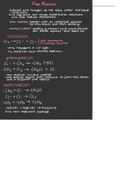
alkanes and halogens do not react under standard
conditions
↳ UV radiation can cause substitution reactions
via free radical mechanisms -
free radical -
species with an unpaired electron
quickly and short
reacts
existing
-
.
hemolytic fission breaking of covalent bond where electron
-
pair shared
equally each keeps one
-
-
initiation
CL2 →
CL .
+ CL .
} dot represents
unpaired electron
•
only happens in UV
light .
.
CL2 produces two chlorine radicals .
propagation
CL .
t CH4 → .
CH3 t HCl
•
CH3 tclz →
CH34 t CL .
•
new radical always formed
a
free radical reacts with molecule to
form new bonds
and a different free radical .
termination
•
CH3 t CL .
→ CH3 Cl
Cl .
t CL .
→ CL2
•
CH3 t.CH 3
→ C2H 6
•
radical t radical → molecule .
↳ no new radicals formed .
•
alkanes and halogens do not react under standard
conditions
↳ UV radiation can cause substitution reactions
via free radical mechanisms -
free radical -
species with an unpaired electron
quickly and short
reacts
existing
-
.
hemolytic fission breaking of covalent bond where electron
-
pair shared
equally each keeps one
-
-
initiation
CL2 →
CL .
+ CL .
} dot represents
unpaired electron
•
only happens in UV
light .
.
CL2 produces two chlorine radicals .
propagation
CL .
t CH4 → .
CH3 t HCl
•
CH3 tclz →
CH34 t CL .
•
new radical always formed
a
free radical reacts with molecule to
form new bonds
and a different free radical .
termination
•
CH3 t CL .
→ CH3 Cl
Cl .
t CL .
→ CL2
•
CH3 t.CH 3
→ C2H 6
•
radical t radical → molecule .
↳ no new radicals formed .