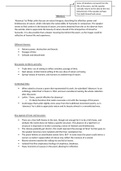
Sense of bleakness conveyed from the
title of the poem, and the speaker
cyclically returns to this idea by the end.
Detachment of the speaker perhaps
from both himself and nature
‘Absences’
‘Absences’ by Philip Larkin focuses on natural imagery, describing the effortless power and
limitlessness of nature, which reiterates the vulnerability of humanity in comparison. The speaker
seems to find comfort in the beauty of nature, yet seems detached from this as he observes from
the outside, able to appreciate the beauty of nature devoid of the interjection of himself or
humanity. It is also possible that a deeper meaning lies behind the poem, as the images could be
reflective of human life and experience.
Different themes:
Natures power, destruction and beauty
Passage of time
Solitude and detachment
Key poems to link to and why:
Triple time- use of setting to reflect emotion; passage of time.
Next please- similar liminal setting of the sea; idea of nature as freeing
Spring- beauty of humans, and humans as undeserving of nature.
Contextual links:
When asked to choose a poem that represented his work, he submitted ‘Absences’ to an
anthology called Poet’s Choice in 1962, and even considered naming the whole collection
after this poem.
Larkin: ‘I have…special affection for absences’.
o It’s likely therefore that Larkin resonates a lot with the message of this poem.
Could argue that Larkin slightly veers away from the traditional movement poetry, as in
‘absences’ he is able to appreciate nature and its beauty almost in a romanticised way.
Key aspects of form and structure:
There are a few half-rhymes in the text, though not enough for it to be a full rhyme, and
similarly the metre does not follow a specific structure. This absence of a rigid form or
structure is important in further conveying a sense of freedom and limitlessness.
The stanzas gradually get shorter- this could represent the passage of time? As time goes on
the speaker becomes more isolated until the final, standalone line.
The poem follows an unorthodox sonnet form. BUT- in some ways this poem could mirror a
sonnet, as Larkin’s appreciation of nature may reflect the romance of a sonnet.
Rhyme scheme matches the rolling rise and fall of waves.
Isolated final line emphasises feelings of emptiness, bleakness.
Many moments of caesura in the poem allowing for reflection.
title of the poem, and the speaker
cyclically returns to this idea by the end.
Detachment of the speaker perhaps
from both himself and nature
‘Absences’
‘Absences’ by Philip Larkin focuses on natural imagery, describing the effortless power and
limitlessness of nature, which reiterates the vulnerability of humanity in comparison. The speaker
seems to find comfort in the beauty of nature, yet seems detached from this as he observes from
the outside, able to appreciate the beauty of nature devoid of the interjection of himself or
humanity. It is also possible that a deeper meaning lies behind the poem, as the images could be
reflective of human life and experience.
Different themes:
Natures power, destruction and beauty
Passage of time
Solitude and detachment
Key poems to link to and why:
Triple time- use of setting to reflect emotion; passage of time.
Next please- similar liminal setting of the sea; idea of nature as freeing
Spring- beauty of humans, and humans as undeserving of nature.
Contextual links:
When asked to choose a poem that represented his work, he submitted ‘Absences’ to an
anthology called Poet’s Choice in 1962, and even considered naming the whole collection
after this poem.
Larkin: ‘I have…special affection for absences’.
o It’s likely therefore that Larkin resonates a lot with the message of this poem.
Could argue that Larkin slightly veers away from the traditional movement poetry, as in
‘absences’ he is able to appreciate nature and its beauty almost in a romanticised way.
Key aspects of form and structure:
There are a few half-rhymes in the text, though not enough for it to be a full rhyme, and
similarly the metre does not follow a specific structure. This absence of a rigid form or
structure is important in further conveying a sense of freedom and limitlessness.
The stanzas gradually get shorter- this could represent the passage of time? As time goes on
the speaker becomes more isolated until the final, standalone line.
The poem follows an unorthodox sonnet form. BUT- in some ways this poem could mirror a
sonnet, as Larkin’s appreciation of nature may reflect the romance of a sonnet.
Rhyme scheme matches the rolling rise and fall of waves.
Isolated final line emphasises feelings of emptiness, bleakness.
Many moments of caesura in the poem allowing for reflection.