

🌵
Photosynthesis
Properties of Plant Cells that Enable Photosynthesis
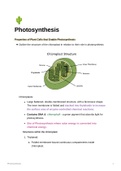
Outline the structure of the chloroplast in relation to their role in photosynthesis
Chloroplasts:
Large flattened, double-membraned structure, with a biconcave shape.
The inner membrane is folded and stacked into thylakoids to increase
the surface area of enzyme-controlled chemical reactions.
Contains DNA & chlorophyll - a green pigment that absorbs light for
photosynthesis.
Site of Photosynthesis where solar energy is converted into
chemical energy.
Structures within the chloroplast:
1. Thylakoid:
a. Folded membrane-bound continuous compartments inside
chloroplast.
Photosynthesis 1
, b. Site of light-dependent reactions of photosynthesis /
photophosphorylation
2. Granum:
a. Stacks of thylakoid membrane discs containing photosynthetic
pigments such as chlorophyll arranged as photosystems
b. Joined together by lamellae - extensions of thylakoid membranes
3. Stroma:
a. Semifluid matrix surrounding the grana
b. Contains DNA and ribosomes
c. Site of Calvin Cycle / Light independent reaction
4. Chloroplast envelope:
a. The outer and inner membrane of the chloroplast including the
intermembrane space
5. Lamellae:
a. Extensions of the thylakoid membrane which connects two or more
grana.
b. Maintain a working distance between each granum so each gets
enough sunlight.
6. Ribosomes
7. Starch Grains: Compact store of energy that can be hydrolysed fast to
provide energy for photosynthesis
Differentiate between Absorption and Action spectra of photosynthetic pigments
Chlorophyll is a mixture of pigments that absorb different wavelengths of
light (solar energy) and convert them to chemical energy. These include:
Chlorophyll a - Absorbs blue-green light at 430 nm - 663 nm
Chlorophyll b - Absorbs yellow-green light at 453 nm - 642 nm
Carotenoids - absorb light and prevent damage to chlorophyll. Found in the
form of beta cartoene (orange) ad xanthophyll (yellow)
Pheaophytin - gray in colour
Photosynthesis 2
Photosynthesis
Properties of Plant Cells that Enable Photosynthesis
Outline the structure of the chloroplast in relation to their role in photosynthesis
Chloroplasts:
Large flattened, double-membraned structure, with a biconcave shape.
The inner membrane is folded and stacked into thylakoids to increase
the surface area of enzyme-controlled chemical reactions.
Contains DNA & chlorophyll - a green pigment that absorbs light for
photosynthesis.
Site of Photosynthesis where solar energy is converted into
chemical energy.
Structures within the chloroplast:
1. Thylakoid:
a. Folded membrane-bound continuous compartments inside
chloroplast.
Photosynthesis 1
, b. Site of light-dependent reactions of photosynthesis /
photophosphorylation
2. Granum:
a. Stacks of thylakoid membrane discs containing photosynthetic
pigments such as chlorophyll arranged as photosystems
b. Joined together by lamellae - extensions of thylakoid membranes
3. Stroma:
a. Semifluid matrix surrounding the grana
b. Contains DNA and ribosomes
c. Site of Calvin Cycle / Light independent reaction
4. Chloroplast envelope:
a. The outer and inner membrane of the chloroplast including the
intermembrane space
5. Lamellae:
a. Extensions of the thylakoid membrane which connects two or more
grana.
b. Maintain a working distance between each granum so each gets
enough sunlight.
6. Ribosomes
7. Starch Grains: Compact store of energy that can be hydrolysed fast to
provide energy for photosynthesis
Differentiate between Absorption and Action spectra of photosynthetic pigments
Chlorophyll is a mixture of pigments that absorb different wavelengths of
light (solar energy) and convert them to chemical energy. These include:
Chlorophyll a - Absorbs blue-green light at 430 nm - 663 nm
Chlorophyll b - Absorbs yellow-green light at 453 nm - 642 nm
Carotenoids - absorb light and prevent damage to chlorophyll. Found in the
form of beta cartoene (orange) ad xanthophyll (yellow)
Pheaophytin - gray in colour
Photosynthesis 2


