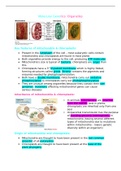
Molecular Genetics: Organelles
Key features of mitochondria & chloroplasts:
Present in the cytoplasm of the cell – most eukaryotic cells contain
mitochondria and chloroplasts are found in most plants
Both organelles provide energy to the cell, producing ATP molecules
Mitochondria’s size is typical of bacteria, chloroplasts are larger than
this
Chloroplasts have a 3rd thylakoid membrane which is highly folded,
forming structures called grana. Stroma contains the pigments and
enzymes needed for photophosphorylation.
Both have a double membrane, mitochondria carry out oxidative
phosphorylation & chloroplasts carry out photophosphorylation
They are unusual among organelles because they contain their own
genomes: mutations affecting mitochondrial genes can cause
serious diseases
Inheritance of mitochondria & chloroplasts:
In animals mitochondria are inherited
from the mother (and in plants,
chloroplasts are inherited only from one
sex)
Uniparental transmission has the purpose
of avoiding genomic heterogeneity in
mitochondria (having several different
types of mitochondria due to mutations
within mitochondria – lowers genetic
diversity within an organism)
Origin of mitochondria and chloroplasts:
Mitochondria are thought to have been present in the last common
ancestor of all eukaryotes
Chloroplasts are thought to have been present at the base of the
plant phylogeny
, Some species have lost their mitochondria/ chloroplasts later in their
evolution but some mitochondrial genes are still present in their
nuclear genomes
Endosymbiotic theory:
DNA exchanges:
Mitochondria and chloroplasts have exchanged genetic material
with the nucleus. Many mitochondrial and chloroplast genes have
migrated to the nucleus. Organelles are thus dependent on nuclear
protein synthesis for basic functions.
E.g. mitochondria are dependent on nuclear transcription: key
mitochondria genes for replication & gene expression have migrated
to the nucleus. Proteins (such as DNA polymerase, initiation factors,
RNA polymerase, other tRNAs & ribosomal proteins) are encoded in
the nucleus, translated in the cytoplasm and then transported to
mitochondria.
1. CHLOROPLAST
Genome Organisation:
Cells can have multiple chloroplasts per cell
Each chloroplast might contain multiple genome copies
Genomes vary in size between species from 80,000 to 600,000 bp
Usually circular double stranded DNA
Highly coiled
No histone proteins/ histone-like proteins
Typical vascular plant chloroplast contains: rRNAs, tRNAs, ribosomal
proteins & genes involved in photosynthesis (e.g. coding for enzyme
RubisCO, the most abundant protein on Earth)
Many genes are arranged in operons like bacteria
Order of many genes is shared with E.coli
Chloroplast genomes may contain large amounts of non-coding DNA
and many genes have introns
Gene expression:
Key features of mitochondria & chloroplasts:
Present in the cytoplasm of the cell – most eukaryotic cells contain
mitochondria and chloroplasts are found in most plants
Both organelles provide energy to the cell, producing ATP molecules
Mitochondria’s size is typical of bacteria, chloroplasts are larger than
this
Chloroplasts have a 3rd thylakoid membrane which is highly folded,
forming structures called grana. Stroma contains the pigments and
enzymes needed for photophosphorylation.
Both have a double membrane, mitochondria carry out oxidative
phosphorylation & chloroplasts carry out photophosphorylation
They are unusual among organelles because they contain their own
genomes: mutations affecting mitochondrial genes can cause
serious diseases
Inheritance of mitochondria & chloroplasts:
In animals mitochondria are inherited
from the mother (and in plants,
chloroplasts are inherited only from one
sex)
Uniparental transmission has the purpose
of avoiding genomic heterogeneity in
mitochondria (having several different
types of mitochondria due to mutations
within mitochondria – lowers genetic
diversity within an organism)
Origin of mitochondria and chloroplasts:
Mitochondria are thought to have been present in the last common
ancestor of all eukaryotes
Chloroplasts are thought to have been present at the base of the
plant phylogeny
, Some species have lost their mitochondria/ chloroplasts later in their
evolution but some mitochondrial genes are still present in their
nuclear genomes
Endosymbiotic theory:
DNA exchanges:
Mitochondria and chloroplasts have exchanged genetic material
with the nucleus. Many mitochondrial and chloroplast genes have
migrated to the nucleus. Organelles are thus dependent on nuclear
protein synthesis for basic functions.
E.g. mitochondria are dependent on nuclear transcription: key
mitochondria genes for replication & gene expression have migrated
to the nucleus. Proteins (such as DNA polymerase, initiation factors,
RNA polymerase, other tRNAs & ribosomal proteins) are encoded in
the nucleus, translated in the cytoplasm and then transported to
mitochondria.
1. CHLOROPLAST
Genome Organisation:
Cells can have multiple chloroplasts per cell
Each chloroplast might contain multiple genome copies
Genomes vary in size between species from 80,000 to 600,000 bp
Usually circular double stranded DNA
Highly coiled
No histone proteins/ histone-like proteins
Typical vascular plant chloroplast contains: rRNAs, tRNAs, ribosomal
proteins & genes involved in photosynthesis (e.g. coding for enzyme
RubisCO, the most abundant protein on Earth)
Many genes are arranged in operons like bacteria
Order of many genes is shared with E.coli
Chloroplast genomes may contain large amounts of non-coding DNA
and many genes have introns
Gene expression: