Plant Organs, Tissues and Cells
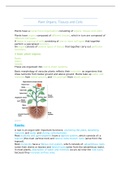
Plants have a hierarchical organisation consisting of organs, tissues and cells:
Plants have organs composed of different tissues, which in turn are composed of
different cell types.
A tissue is a group of cells consisting of one or more cell types that together
perform a specialised function.
An organ consists of several types of tissues that together carry out particular
functions.
3 basic plant organs:
Roots
Stems
Leaves
These are organised into root & shoot systems.
Basic morphology of vascular plants reflects their evolution as organisms that
draw nutrients from below ground and above ground. Plants take up water and
minerals from below ground, and CO2 and light from above ground.
Roots:
A root is an organ with important functions: anchoring the plant, absorbing
minerals and water and storing carbohydrates.
Most eudicots and gymnosperms have a taproot system, which consists of: a
taproot (the main vertical root) and lateral roots/ branch roots (arise from the
taproot).
Most monocots have a fibrous root system, which consists of: adventitious roots
(arise from stems or leaves) and lateral roots (arise from the adventitous roots).
In most plants, absorption of water and minerals occurs at/ near the root hairs,
because they increase surface area.
, Many plants have root adaptations with specialised functions: e.g. Aerial roots of
hala trees that grow in sandy soils of the south pacific support the tall top heavy
tree. Sugar beet storage roots store water and sugar. Seeds of the strangler fig
germinate in the branches of tall trees of other species and send aerial roots
down to the soil – eventually the ‘host’ tree dies through shading by fig leaves.
Mangroves produce negatively geotropic roots called pneumatophores to obtain
oxygen which is lacking in thick mud. Aerial roots form buttress structures to
support trees in tropical forests where root systems can be very shallow.
Stem:
An organ consisting of: an alternating system of nodes (the points at which
leaves are attached) and internodes (the stem segments between nodes).
An axillary bud is a structure that has the potential to form a lateral shoot, or
branch.
An apical bud or terminal bud is located near the shoot tip and causes elongation
of a young shoot.
Apical dominance helps to maintain dormancy in most axillary buds.
Many plants have modified stems: e.g. rhizomes (horizontal shoots that grow just
below the soil surface), bulbs (vertical underground shoots that store food),
stolons (horizontal shoots that grow along the soil surface and allow asexual
reproduction of plantlets at nodules along the stolon) and tubers (enlarged ends
of rhizomes or stolons for storing food).
Leaves:
The leaf is the main photosynthetic organ of most vascular plants.
Leaves generally consist of a flattened blade and a stalk called the petiole, which
joins the leaf to a node of the stem.
Monocots and eudicots differ in the arrangement of veins, the vascular tissue of
leaves: most monocots have parallel veins, whereas most eudicots have
branching veins.
In classifying angiosperms, taxonomists may use leaf morphology as a criterion.
Some plant species have evolved modified leaves that serve various functions:
e.g. Tendrils are modified leaves that plants use to cling to objects – once
attached the tendril coils pulling the plant closer to the support – some tendrils
such as grapevine are modified stems. Spines are modified leaves – in a cactus,
photosynthesis is carried out in the fleshy green stem. Storage leaves in an ice
plant store water. Reproductive leaves of some succulents form adventitious
Plants have a hierarchical organisation consisting of organs, tissues and cells:
Plants have organs composed of different tissues, which in turn are composed of
different cell types.
A tissue is a group of cells consisting of one or more cell types that together
perform a specialised function.
An organ consists of several types of tissues that together carry out particular
functions.
3 basic plant organs:
Roots
Stems
Leaves
These are organised into root & shoot systems.
Basic morphology of vascular plants reflects their evolution as organisms that
draw nutrients from below ground and above ground. Plants take up water and
minerals from below ground, and CO2 and light from above ground.
Roots:
A root is an organ with important functions: anchoring the plant, absorbing
minerals and water and storing carbohydrates.
Most eudicots and gymnosperms have a taproot system, which consists of: a
taproot (the main vertical root) and lateral roots/ branch roots (arise from the
taproot).
Most monocots have a fibrous root system, which consists of: adventitious roots
(arise from stems or leaves) and lateral roots (arise from the adventitous roots).
In most plants, absorption of water and minerals occurs at/ near the root hairs,
because they increase surface area.
, Many plants have root adaptations with specialised functions: e.g. Aerial roots of
hala trees that grow in sandy soils of the south pacific support the tall top heavy
tree. Sugar beet storage roots store water and sugar. Seeds of the strangler fig
germinate in the branches of tall trees of other species and send aerial roots
down to the soil – eventually the ‘host’ tree dies through shading by fig leaves.
Mangroves produce negatively geotropic roots called pneumatophores to obtain
oxygen which is lacking in thick mud. Aerial roots form buttress structures to
support trees in tropical forests where root systems can be very shallow.
Stem:
An organ consisting of: an alternating system of nodes (the points at which
leaves are attached) and internodes (the stem segments between nodes).
An axillary bud is a structure that has the potential to form a lateral shoot, or
branch.
An apical bud or terminal bud is located near the shoot tip and causes elongation
of a young shoot.
Apical dominance helps to maintain dormancy in most axillary buds.
Many plants have modified stems: e.g. rhizomes (horizontal shoots that grow just
below the soil surface), bulbs (vertical underground shoots that store food),
stolons (horizontal shoots that grow along the soil surface and allow asexual
reproduction of plantlets at nodules along the stolon) and tubers (enlarged ends
of rhizomes or stolons for storing food).
Leaves:
The leaf is the main photosynthetic organ of most vascular plants.
Leaves generally consist of a flattened blade and a stalk called the petiole, which
joins the leaf to a node of the stem.
Monocots and eudicots differ in the arrangement of veins, the vascular tissue of
leaves: most monocots have parallel veins, whereas most eudicots have
branching veins.
In classifying angiosperms, taxonomists may use leaf morphology as a criterion.
Some plant species have evolved modified leaves that serve various functions:
e.g. Tendrils are modified leaves that plants use to cling to objects – once
attached the tendril coils pulling the plant closer to the support – some tendrils
such as grapevine are modified stems. Spines are modified leaves – in a cactus,
photosynthesis is carried out in the fleshy green stem. Storage leaves in an ice
plant store water. Reproductive leaves of some succulents form adventitious