
8.1 ENERGY CHANGES
08 March 2021
18:17
Enthalpy Change - Overall energy exchanged with the surroundings when a change
happens at constant pressure.
● KJ/Mol
Standard conditions are room temperature 298K and 1 atm (100KPa).
8.2 ENTHALPY CHANGES
08 March 2021
20:23
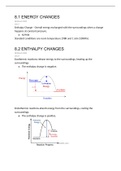
Exothermic reactions release energy to the surroundings, heating up the
surroundings.
● The enthalpy change is negative.
Endothermic reactions absorb energy from the surroundings, cooling the
surroundings.
● The enthalpy change is positive.
, 8.3 MEASURING ENTHALPY CHANGES
08 March 2021
21:17
CALORIMETRY
To find the enthalpy change:
● q = m c ΔT
To find the enthalpy change per mole:
● ΔH = q/number of moles
There are 2 main ways to measure energy change in a reaction.
For reactants that take place in a solution:
● Enthalpy change can be measured using insulated plastic containers, I.e
plastic, with a lid on top and a thermometer.
● The energy released will not be able to escape to the surroundings and no
energy can enter from the surroundings, so energy exchange only occurs with
the solution.
● Measure the starting temperature.
● Start reaction by adding the reactants together.
● Record the highest / lowest temperature.
Energy released from the reaction will heat the solution.
Energy absorbed by the reaction will cool the solution.
In this reaction we assume that:
● All energy released goes into the solution.
● All energy absorbed comes from the solution.
There are some inaccuracies:
● Heat loss by evaporation.
● Energy is absorbed by the walls of the calorimeter.
08 March 2021
18:17
Enthalpy Change - Overall energy exchanged with the surroundings when a change
happens at constant pressure.
● KJ/Mol
Standard conditions are room temperature 298K and 1 atm (100KPa).
8.2 ENTHALPY CHANGES
08 March 2021
20:23
Exothermic reactions release energy to the surroundings, heating up the
surroundings.
● The enthalpy change is negative.
Endothermic reactions absorb energy from the surroundings, cooling the
surroundings.
● The enthalpy change is positive.
, 8.3 MEASURING ENTHALPY CHANGES
08 March 2021
21:17
CALORIMETRY
To find the enthalpy change:
● q = m c ΔT
To find the enthalpy change per mole:
● ΔH = q/number of moles
There are 2 main ways to measure energy change in a reaction.
For reactants that take place in a solution:
● Enthalpy change can be measured using insulated plastic containers, I.e
plastic, with a lid on top and a thermometer.
● The energy released will not be able to escape to the surroundings and no
energy can enter from the surroundings, so energy exchange only occurs with
the solution.
● Measure the starting temperature.
● Start reaction by adding the reactants together.
● Record the highest / lowest temperature.
Energy released from the reaction will heat the solution.
Energy absorbed by the reaction will cool the solution.
In this reaction we assume that:
● All energy released goes into the solution.
● All energy absorbed comes from the solution.
There are some inaccuracies:
● Heat loss by evaporation.
● Energy is absorbed by the walls of the calorimeter.


