Edexcel A level Geography Unit 1 Topic 1: Tectonic Processes and Hazards
Enquiry Question 1: Why are some locations more at risk from tectonic hazards?
The Global Distribution of Hazards
All tectonic hazards are caused by the Earth’s internal heat engine. Radioactive decay of isotopes in
the Earth’s core and mantle generate huge amounts of heat which flow towards the surface. This
heat flow generates convection currents in the plastic mantle. The Earth’s interior is dynamic rather
than static. Geophysical hazards occur near plate boundaries. These plates move at different speeds
and directions which can cause collisions
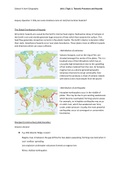
<Distribution of volcanoes
Volcano hotspots, such as the ring of fire, are
situated amongst the centre of the plates. This is a
localised area of the lithosphere which has an
unusually high temperature due to the upwelling
of hot molten material from the core. At hotspots,
magma rises as a plume generating basaltic
volcanoes that tend to erupt continually. Over
millennia this produces a chain of volcanic islands
with extinct ones most distant from the plume
<Distribution of earthquakes
Intraplate earthquakes occur in the middle of
plates. This may be due to pre-existing weaknesses
which become reactivated, forming seismic waves.
For example, an intraplate earthquake may occur
on solid crust, which has weakened over time,
cracks under pressure. Usually, the most powerful
earthquakes occur at convergent or conservative
boundaries.
Divergent (constructive) plate boundary
Oceanic-Oceanic
❖ E.g. Mid-Atlantic Ridge, Iceland
⮚ Magma rises in between the gap left by the two plates separating, forming new land when it
cool- seafloor spreading
⮚ Less explosive underwater volcanoes formed as magma rises
⮚ Minor, shallow earthquakes
, Edexcel A level Geography Unit 1 Topic 1: Tectonic Processes and Hazards
Continent-Continent
❖ E.g. African Rift Valley/Red Sea
⮚ Any land in the middle of the separation is forced apart, causing a rift valley
⮚ Eventually the gap will most likely fill with water and separate completely from the main
island
⮚ Caused by geologically recent mantle plume
⮚ Basaltic volcanoes and minor earthquakes
Convergent (collision/destructive) plate boundary
Continent-Continent
❖ E.g. Himalayas
⮚ The collision of two continental landmasses creates a mountain belt
⮚ Infrequent, major earthquakes distributed over a large area
⮚ Fold mountains formed from piles of continental crust
Oceanic-Oceanic
❖ E.g. Aleutian Islands, Alaska
⮚ One oceanic plate is subducted under the other generating frequent earthquakes and an
arc/chain of volcanic islands
Oceanic-Continental
❖ E.g. Andean Mountains
⮚ An oceanic plate is subducted under the continental, creating volcanic mountain range,
frequent large earthquakes and violent eruptions
⮚ The plate subducting leaves a deep ocean trench
Conservative plate boundary
Oceanic-Continental
E.g. San Andreas Fault Zone, California
Enquiry Question 1: Why are some locations more at risk from tectonic hazards?
The Global Distribution of Hazards
All tectonic hazards are caused by the Earth’s internal heat engine. Radioactive decay of isotopes in
the Earth’s core and mantle generate huge amounts of heat which flow towards the surface. This
heat flow generates convection currents in the plastic mantle. The Earth’s interior is dynamic rather
than static. Geophysical hazards occur near plate boundaries. These plates move at different speeds
and directions which can cause collisions
<Distribution of volcanoes
Volcano hotspots, such as the ring of fire, are
situated amongst the centre of the plates. This is a
localised area of the lithosphere which has an
unusually high temperature due to the upwelling
of hot molten material from the core. At hotspots,
magma rises as a plume generating basaltic
volcanoes that tend to erupt continually. Over
millennia this produces a chain of volcanic islands
with extinct ones most distant from the plume
<Distribution of earthquakes
Intraplate earthquakes occur in the middle of
plates. This may be due to pre-existing weaknesses
which become reactivated, forming seismic waves.
For example, an intraplate earthquake may occur
on solid crust, which has weakened over time,
cracks under pressure. Usually, the most powerful
earthquakes occur at convergent or conservative
boundaries.
Divergent (constructive) plate boundary
Oceanic-Oceanic
❖ E.g. Mid-Atlantic Ridge, Iceland
⮚ Magma rises in between the gap left by the two plates separating, forming new land when it
cool- seafloor spreading
⮚ Less explosive underwater volcanoes formed as magma rises
⮚ Minor, shallow earthquakes
, Edexcel A level Geography Unit 1 Topic 1: Tectonic Processes and Hazards
Continent-Continent
❖ E.g. African Rift Valley/Red Sea
⮚ Any land in the middle of the separation is forced apart, causing a rift valley
⮚ Eventually the gap will most likely fill with water and separate completely from the main
island
⮚ Caused by geologically recent mantle plume
⮚ Basaltic volcanoes and minor earthquakes
Convergent (collision/destructive) plate boundary
Continent-Continent
❖ E.g. Himalayas
⮚ The collision of two continental landmasses creates a mountain belt
⮚ Infrequent, major earthquakes distributed over a large area
⮚ Fold mountains formed from piles of continental crust
Oceanic-Oceanic
❖ E.g. Aleutian Islands, Alaska
⮚ One oceanic plate is subducted under the other generating frequent earthquakes and an
arc/chain of volcanic islands
Oceanic-Continental
❖ E.g. Andean Mountains
⮚ An oceanic plate is subducted under the continental, creating volcanic mountain range,
frequent large earthquakes and violent eruptions
⮚ The plate subducting leaves a deep ocean trench
Conservative plate boundary
Oceanic-Continental
E.g. San Andreas Fault Zone, California