Theme 1: Introduction to markets and market failure
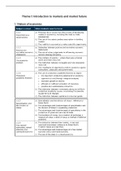
1. 1 Nature of economics
,1. 1. 1. Economics is a Social Science
a. Economics is a social science.
It is a science as it uses a scientific method:
- Observation and measurement of data
- Data analysis
- Hypothesis formulation
It is a social science because you can not carry experiments on a society or an economy
as there is no ceteris paribus.
b. In economics, one must build models, for this one must make assumptions.
c. Ceteris paribus: everything else remains constant.
1. 1. 2. Positive and Normative Statements
a. Positive statement: a statement that can be proven right or wrong.
Normative statement: a statement that can not be proven right or wrong.
1. 1. 3. The Economic Problem
a. Infinite ≠
limited
needs & wants ↓ resources
scarcity
∴ must choose!
∴ opportunity
cost
b. Renewable resources: self-replacing and inexhaustible resources
Non-renewable resources: resources that are limited as they are not replenished at the
same pace at which they are consumed.
Sustainable resources: resources which can be exploited without fear of them running
out.
c. Opportunity cost: the sacrificing of the next best alternative forgone
- Economic goods: goods that use up resources that have an alternative
- Free goods: goods that need no resources to be made
d. Factors of production:
, - Land: any naturally occurring resource, not just the surface of the Earth. All
mineral deposits, the contents of the oceans, climatic conditions… that can be
used to satisfy the economy.
- Capital: a man-made resource.
- Fixed capital: the stock of machines, buildings, vehicles, power stations,
roads… that are used in the production process.
- Working capital: man-made resources that will be used up in the
production process.
- Labour: the human effort that is used to make goods and services. Both physical
and mental work.
- Human capital: a nation’s stock of skilled and educated workers.
- Entrepreneurship: the skill and know-how of combining the other three factors
of production. Involves organisation skills and risk-taking.
e. What, how, for whom?
Every society must answer these questions to provide for the material wants.
- What to produce? This means the quantity and variety of goods and services.
- How to produce? This is about organising and combining factors of production to
produce the goods we want.
- For whom to produce? How we will share out the goods and services produced
amongst the population.
How we answer these questions determines what kind of economic system we have.
1. 1. 4. Production Possibility Frontier (PPF)
a. A PPF depicts:
The maximum productive potential of an economy: the curve (if opp. cost is not
constant)/straight line (if opp. cost is constant)
, Capi
tal
Goo
ds
Y
1
D
Y C
2
X1 Consu
X2 mer
- The opportunity cost: found through marginal analysis.
Goods
- To get from A to B, the opp. cost is of Y1 - Y2 capital goods, for X2 - X1 more
consumer goods
- Economic growth or decline: inwards/outwards shifts in the curve.
- ⇗
- Possible and unattainable production
- Point A/B: most productive output
- Point C: unproductive output
- Point D: currently unattainable output. Can get there through exploitation
b. A movement along the PPF would be going from one point on the curve to another.
A shift in the PPF would be the outwards or inwards translating of the curve depending
on if the total output grows or declines.
A shift (outwards) could be caused by:
- An increase in the supply of workers
- Improved education and training
- Technological change
- Discovery of new mineral deposits
There can be one sided shifts.
c. Consumer goods: goods that will be directly consumed.
Capital goods: goods that are used in the production of other goods.
1. 1 Nature of economics
,1. 1. 1. Economics is a Social Science
a. Economics is a social science.
It is a science as it uses a scientific method:
- Observation and measurement of data
- Data analysis
- Hypothesis formulation
It is a social science because you can not carry experiments on a society or an economy
as there is no ceteris paribus.
b. In economics, one must build models, for this one must make assumptions.
c. Ceteris paribus: everything else remains constant.
1. 1. 2. Positive and Normative Statements
a. Positive statement: a statement that can be proven right or wrong.
Normative statement: a statement that can not be proven right or wrong.
1. 1. 3. The Economic Problem
a. Infinite ≠
limited
needs & wants ↓ resources
scarcity
∴ must choose!
∴ opportunity
cost
b. Renewable resources: self-replacing and inexhaustible resources
Non-renewable resources: resources that are limited as they are not replenished at the
same pace at which they are consumed.
Sustainable resources: resources which can be exploited without fear of them running
out.
c. Opportunity cost: the sacrificing of the next best alternative forgone
- Economic goods: goods that use up resources that have an alternative
- Free goods: goods that need no resources to be made
d. Factors of production:
, - Land: any naturally occurring resource, not just the surface of the Earth. All
mineral deposits, the contents of the oceans, climatic conditions… that can be
used to satisfy the economy.
- Capital: a man-made resource.
- Fixed capital: the stock of machines, buildings, vehicles, power stations,
roads… that are used in the production process.
- Working capital: man-made resources that will be used up in the
production process.
- Labour: the human effort that is used to make goods and services. Both physical
and mental work.
- Human capital: a nation’s stock of skilled and educated workers.
- Entrepreneurship: the skill and know-how of combining the other three factors
of production. Involves organisation skills and risk-taking.
e. What, how, for whom?
Every society must answer these questions to provide for the material wants.
- What to produce? This means the quantity and variety of goods and services.
- How to produce? This is about organising and combining factors of production to
produce the goods we want.
- For whom to produce? How we will share out the goods and services produced
amongst the population.
How we answer these questions determines what kind of economic system we have.
1. 1. 4. Production Possibility Frontier (PPF)
a. A PPF depicts:
The maximum productive potential of an economy: the curve (if opp. cost is not
constant)/straight line (if opp. cost is constant)
, Capi
tal
Goo
ds
Y
1
D
Y C
2
X1 Consu
X2 mer
- The opportunity cost: found through marginal analysis.
Goods
- To get from A to B, the opp. cost is of Y1 - Y2 capital goods, for X2 - X1 more
consumer goods
- Economic growth or decline: inwards/outwards shifts in the curve.
- ⇗
- Possible and unattainable production
- Point A/B: most productive output
- Point C: unproductive output
- Point D: currently unattainable output. Can get there through exploitation
b. A movement along the PPF would be going from one point on the curve to another.
A shift in the PPF would be the outwards or inwards translating of the curve depending
on if the total output grows or declines.
A shift (outwards) could be caused by:
- An increase in the supply of workers
- Improved education and training
- Technological change
- Discovery of new mineral deposits
There can be one sided shifts.
c. Consumer goods: goods that will be directly consumed.
Capital goods: goods that are used in the production of other goods.